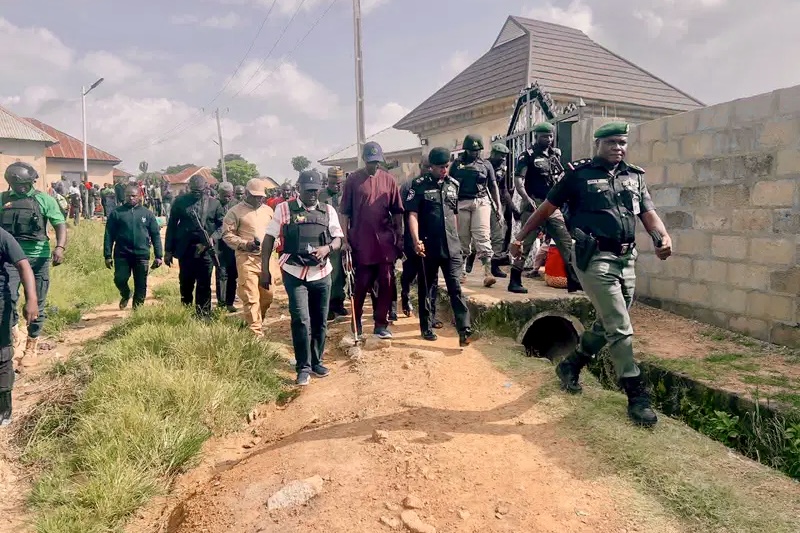
The arrest of a suspected mastermind over the massacre in Bin-Per community, Mangu Local Government Area of Plateau State, has offered investigators a potentially important lead, but it has also exposed a far more troubling question: how heavily armed attackers were able to enter a vulnerable rural community at night, move from house to house and leave after killing scores of residents.
The Plateau State Police Command says it has arrested a suspect believed to have played a central role in planning Tuesday’s attack in Kombun District. Police Public Relations Officer, SP Alfred Alabo, confirmed the arrest on Wednesday and said investigations were continuing, while security forces were hunting other suspects who escaped from the scene.
At least 25 people were reported killed and four injured, according to the Plateau police-linked account carried by several Nigerian newspapers. Earlier independent reporting from the scene put the death toll at 24, illustrating the fluidity of casualty figures in the immediate aftermath of mass violence.
For the families burying their relatives, however, the difference between 24 and 25 is not the central issue. What matters is that an entire community was attacked while people were asleep, homes were entered and lives were lost on a scale that residents say demanded a much faster security response.
The night Bin-Per became a killing ground
The assault began late on Monday and continued into the early hours of Tuesday, according to residents and local sources. The attackers reportedly entered the Bin-Per community around midnight and moved from house to house. Survivors said the gunmen were armed and that residents were caught largely unaware.
One survivor, Mathew Joseph, told Anadolu: “We were sleeping when we heard people in our neighbourhood screaming.” He added: “I saw armed men approaching my house before I managed to escape.”
Those two sentences capture the most disturbing feature of the attack: it was not simply a confrontation between armed groups in a remote bush location. Residents described a deliberate assault on homes at a time when the civilian population was least capable of defending itself.
Matthew Sylvester Kwarpo, a member of the Plateau State House of Assembly representing Mangu South Constituency, said the violence also resulted in the burning of 38 houses, while farmlands, stored grains and other property were destroyed. He called for stronger intelligence gathering, surveillance and rapid deployment to exposed communities, as well as emergency assistance for affected residents.
The destruction therefore goes beyond the headline casualty figure. Where houses are burned, food stores destroyed and farmland damaged, the consequences continue long after the gunmen have disappeared. Families lose shelter, food stocks and productive assets at the same time. For a rural population approaching another farming cycle, that can become a security issue in its own right.
Police arrest could open the door to the real investigation
The arrest announced by the Plateau police is potentially significant because it shifts the investigation from simply identifying shooters to determining whether the attack involved planning, reconnaissance, mobilisation and logistical support.
Police say the suspect is believed to be the mastermind, but that allegation has not yet been tested in court. His identity and the precise evidence linking him to the operation have not been publicly disclosed in the reports examined for this investigation.
That distinction matters.
In Nigeria’s recurrent communal and militia-related violence, arrests occasionally produce headlines without producing a full evidentiary picture of who financed an operation, who supplied weapons, who provided intelligence, who selected targets and who coordinated escape routes. Those questions will determine whether the latest arrest becomes a genuine breakthrough or merely another announcement in a long chain of unresolved security cases.
Alabo said investigations were ongoing and that security operatives had begun a manhunt for other attackers who fled the area.
For investigators, the fleeing suspects may be as important as the person already in custody. If mobile phones, firearms, vehicles, financial transfers, communications records and witness testimony can establish a chain of command, the Bin-Per attack could provide security agencies with a clearer picture of the network behind the killings.
The casualty toll tells only part of the story
The immediate death toll has varied between reports. TRT World, citing Anadolu and local sources, initially reported at least 24 people killed. Nigerian reports following the police confirmation put the figure at 25, with four people injured.
The difference is not unusual in the aftermath of a rural mass-casualty incident. Bodies may be recovered from multiple locations, injured victims may die later, and information may move slowly from villages to local officials and then to state authorities.
The fact that victims were given a mass burial underscores the scale of the tragedy. Community women subsequently staged a peaceful protest demanding urgent government action and stronger protection for residents.
That protest is politically significant because it demonstrates that public anger is no longer centred solely on the identity of the attackers. Residents are increasingly judging the state by whether it can prevent armed groups from repeatedly reaching unprotected settlements.
Plateau’s warning signs were already visible
The Bin-Per massacre did not occur in a security vacuum.
In the weeks preceding the attack, Mangu recorded several incidents involving armed groups, cattle, farmland disputes and communal confrontation.
On 9 August, troops of Operation ENDURING PEACE reportedly responded to suspicious movements around Rangai and adjoining communities in Mangu. A subsequent gun battle left an armed militia member dead and led to the recovery of two locally fabricated AK-47 rifles.
On 11 August, troops responding to reports of farmland destruction in Manja Forest, also in Mangu, engaged suspected armed herders and forced them to withdraw, according to security reporting. Troops then maintained a presence in the area and engaged community leaders and local vigilantes.
The following day, 12 August, three people were reportedly killed during a clash between suspected Fulani and Mwaghavul youths in Jwak Maitumbi. Troops intervened, conducted clearance operations and reportedly used drone surveillance to monitor the area.
Even before the Bin-Per attack, therefore, the security picture showed repeated indicators of escalating local tension.
There were also reports earlier in August of cattle being killed in Mangu and of troops intervening to prevent possible reprisals. One report said four cattle belonging to a Fulani herder were killed near Gaude and Aloghom, prompting security forces to engage community leaders in efforts to stop retaliatory violence.
These incidents matter because they show how quickly apparently isolated disputes can become part of a wider cycle of revenge.
The deeper problem: warning without prevention
Plateau’s security challenge has never been exclusively about the aftermath of an attack.
The more difficult question is whether authorities are consistently converting intelligence into preventive action.
Operation Enduring Peace has repeatedly demonstrated the ability to respond once violence has started. Troops have intercepted armed groups, recovered weapons, deployed drones, conducted clearance operations and engaged community stakeholders.
Yet Bin-Per shows the gap between tactical response and community protection.
A force can repel an attack in one location and still leave another settlement exposed. A distress call can generate an immediate deployment and still arrive after the first homes have been attacked. A patrol can deter violence during daylight and yet fail to prevent an organised night assault.
That is why the investigation should not stop with the person in police custody.
It should examine the entire security chain: what information existed before the attack; whether authorities received warnings; which units were responsible for Kombun District; how quickly reinforcements could reach Bin-Per; whether local vigilante or community early-warning systems were functioning; and why a group reportedly capable of moving from house to house could operate for long enough to inflict such casualties.
Those questions are not allegations against any individual officer. They are necessary questions for a serious post-incident security review.
Military response now shifts closer to Mangu
In the latest development, Leadership reported that the Joint Security Task Force, operating under Operation Enduring Peace, had relocated its tactical headquarters from Jos to Mangu Local Government Area following the latest violence. The move was presented as part of an effort to place operational command closer to the communities facing repeated attacks.
The military has previously emphasised the need for intelligence-led operations and closer engagement with communities.
Major General Maxwell Dangana, who assumed command of 3 Division and Operation Enduring Peace in July, pledged that the military would remain professional and impartial in dealing with Plateau’s security challenges.
The new operational posture will now be tested in the hardest possible environment: whether a stronger command presence in Mangu can translate into faster response times, better intelligence and fewer civilian deaths.
History provides a reason for caution.
Operation Safe Haven previously established forward operating bases in parts of Mangu precisely because remote communities required a faster security response. A Daily Trust report on an earlier forward operational base in Gyambwas described its purpose as providing security, increasing patrols and helping residents return to communities abandoned during previous crises.
The lesson is clear: security infrastructure close to threatened populations is not new. The continuing challenge is making such infrastructure effective enough to prevent attacks rather than simply reacting to them.
A community trapped between grief and fear
For Bin-Per residents, the immediate priorities are more basic.
Families need protection, medical care, food and shelter. Those whose homes were destroyed face the possibility of displacement. Farmers whose crops or stored grain were lost face a second crisis when they return to their fields.
Kwarpo’s call for emergency food, shelter and medical support therefore deserves attention alongside the military response.
The women who protested after the killings are equally important to the story. Their action was peaceful, but its message was forceful: the population wants security, not only investigations after bodies have been buried.
Plateau Governor Caleb Mutfwang condemned the attack and directed security agencies to intensify surveillance and patrols in Bin-Per and other vulnerable communities, while urging residents to remain calm, reject reprisals and provide information that could help identify the perpetrators.
That appeal to avoid retaliation is critical.
Plateau’s violence has repeatedly shown how one killing can become the trigger for another. A cattle killing can produce a reprisal. A reprisal can become a raid. A raid can produce displacement. Displacement can deepen land disputes. The resulting fear can then become an engine for the next confrontation.
Breaking that cycle requires both enforcement and trust.
What investigators must now establish
The Bin-Per case should ultimately answer at least five questions.
First, who planned the attack?
Second, who supplied the weapons and logistics?
Third, how did the attackers obtain information about the community and the vulnerability of residents at night?
Fourth, why did they escape after attacking a settlement of this size?
And fifth, what warnings or indicators were available to security agencies before the assault?
The arrest of an alleged mastermind potentially gives investigators an entry point into those questions. But an arrest is only the beginning.
The real test will be whether investigators can move from one suspect to the wider network, secure credible evidence, identify every participant and prosecute those responsible under due process.
Anything less risks producing another brief moment of official reassurance followed by another attack.
The bigger security test for Plateau
Bin-Per has once again demonstrated the peculiar danger facing rural communities in Plateau: violence can erupt through a combination of local grievances, organised armed groups, land and livelihood disputes, retaliatory attacks and weak early-warning coverage.
Recent incidents in Mangu — from armed militia encounters to farmland disputes, cattle-related tensions and communal clashes — suggest that the warning signs were multiplying before Tuesday night’s bloodshed.
The arrest of the suspected mastermind is therefore a potentially important first step.
But the measure of success will not be the arrest itself.
It will be whether the remaining attackers are found, whether the alleged network behind the operation is dismantled, whether vulnerable communities can sleep without fear, and whether the next warning reaches armed responders before another family is forced to bury its loved ones.
For Bin-Per, the question is no longer whether the state knows that the community is vulnerable.
It is whether the state can prove that it is finally prepared to protect it.
Investigative note
Casualty figures: This report uses the 25 deaths and four injuries figure reported following the Plateau police confirmation and carried by major Nigerian outlets. Earlier reporting based on residents and local sources put the death toll at 24, so the figure should be regarded as subject to final official reconciliation.
Follow us on our broadcast channels today!
- WhatsApp: https://whatsapp.com/channel/0029VawZ8TbDDmFT1a1Syg46
- Telegram: https://t.me/atlanticpostchannel
- Facebook: https://www.messenger.com/channel/atlanticpostng