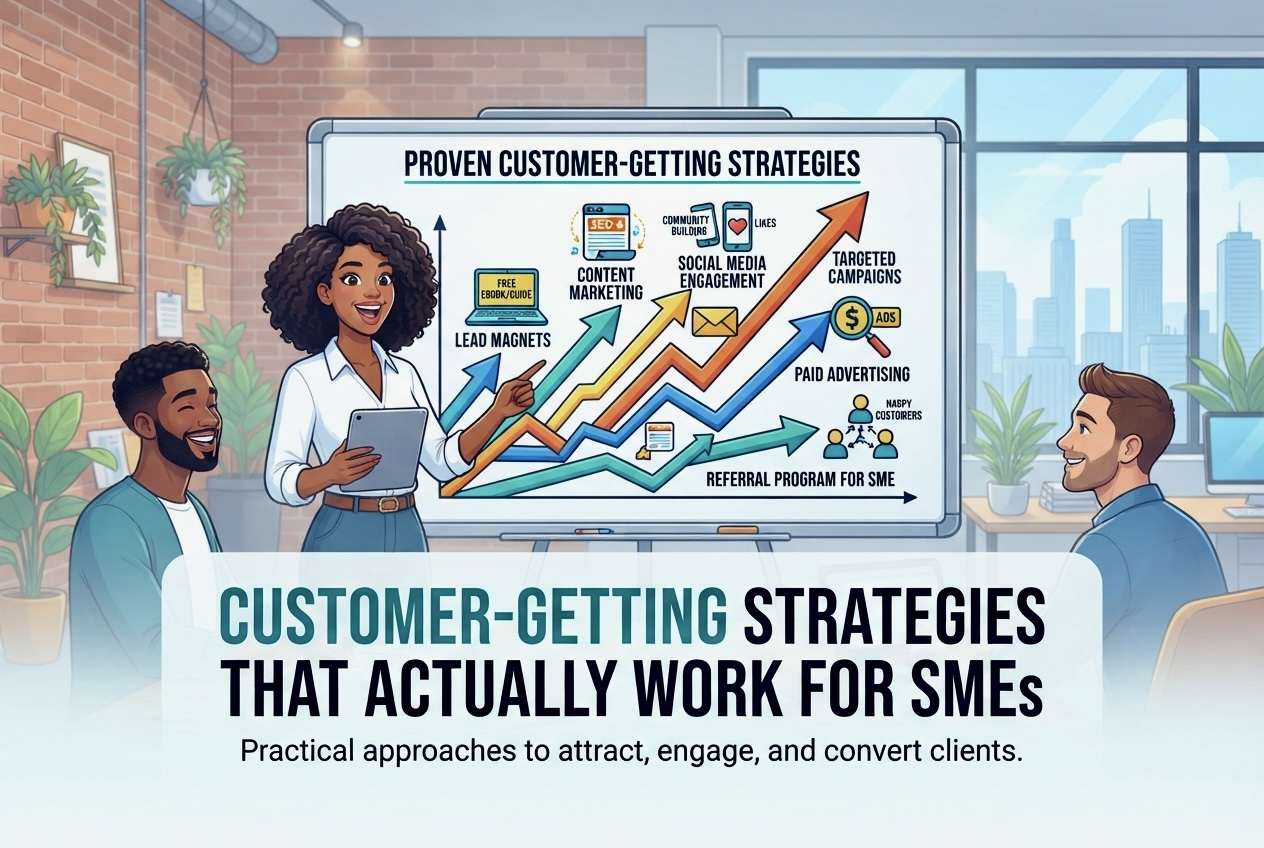
From Google searches and WhatsApp sales to customer referrals and targeted advertising, these five practical strategies can help Nigerian small businesses attract paying customers without wasting money on marketing.
For many Nigerian small and medium-sized enterprises (SMEs), the biggest obstacle to growth is not necessarily the quality of their products. It is finding enough people willing to pay for them.
A survey published by Mola on 14 October 2026 found that 57 per cent of 495 Nigerian small-business owners surveyed identified getting customers or improving business visibility as their biggest challenge. The survey was based on a self-selected business community, rather than a nationally representative sample, but its findings highlight a familiar problem for entrepreneurs.
A business can have an excellent product, competitive prices and a hardworking owner yet struggle to generate consistent sales. Meanwhile, a competitor with a clearer offer, stronger customer relationships and a better way of reaching buyers may grow faster.
The difference is often not how much money each business spends on advertising. It is how effectively they turn attention into trust, enquiries into purchases and first-time buyers into repeat customers.
For Nigerian SMEs operating under pressure from electricity costs, logistics expenses, expensive data and limited marketing budgets, customer acquisition must be deliberate. The goal is not to become popular everywhere. It is to become visible to the right people and make buying as straightforward as possible.
1. Stop selling to everybody. Find the customer most likely to buy
One of the most expensive mistakes an SME can make is trying to appeal to everyone.
A fashion business that targets “people who love clothes” is competing with almost every clothing seller. A business that targets working women looking for affordable office outfits, with reliable delivery in Lagos, has a much clearer starting point.
The difference is focus.
Before spending money on marketing, answer three questions.
Who is most likely to buy your product? What problem are they trying to solve? Why should they choose your business instead of another seller?
Then turn the answers into an offer that customers can understand immediately.
Consider a small catering business. Rather than advertising only that it sells delicious food, it could target offices that need dependable lunch deliveries for staff meetings, training sessions or regular workdays.
The offer becomes more specific, the prospective customer becomes easier to identify, and the business can approach offices, administrators and event organisers directly.
A similar principle applies to a cleaning company targeting landlords, an accountant serving small businesses or a technology entrepreneur selling inventory software to independent retailers.
The practical move: Choose one customer group and one main offer for your next marketing campaign. Explain the benefit, the price or starting price, the location you serve and how to order.
Do not change five things at once. A focused offer makes it easier to discover what attracts customers and what puts them off.
2. Make Google work for you while you concentrate on the business
Not every potential customer discovers a business through Instagram, TikTok or Facebook. Some are already searching for a solution.
A person searching for a plumber in Abuja, a bakery in Port Harcourt or an office-cleaning service in Lagos may be much closer to making a purchase than someone casually scrolling through social media.
That is where local search optimisation becomes valuable.
Google Business Profile allows eligible businesses to manage how they appear on Google Search and Maps. Businesses can provide their contact details, operating hours, photographs and other useful information.
Google says complete, accurate profiles improve the likelihood of appearing in relevant local searches. Local results are primarily influenced by relevance, distance and prominence. Reviews and other signals can contribute to prominence, although businesses cannot pay Google to secure a better local ranking.
For an SME, getting the basics right is a sensible first step.
Create or claim the appropriate business profile. Verify it, choose the right category, publish accurate contact details and opening hours, and upload genuine photographs of your products, premises or completed work.
Ask satisfied customers for honest reviews. Respond professionally to complaints and questions rather than ignoring them.
The website is important, too.
A business selling solar installations should not rely on a homepage containing only a telephone number and a general description. It should explain the services offered, the locations covered, the problems addressed and how a prospective customer can request a quotation.
A Lagos-based solar installer, for example, might develop useful service pages around residential solar installation, inverter maintenance and backup power for small offices.
The objective is to answer questions customers already ask.
This strategy is particularly useful for plumbers, electricians, repair technicians, consultants, restaurants, professional service providers and other SMEs whose customers search by location or specific need.
The practical move: Spend one afternoon improving your online business profile and identifying three search phrases a customer would use when looking for your product or service. Make sure your website, where available, answers those searches directly.
Do not expect instant rankings. Search visibility takes time, and a complete profile does not guarantee a place at the top.
3. Turn WhatsApp into a sales desk, not just a messaging app
For many Nigerian SMEs, WhatsApp is already where business happens.
Customers enquire about prices, request photographs, confirm availability, negotiate delivery and send payment notifications. Yet businesses frequently lose potential sales because their buying process is disorganised.
A prospective customer may ask for a price and wait hours for a response. Another may receive a photograph without a product description. Someone else may abandon an order because the delivery fee or payment process is unclear.
These are preventable problems.
WhatsApp Business provides practical tools that can help smaller businesses organise customer communication, including business profiles, catalogues and messaging features. Meta also promotes tools that help businesses connect with customers across its platforms.
Start by making your business profile informative and professional.
Where appropriate, display your products in a catalogue with clear descriptions, prices and photographs. Prepare quick replies for frequently asked questions. Explain delivery arrangements, accepted payment methods, return policies and how customers can place an order.
The aim is to reduce the number of unanswered questions between interest and payment.
For example, compare these two messages:
“New bags available. Send a DM.”
“Office tote bag available for ₦25,000. Nationwide delivery available at an additional charge. Message us to confirm colours and place your order.”
The second tells the prospective customer what is available, gives a price and explains the next step.
Your social media content should lead naturally into this buying process. A product demonstration can direct interested viewers to WhatsApp. A customer testimonial can point to a specific service. A limited-time offer can include a clear ordering instruction.
Speed matters, too. Set realistic response targets during business hours and follow up politely with genuine prospects who have asked for information but have not completed an order.
Do not turn every customer interaction into a sales pitch. Meta gives users control over business messages, including the ability to stop receiving them, and has introduced limits intended to prevent excessive marketing messages. Obtain appropriate consent before sending promotional messages and respect requests to stop.
The practical move: Review the last ten customer enquiries that did not result in sales. Identify the most common objections, whether price, delivery, trust, availability or slow responses. Improve the process that causes the greatest number of lost sales.
4. Turn satisfied customers and business partnerships into a source of new sales
Some SMEs spend money continually trying to reach strangers while overlooking people who already know their business.
A satisfied customer can be more than a completed transaction. That customer may know other people with the same need, and a recommendation can help a prospective buyer feel more confident about trying a relatively unfamiliar business.
But referrals rarely become a reliable sales channel by accident.
The business must make it easy for customers to recommend it.
After delivering an order successfully, ask the customer to share the business with someone who might benefit from the product or service. Provide a short message or catalogue link they can forward.
Where the margins allow, offer a reasonable incentive for a completed referral. It might be a discount on the next purchase, free delivery or an added service.
A training company might reward an existing participant who introduces a new paying student. A cleaning business might offer a returning customer a discount after a successful referral. A food vendor could reward an office administrator who helps secure a regular catering contract.
The reward should make commercial sense. Do not offer discounts so large that each new customer becomes unprofitable.
Partnerships can extend the same principle beyond your existing customer base.
A photographer can partner with makeup artists and event planners. A printing business can work with schools, training providers and event organisers. A business software provider can approach accountants or business consultants who serve the same customer group.
Each partner already has a relationship with people who might need the other business’s services.
The arrangement could involve reciprocal referrals, a joint promotion or a combined offer. Agree on the terms clearly and track where enquiries originate.
Trust remains essential. Poor service, unreliable delivery or misleading promises can damage the reputation that referrals depend on.
The practical move: Contact ten satisfied customers or five complementary businesses this week. Make a specific request for an introduction or propose one simple partnership. Record the enquiries and sales generated.
Do not confuse the number of people contacted with the number of customers acquired.
5. Create useful content, then advertise what proves it can sell
Social media provides an accessible way for SMEs to demonstrate products, answer questions and reach potential buyers. But having an account and posting regularly are not customer-acquisition strategies by themselves.
The content must give prospective customers a reason to pay attention.
A furniture maker could show how a product is constructed, explain how to maintain it and publish photographs of completed orders. A fashion retailer could demonstrate how an outfit fits different occasions. A business consultant could explain a common operational mistake and show how a practical solution works.
Where customers give permission, real testimonials and case studies can help demonstrate credibility.
The content should address the questions people ask before spending money. What does the product do? How much does it cost? Is it durable? How does delivery work? What happens if something goes wrong?
Research published in September 2026 by the Kwararafa University Journal of Multidisciplinary Research and Innovationexamined 399 MSMEs in Abuja Municipal Area Council. It found that social media marketing significantly predicted sales performance within the study, while identifying data costs, connectivity, digital skills and content creation as challenges for businesses. The findings support the value of purposeful social marketing, not the assumption that every post automatically produces sales.
aa.unij.co.uk
For a business with limited resources, the sensible approach is to start with one or two platforms where its target customers are active. A business selling visually appealing consumer products may prioritise Instagram and WhatsApp, while a professional services firm may benefit more from search visibility, referrals and relevant business communities.
Once a particular offer attracts genuine enquiries, consider a small paid advertising test.
Do not begin by spending heavily to promote the entire business. Promote one product or service to a clearly defined audience, use a direct call to action and give customers a simple route to enquire or order.
Track what happens after the advertisement is seen.
How many people enquire? How many receive quotations? How many pay? How much does it cost to acquire each new paying customer?
Suppose a business spends ₦40,000 on an advertising campaign and the associated creative work, then gains ten new paying customers. Its acquisition cost is ₦4,000 per customer.
That calculation is useful, but it is only the beginning. The business must compare the cost with the gross profit and other costs associated with fulfilling those orders. Ten customers are not necessarily a successful campaign if serving them costs more than they generate.
Likes, impressions and followers can help explain audience behaviour, but they do not replace sales figures.
The practical move: Test one offer, one audience and one main call to action. Keep a record of spending, enquiries and completed purchases. Repeat what produces profitable customers and change what does not.
A 30-day plan to get more customers
The strategies become more useful when they are organised into a routine rather than treated as isolated marketing activities.
Week 1
Clarify your offer
Identify your most promising customer group, choose one product or service to promote, improve your WhatsApp Business profile and check your Google Business Profile if eligible.
Week 2
Activate your network
Contact satisfied customers, ask for honest reviews and referrals, and approach potential business partners who serve the same audience.
Week 3
Publish content that answers real questions
Share product demonstrations, useful explanations and customer-approved proof of results. Record the source of each meaningful enquiry.
Week 4
Measure and improve
Review sales, conversion rates and acquisition costs. Test a modest advertising campaign only if the offer and buying process are ready, then decide what to repeat.
At the end of the month, review four figures: the number of qualified enquiries, the number of new paying customers, the total cost of acquiring them and the revenue those customers generated.
These figures will tell you more about your progress than follower counts alone.
The right results will vary by industry. A restaurant seeking daily orders needs a different sales process from a consulting firm pursuing a handful of large corporate contracts. What matters is matching the strategy to the customer and measuring whether it works.
For Nigerian SMEs, getting more customers does not always require a bigger marketing budget. It requires a clearer offer, better visibility, a buying process that removes friction and a disciplined system for learning from every sale.



Join the debate; let’s know your opinion.