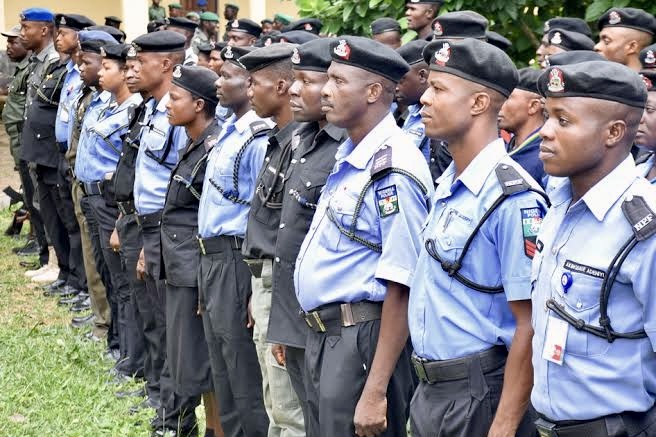
‘We’re Dying From Bullets and Hardship’: Benue Police Allege Four Months Without Operational Allowances
Atlantic Post | National Security and Special Investigations
Deck: Mobile Police personnel deployed to Benue say operational allowances remain unpaid as armed attacks intensify across vulnerable communities. With lawmakers demanding answers over mounting deaths, the allegations raise urgent questions about frontline funding, police welfare and accountability between federal and state authorities.
Recommended length: 1,200–1,400 words for a substantial investigative report.
When the officers fighting insecurity say they cannot survive the assignment
Police officers deployed to confront armed groups in Benue State say they are facing two battles at once: the threat of deadly attacks and months without their operational allowances.
The personnel, drawn from the 45 Police Mobile Force (PMF) and more than 11 other squadrons deployed from Abuja, allege that payments have been delayed for between three and five months, depending on the unit.
Their complaint is particularly troubling because it comes from officers assigned to some of the state’s most dangerous locations, including Logo, Ukum and Kwande local government areas.
“We’re dying from bullets and hardship at the same time,” one of the officers told SaharaReporters in a telephone interview, speaking anonymously because of fears of victimisation.
The allegation is not simply about money owed to serving policemen. It raises a fundamental public safety question: can Nigeria expect security personnel to sustain dangerous operations when the funding arrangements supporting their deployment remain unclear?
The officers have accused the Benue State Government of failing to provide the assistance they say they need. But the precise arrangements for paying the disputed allowances, the amounts outstanding and the government agency responsible for any delay have not been established by the available evidence.
Those unanswered questions matter. Without payment records and an official account of the funding arrangements, responsibility cannot fairly be assigned to one institution.
The allegations were reported by SaharaReporters on September 27 and have resurfaced amid further concern over killings in the state.
‘We came from Abuja’ — but where is the operational support?
One officer said personnel from the 45 PMF arrived in Benue on January 28, 2026, for special-duty operations.
“I’m from 45 PMF on special duty here in Benue State. We came from Abuja to this state since January 28, 2026. For four months now we have not been paid operation allowances and the state government is not doing anything about it,” the officer said.
The distinction between the date of deployment and the period of alleged non-payment is important. The officer did not say that all allowances had been withheld since January. The specific claim was that four months of operational allowances remained unpaid.
Other units reportedly face different periods of arrears. Some personnel said to be serving in the affected areas have gone five months without the relevant payments, while others have waited three months.
The officers also insist that the problem extends beyond their own squadron.
“This thing is not affecting only 45 PMF but also other squadrons in places like Kwande, Ukum and Logo local government areas,” another officer said.
If the allegation is accurate across more than 11 squadrons, the matter requires a response extending beyond an individual payment dispute.
The Nigeria Police Force would need to establish which units are affected, how much is outstanding, when the claims became due and whether funds were requested, approved or released.
Neither the number of personnel affected nor the total value of the alleged arrears has been established by the information currently available.
That missing financial picture is central to the investigation.
Frontline danger is no longer an isolated concern
The officers describe operating in difficult terrain, searching through bushland and attempting to dislodge armed groups accused of terrorising communities.
One said the assignment had become increasingly dangerous, particularly in Logo Local Government Area, where he alleged that three colleagues had been killed in recent weeks.
“A few weeks ago, we lost two of our men in an ambush in Logo Local Government Area and a week before that, we lost one Inspector to armed bandit attack. Also in Kwande Local Government Area, we have been facing communal crisis. We’re dying from bullets and hardship at the same time,” the officer said.
The account comes against a backdrop of independently reported attacks on Mobile Police personnel.
In September, reports documented the deaths of Mobile Police officers in attacks around Ayilamo, in Logo Local Government Area. The reported incidents included an attack on September 10 and a subsequent ambush on September 14.
On October 22, the Senate called on Inspector-General of Police Olatunji Disu to investigate a series of deadly attacks in Benue North-East Senatorial District.
During the debate, Senator Emmanuel Memga Udende cited a combined death toll of 113 people across four attacks in Katsina-Ala, Ukum and Logo local government areas. The figure he presented included six Mobile Police personnel reportedly killed in an attack on Ayilamo.
The Senate also called for stronger security operations and effective early-warning and rapid-response mechanisms.
The figure of 113 is the total cited by the senator in his motion; it should not be treated as an independently reconciled final casualty count.
Nevertheless, the parliamentary intervention reinforces the seriousness of the security crisis in the areas where the officers say they are operating without their expected allowances.
The available information does not establish that delayed allowances caused any of the reported deaths. It does, however, raise legitimate questions about whether the personnel assigned to these operations are receiving the support required to perform their duties.
Kwande: communal violence and a prolonged security assignment
The officers’ account also points to continuing communal violence in Kwande Local Government Area.
“There is a communal crisis between two communities in Kwande Local Government Area and destruction and burning of houses happened last week. It has been happening since we came in January,” one officer said.
The account suggests that personnel have been operating in an area where threats have persisted for months. It also raises questions about how deployments are reviewed when violence continues and whether the security resources assigned to an area are sufficient for the demands placed on them.
An effective response requires more than sending officers into a volatile location. It also requires a clear operational plan, appropriate equipment, reliable logistical support, timely payments and a system for escalating problems before they affect frontline performance.
The allegations do not establish that the officers lacked weapons, ammunition, food or other specific supplies. Nor do they show that an allowance delay directly compromised a particular operation.
Those issues would need to be established through interviews with additional officers, deployment records, duty rosters, payment schedules and official accounts from the relevant authorities.
But where officers report prolonged delays in their operational entitlements, the Force cannot reasonably expect the issue to be resolved through silence.
One officer described their position in stark terms:
“We are going from bush to bush, combing to flush out the terrorists and bandits terrorising the people and the state government is not doing anything to assist us. Yet, we can’t speak for ourselves.”
The allegation of abandonment remains unverified. The reported fear of speaking openly, however, makes independent scrutiny more important, not less.
Who is responsible for paying the allowances?
This is the central accountability question.
The officers have directed their criticism at the Benue State Government. But the Nigeria Police Force is a federal institution, and the legal framework governing police funding does not support the automatic assumption that a state government is responsible for every allowance owed to federal police personnel.
Under the Police Act 2020, the Police Force’s General Fund includes budgetary allocations and contributions that state governments may make available. The Act provides for that fund to be used for the Force’s operations, salaries, allowances and related expenditure.
It also requires state governments to keep records of their contributions and specify the purposes for which those contributions are made.
The distinction matters.
A state’s contribution towards policing operations may be important, including where local security conditions demand additional support. But the existence of such contributions does not, by itself, establish that a state has promised to pay a particular squadron’s allowances.
To determine responsibility in this case, the authorities would need to answer several basic questions.
Was the deployment from Abuja accompanied by an approved operational budget? Were the allowances funded through the Nigeria Police Force’s federal allocations, a specific special-duty arrangement or a contribution from Benue State? Were payment claims submitted and approved? Were funds released but not disbursed, or were the funds never made available?
These are different possibilities, and each would point to a different accountability trail.
The relevant documents should include deployment orders, allowance schedules, approved payment vouchers, records of fund releases and any agreement under which Benue State was expected to contribute to the assignment.
Without those records, neither the officers’ accusation against the state government nor any attempt by the authorities to dismiss it would settle the issue.
The test is documentary: who was required to pay, what was approved, what was released and what reached the officers?
Federal welfare reforms face a frontline test
The allegations also come as the Federal Government is reviewing police pay and welfare arrangements.
In August 2026, the Federal Ministry of Police Affairs announced that a ministerial and stakeholders’ committee was reviewing the police salary structure, allowances, insurance, pension-related benefits and other welfare packages.
The committee’s work reflects official recognition that police welfare and outstanding entitlements require attention. It does not, however, confirm that the specific Benue operational allowances were outstanding or identify the cause of any delay.
The difference between announcing a welfare review and resolving an operational payment dispute is significant.
A review may inform future policy. An officer deployed to a dangerous assignment needs the applicable entitlements paid when they fall due.
The Benue allegations therefore present a practical test for the institutions responsible for police administration and funding. Can they trace an operational allowance from the original approval through to the officer entitled to receive it?
If the answer is yes, the payment records should make it possible to identify where the process stalled. If the answer is no, that would raise a wider concern about how special-duty deployments are budgeted, monitored and audited.
In either case, a public response should go beyond a general promise to improve welfare.
The Force should identify the affected units, confirm the status of the payment claims and explain what steps are being taken to resolve any verified arrears. The relevant government authorities should disclose whether funds were requested or committed and clarify the division of responsibility.
That would help establish the facts without exposing sensitive operational information or compromising personnel deployed to dangerous areas.
The questions Benue’s security authorities must answer
The allegations leave several issues requiring an authoritative explanation.
First, how many officers across the 45 PMF and other squadrons are affected, and how much is outstanding?
Second, which authority is responsible for the disputed payments under the applicable deployment and funding arrangements?
Third, what action has the Nigeria Police Force taken to verify the complaints, settle any legitimate claims and protect officers who report welfare concerns?
Fourth, what assistance, if any, did the Benue State Government formally undertake to provide, and what records exist of any funds released for the purpose?
Finally, what operational safeguards are in place to ensure that delayed payments do not undermine morale, logistics or the sustainability of deployments in communities exposed to repeated attacks?
The answers would help distinguish an administrative delay from a failure of budgeting, disbursement or oversight.
They would also offer a clearer picture of whether the problem is restricted to one deployment or points to a wider weakness in special-duty policing.
The people of Benue cannot afford a funding blind spot
The residents of Logo, Ukum and Kwande need security personnel who can carry out their duties effectively and remain available for sustained operations. The officers deployed there deserve a transparent system that meets their legitimate entitlements.
Neither side should have to rely on anonymous allegations or unanswered telephone calls to establish how frontline policing is funded.
The reported deaths, communal violence and alleged allowance arrears are distinct issues. Each requires evidence and a proper response. But together, they make the questions surrounding the deployment difficult to ignore.
The officer who spoke anonymously said: “Yet, we can’t speak for ourselves.”
That statement should prompt the Nigeria Police Force, the Police Affairs Ministry and the Benue State Government to provide a clear account of the arrangements governing the deployment.
If the allowances were paid, the records should show when and to whom. If they remain outstanding, the authorities should identify the responsible office and set out how the claims will be resolved.
In a state where security personnel and civilians continue to face deadly attacks, unanswered questions about the funding of frontline operations are not merely administrative matters.
They are questions of public safety.



Join the debate; let’s know your opinion.