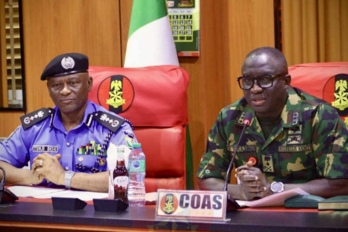
ABUJA, Nigeria — President Bola Ahmed Tinubu is set to announce another upward salary review for personnel of the Armed Forces of Nigeria, according to the Minister of Defence, General Christopher Gwabin Musa (rtd), who framed the move as part of a broader push to improve troop welfare, morale and operational readiness.
The minister made the disclosure in Abuja while addressing a workshop for widows and wives of service personnel, and the Defence Ministry says the initiative was designed to support military families as well as the troops themselves.
General Musa’s remarks were more revealing than routine. He said military pay had already risen from ₦49,000 to ₦100,000 during his tenure as Chief of Defence Staff, and added that “very soon, Mr President will announce another salary increase for our men.”
He also stressed that “soldiers are now receiving ₦100,000” after the earlier adjustment, language that underlines how far welfare has become a central policy lever in Nigeria’s security debate.
That is precisely why the Nigeria Police Force should not be left standing at the back of the queue. The police are the country’s first line of internal security, yet they remain trapped in a system long criticised for low pay, weak housing, delayed pensions and poor health coverage.
A 2025 policy brief by the Athena Centre for Policy and Leadership described the NPF as suffering from a “welfare deficit” that depresses morale, distorts professional ethics and weakens operational effectiveness. In other words, poor welfare is no longer merely a human resources issue; it is a security risk.
The case for a police salary review is even stronger now than it was in January 2022, when the Federal Executive Council approved a 20 per cent increase in police allowances, alongside a review of duty tour allowance and the release of funds for outstanding benefits.
That package followed the shock of #EndSARS and was meant to improve take-home pay, but it was not the same as a sustained, inflation-proof salary correction.
Three and a half years later, Nigeria’s cost of living has changed substantially, and police officers have been carrying a heavier burden with little evidence of a matching wage response.
The wider security environment also makes the argument unavoidable. In June 2026, Nigeria’s headline inflation rate stood at 15.91 per cent, according to the National Bureau of Statistics and the CBN inflation table. That means every fixed salary loses value by the month unless it is adjusted.
For a police constable living on a rigid pay packet while commuting, feeding a family and funding duty-related expenses, a stale wage structure becomes a morale killer and a corruption risk. That is an inference, but it is a hard one to escape when inflation remains elevated and security work remains constant.
There is also the question of workload. President Tinubu declared a nationwide security emergency last year and ordered the recruitment of 20,000 additional police officers, taking the force to 50,000 recruits in the plan outlined then.
More recently, Nigeria’s Senate approved a bill to allow states to create their own police forces, reflecting broad recognition that the federal system is overstretched.
AP reported that the current centralised model has been strained by insecurity, with militants and criminal groups exploiting thin police presence in vast rural areas. If the state is demanding more from the police, the state must also pay more to keep them functional.
The point is not to play the military and police against each other. It is to insist on parity in the treatment of personnel who are both indispensable to national survival.
The Defence Ministry’s own welfare message, including the distribution of ₦25 million to 500 widows and wives of frontline personnel through SMEDAN, reinforces a simple truth: security work destroys family stability as much as it protects the republic. The same logic should apply to police families, especially those of officers killed in action, injured on duty or left to survive on meagre pensions.
The police deserve more than applause, slogans and periodic promises. They deserve a structured upward salary review, upgraded allowances, dependable housing support, decent insurance and a welfare architecture that matches their national burden.
The government has already shown, through the armed forces announcement and the 2022 police pay package, that it understands welfare can move morale. The next step is to stop treating the Nigeria Police Force as the neglected sibling of the security family and to recognise it as the institution that holds the line between ordinary life and organised chaos. That is not generosity; it is national security.
Follow us on our broadcast channels today!
- WhatsApp: https://whatsapp.com/channel/0029VawZ8TbDDmFT1a1Syg46
- Telegram: https://t.me/atlanticpostchannel
- Facebook: https://www.messenger.com/channel/atlanticpostng