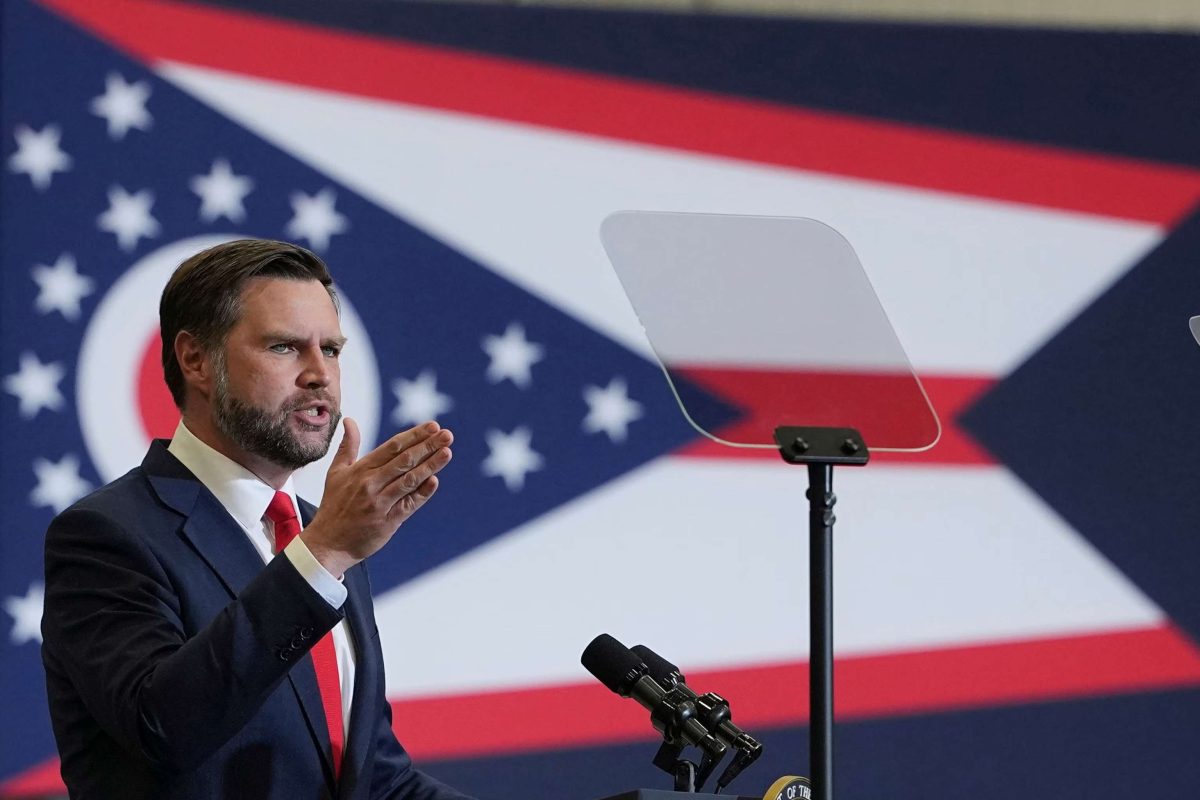
JD Vance’s description of America’s dependence on foreign defence suppliers as “despicable” exposes an uncomfortable contradiction. The United States dominates global arms exports, yet critical minerals, microchips and components used in its military industrial complex remain tied to international supply chains.
The United States can manufacture some of the world’s most advanced fighter aircraft, missiles, naval vessels and military technologies. It can also supply sophisticated weapons to governments across several continents.
But behind that military power lies an uncomfortable reality: America cannot yet produce everything its armed forces need without relying on foreign suppliers.
That contradiction has become the subject of a fresh political intervention by Vice-President JD Vance, who has described America’s dependence on foreign countries for materials and components used in military production as “despicable”.
His remarks have reopened an important question about American national security: how powerful can a country really be militarily when parts of its weapons manufacturing infrastructure depend on supply chains beyond its control?
The answer could have consequences far beyond Washington, particularly for America’s allies, competitors and the international arms industry.
What Vance actually said and why it matters
Vance made the remarks during an appearance on Fox News’ The Ingraham Angle, where presenter Laura Ingraham asked him what Congress should prioritise during its lame-duck session.
The vice-president identified the confirmation of presidential appointments and increased investment in America’s military among the priorities.
He argued that strengthening the armed forces must involve more than purchasing additional weapons.
According to Vance:
“It is despicable that we rely on foreign countries to make the things that we need to make the weapons that our troops need to defend us.”
He continued by arguing that military investment must include rebuilding America’s industrial capacity.
“That is real national security, building our own stuff.”
Vance also criticised Democratic administrations, claiming that when Democrats hold power, they underinvest in the American military.
His intervention connects military preparedness with a broader political ambition to restore domestic manufacturing, industrial employment and economic sovereignty.
The underlying concern, however, is bigger than party politics.
America’s defence industry faces a structural challenge that years of globalisation have helped create.
America is the world’s biggest arms exporter, not an ordinary weapons importer
There is an important distinction between depending on foreign countries for complete weapons and depending on them for the materials and components needed to manufacture weapons domestically.
The United States remains overwhelmingly dominant in the international arms market.
According to the Stockholm International Peace Research Institute’s March 2026 assessment, America accounted for 42 per cent of global major arms exports between 2021 and 2025.
Its arms exports increased by 27 per cent compared with the preceding five-year period, and it supplied major weapons to 99 countries.
It was responsible for a greater share of global arms exports than the next seven largest suppliers combined.
These figures challenge any suggestion that America has lost its ability to manufacture sophisticated military equipment.
The vulnerability lies deeper within the production system.
A fighter aircraft assembled in an American factory may contain specialised electronics, minerals, magnets and other components whose manufacturing history crosses several international borders.
The final product may be American, but the industrial ecosystem supporting it is not necessarily American.
That distinction is central to understanding Vance’s warning.
The Pentagon’s supply chain has a visibility problem
An investigation published by the US Government Accountability Office (GAO) on 24 July 2025 exposed significant weaknesses in the Pentagon’s knowledge of its suppliers.
The Department of Defence relies on a network of more than 200,000 suppliers to manufacture advanced weapons systems and provide supporting goods, including batteries and manufacturing equipment.
Yet the GAO found that the Pentagon’s principal procurement database offered limited visibility into where materials and lower-tier components were actually manufactured.
The findings expose an important contradiction.
Government procurement records identified the United States as the country of origin for approximately 96 per cent of the value of goods procured between 2020 and 2024.
But those records did not adequately identify the origins of the materials and components supplied through lower levels of the manufacturing chain.
In other words, a weapon recorded as an American procurement could still depend on materials and components manufactured abroad.
The problem is particularly significant in the semiconductor industry.
According to estimates cited by the GAO from defence officials, approximately 88 per cent of microelectronics production and 98 per cent of their assembly, packaging and testing take place overseas.
Taiwan, South Korea and China are among the principal locations involved.
These figures concern the wider microelectronics supply chain, rather than every military-grade chip specifically. Nevertheless, they expose a serious vulnerability for a military increasingly dependent on sophisticated electronic systems.
A disruption in access to these technologies could complicate the production, maintenance and replacement of critical military equipment.
China’s rare-earth dominance presents a strategic vulnerability
One of the most significant challenges concerns rare-earth minerals.
These materials are essential to numerous advanced technologies, including missile guidance systems, aircraft components, satellite communications, precision electronics and military sensors.
Although the United States possesses significant mineral resources, mining alone does not guarantee industrial independence.
The more difficult challenge is processing those minerals into materials suitable for advanced manufacturing.
A Congressional Research Service report published in March 2026 highlights China’s extraordinary position in this industry.
China accounts for approximately 60 per cent of global rare-earth mining, 90 per cent of processing and separation, and 94 per cent of rare-earth-based magnet manufacturing.
These magnets are essential components in numerous advanced industrial and defence applications.
The implications are considerable.
A country might possess the geological resources needed to manufacture its own weapons but remain dependent on another country to process the minerals required for production.
That is precisely the vulnerability confronting Washington.
A January 14, 2026 presidential proclamation acknowledged that the United States was entirely dependent on imports for 12 critical minerals in 2024 and at least 50 per cent dependent on imports for another 29.
It also highlighted the country’s dependence on imported rare-earth permanent magnets, with domestic production meeting only a fraction of military requirements.
This is not simply an economic inconvenience.
It creates an opportunity for foreign governments to influence industrial production through export restrictions, supply disruptions and geopolitical pressure.
The F-35 fighter programme reveals the complexity
The F-35 Joint Strike Fighter offers a particularly useful illustration of the international nature of modern military manufacturing.
The aircraft is an American-led programme involving contributions from seven international partner countries: Australia, Canada, Denmark, Italy, the Netherlands, Norway and the United Kingdom.
This arrangement demonstrates how closely modern defence production is connected to international industrial cooperation.
But the programme has also exposed weaknesses in supply chain transparency.
The 2025 GAO investigation found that the Pentagon had obtained country-of-origin information for first- and second-tier suppliers covering 30,000 of the aircraft’s approximately 40,000 parts.
Yet officials estimated that they had identified country-of-origin information for less than 10 per cent of the lower-tier suppliers providing components and raw materials.
The same investigation documented the discovery of prohibited Chinese magnets in the F-35 supply chain, which led to a temporary manufacturing suspension while alternative suppliers were identified.
More recent findings reinforce the oversight problem.
In a report published on 9 November 2026, the GAO disclosed that the Pentagon still lacked complete records for approximately 26 million F-35 parts valued at $31 billion and held across more than 700 government and contractor-managed facilities worldwide.
The audit concerned asset accountability rather than proving foreign sourcing. Nevertheless, it demonstrates the enormous challenge of tracking and managing the components behind a sophisticated international weapons programme.
The question is no longer simply where a weapon is manufactured. It is whether governments can identify, monitor and secure every critical part of the production chain.
Washington has already begun addressing the problem
Vance’s intervention is also significant because the Trump administration has already acknowledged the strategic implications of foreign supply chain dependence.
On July 20, 2026, President Donald Trump signed Executive Order 14415, titled Securing America’s Defence Supply Chains and Ensuring Domestic Acquisition of Critical Materials.
The order established a policy requiring military equipment and the critical materials and components used to manufacture, maintain and repair it to be sourced domestically or from allied countries.
It also directed the defence establishment to strengthen supply chain mapping, requiring contractors and subcontractors across different levels of production to identify critical supply chains from raw materials to finished products.
The order further seeks to tighten exemptions allowing the procurement of certain materials that do not meet domestic sourcing requirements.
This is important because it shows that the administration’s concern is not limited to Vance’s television appearance.
The issue has already entered presidential policy.
The challenge now is implementation.
Building new processing facilities, expanding semiconductor production, training specialist workers and establishing reliable domestic mineral supply chains require sustained investment.
These cannot be achieved simply through political declarations or short-term increases in defence spending.
Is complete American military self-reliance realistic?
Vance’s argument raises a difficult strategic question.
Should the United States manufacture everything required by its military within its own borders?
The desire to reduce dependence on geopolitical competitors is understandable.
But complete industrial self-sufficiency would be an expensive and potentially counterproductive objective.
Modern weapons systems are products of highly specialised international industries.
America benefits from technological partnerships with European governments, Japan, South Korea, Australia and other allies.
The international F-35 programme demonstrates that cooperation can strengthen military capability rather than automatically undermine national security.
The more practical objective is therefore to distinguish between strategic dependence on potentially hostile suppliers and carefully managed cooperation with trusted partners.
Washington needs reliable alternative sources, domestic processing capacity, strategic reserves and transparent arrangements with allied manufacturers.
It must also ensure that critical components cannot become single points of failure during a major geopolitical crisis.
That requires industrial policy, not merely protectionism.
The real test of American military power
Vance has identified a genuine vulnerability in the American defence industrial base.
The GAO’s findings, China’s dominance of critical mineral processing and the Pentagon’s difficulties tracing lower-tier suppliers all demonstrate that American military manufacturing remains exposed to international supply chain disruptions.
But describing the problem as foreign dependence does not automatically establish that every foreign supplier represents a national security threat.
Nor does the vice-president’s criticism of Democratic administrations establish that one political party alone is responsible for the industrial weaknesses.
His assertion that Democrats have underinvested in the military over the past two decades is a political claim. The interview did not provide a comparable spending analysis or production-capacity assessment to establish it. A meaningful assessment would require examining real-term defence spending, procurement outcomes, manufacturing capacity and industrial readiness across successive administrations.
Ultimately, America’s military strength will depend not merely on how many weapons it can purchase or how advanced its technology becomes.
It will depend on whether it can secure the industrial foundations that make those capabilities possible.
A nation may own the world’s most sophisticated fighter aircraft and command one of the largest military budgets in history, but those advantages become vulnerable when essential components cannot be obtained.
For Washington, the challenge is not simply to build more weapons.
It is to ensure that the factories, minerals, technologies, skilled workers and international partnerships behind those weapons remain secure when the next major geopolitical crisis arrives.
The uncomfortable truth is that American military power may be manufactured in America, but its foundations still reach across the world.
Follow us on our broadcast channels today!
- WhatsApp: https://whatsapp.com/channel/0029VawZ8TbDDmFT1a1Syg46
- Telegram: https://t.me/atlanticpostchannel
- Facebook: https://www.messenger.com/channel/atlanticpostng



Join the debate; let’s know your opinion.