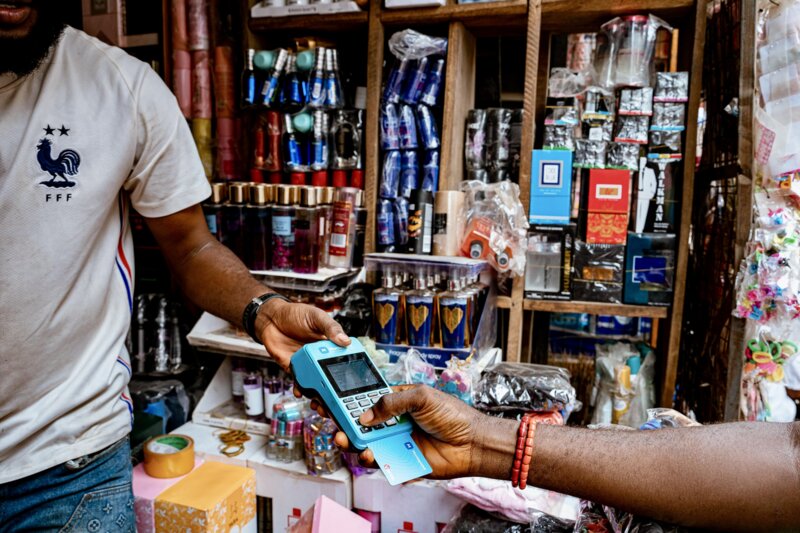
From the roadside POS terminal to the checkout page of an online shop, fintech has quietly rewritten how Nigerians move money. Flutterwave, Paystack, Moniepoint, OPay, PalmPay, Interswitch, Kuda and a growing generation of payment innovators are turning transfers, merchant collections, digital wallets and cross-border payments into everyday infrastructure. But beneath the convenience lies a bigger economic contest over trust, data, regulation and who ultimately controls Nigeria’s financial rails.
Nigeria’s fintech revolution is no longer a startup story
For millions of Nigerians, paying for something used to mean cash in hand, a trip to the bank or, increasingly, an ATM withdrawal.
That world has changed.
Today, a customer can transfer money from a mobile phone in seconds, pay a trader through a POS terminal, settle a bill without visiting a bank, purchase goods online with a card or bank transfer, and receive money from abroad through a digital platform.
The transformation is being driven by fintech companies operating on top of an increasingly sophisticated national payments infrastructure.
The scale is difficult to ignore. NIBSS said Nigeria’s electronic payment transactions reached approximately ₦1.07 quadrillion in 2024, up from about ₦600 trillion in 2023, while transaction volume increased from 9.7 billion to about 11.2 billion.
More recently, NIBSS reported that transaction volumes on its Instant Payments platform had reached 11.2 billion, underlining the extraordinary scale of real-time transfers in the economy.
The numbers matter because they tell a story larger than technology. Fintech is increasingly becoming part of the plumbing of Nigerian commerce.
And the companies building that plumbing are no longer merely competing to provide a better app. They are competing to become indispensable financial infrastructure.
1. Flutterwave: building the bridge between Nigeria and global commerce
Few Nigerian fintech brands illustrate the evolution of the industry better than Flutterwave.
The company began by solving a relatively straightforward problem: enabling businesses to accept and make payments across fragmented African financial systems.
It has since expanded into a much broader payments infrastructure business.
Flutterwave said in 2026 that it had processed more than one billion transactions worth over $40 billion, supporting more than two million businesses and payment activity across multiple currencies and markets. It also reported strong growth in bank-transfer and wallet-based collections.
Its importance to Nigeria is particularly visible in the shift away from cards towards account-based payments.
Flutterwave’s 2025 data showed that bank transfers accounted for 59 per cent of payment value among its enterprise transactions in Nigeria, compared with 37 per cent for cards.
That is revealing.
Nigeria is not simply becoming a card economy. It is becoming an account-to-account economy.
For online businesses, exporters, airlines, technology companies, schools, hotels and thousands of smaller merchants, payment platforms such as Flutterwave provide the connective tissue between the customer’s preferred payment method and the merchant’s bank account.
Its cross-border ambitions are equally significant. The company says it now supports payments across more than 50 currencies and has secured additional licences in African markets.
The implication is clear: the future of Nigerian fintech will not be limited to Nigerians paying Nigerians.
It will increasingly involve Nigerian companies selling to the world and global businesses selling into Nigeria.
2. Paystack: making digital payments easier for African businesses
Paystack occupies a different but equally important position.
The company built its reputation by making online payment acceptance easier for African businesses, particularly startups and growing merchants.
Its platform now supports cards, bank transfers and other payment methods, alongside recurring payments, invoicing, subscription billing and split payments.
The significance of Paystack is not simply that it processes payments.
It has helped make payments a software problem.
Instead of a business having to build complex payment infrastructure itself, developers can integrate APIs and allow customers to pay through familiar channels.
That has helped reduce one of the barriers that historically held back Nigerian e-commerce: the difficulty of reliably collecting money.
Paystack’s current pricing also shows the competitive pressures in the market. Its published Nigerian pricing includes 1.5 per cent plus ₦100 for local transactions, with the ₦100 component waived below ₦2,500 and a ₦2,000 transaction fee cap. International transactions are priced differently.
The bigger strategic battle, however, is over what comes after payment collection.
Paystack is increasingly positioned as business infrastructure—helping companies accept money, initiate transfers, manage recurring collections and connect financial services to their commercial operations.
That is where fintech economics are heading: from payment gateway to operating system for business.
3. Moniepoint: turning the POS terminal into a financial branch
Perhaps nowhere is Nigeria’s fintech transformation more visible than in the POS market.
Moniepoint has become one of the most important players in this space by placing payment infrastructure directly in front of millions of merchants and customers.
In its 2025 review, the company said it served more than six million businesses and 16 million individuals, while processing more than ₦30 trillion in transactions. It also said eight out of 10 in-person payments in Nigeria were made on a Moniepoint terminal.
These are company-reported figures, but they illustrate the extraordinary role of merchant acquiring in Nigeria.
Moniepoint’s strategy goes beyond payment acceptance.
The company has increasingly linked payments with business banking, credit, accounting and other financial services. In 2025, it said it had disbursed more than ₦1 trillion in credit to businesses.
That business model is important because payments generate something valuable beyond fees: data.
A merchant who processes regular sales generates a financial footprint. That footprint can potentially inform lending, cash-flow analysis, risk assessment and other services.
Investors clearly see the opportunity.
Moniepoint’s Series C fundraising reached more than $200 million in 2025, with backing from Development Partners International, LeapFrog Investments, Google’s Africa Investment Fund, IFC and Visa.
Reuters reported that the company’s earlier $110 million round in 2024 pushed its valuation above $1 billion, making it a unicorn.
Moniepoint therefore represents one of the industry’s most important transitions: the POS terminal is no longer just a machine for withdrawals and transfers. It can become the gateway to a merchant’s entire financial life.
4. OPay: putting wallets and everyday payments in consumers’ hands
OPay helped accelerate the mass-market adoption of app-based financial services in Nigeria.
Its model combines digital payments, wallets and financial services with a broad agent and merchant footprint.
The importance of companies in this category is that they address a problem traditional financial institutions have sometimes struggled to solve: convenience at street level.
A bank branch may be several kilometres away. A digital wallet or payment agent may be within walking distance.
That distinction is particularly important in an economy where millions of transactions still involve informal businesses.
Fintech companies have effectively brought parts of the banking system into markets, neighbourhoods, transport hubs and roadside shops.
The result is not that cash has disappeared.
Rather, fintech has created an increasingly interconnected ecosystem in which cash can enter a digital account through an agent, move instantly across bank networks and return to physical commerce through a merchant or POS terminal.
That hybrid cash-digital economy remains one of Nigeria’s defining characteristics.
5. PalmPay: competing on scale, convenience and financial inclusion
PalmPay is another major force in Nigeria’s consumer-fintech revolution.
The company said in July 2025 that it had more than 35 million registered users and could process up to 15 million transactions a day.
Its model spans mobile payments, credit, savings, micro-insurance and an agent network, with Nigeria remaining its largest and most important market.
PalmPay’s growth illustrates an important feature of Nigerian fintech competition: the winning product is often not the one with the most sophisticated technology. It is the one that makes financial activity easiest for the ordinary customer.
That may mean simple transfers, airtime, bills, merchant payments or access to an agent.
In a country where trust and convenience can matter as much as functionality, user experience becomes a financial competitive advantage.
6. Interswitch: the veteran behind the payment ecosystem
Long before fintech became one of Africa’s favourite investment themes, Interswitch was building digital payment infrastructure in Nigeria.
Its role is less visible to consumers than some wallet brands, but potentially just as important.
Interswitch describes itself as an integrated payments and digital commerce company, providing infrastructure connecting financial institutions, merchants and consumers. Its platforms include consumer-facing products such as Quickteller and Verve.
In July 2026, the company was again named among CNBC’s World’s Top Fintech Companies, in the Payments category.
The lesson from Interswitch is that fintech is not only about flashy consumer applications.
Behind every successful digital payment sits a complicated web of switching, routing, authentication, settlement, fraud controls and connectivity.
That infrastructure business is becoming increasingly strategic as Nigeria’s payment volumes climb.
7. Kuda: showing how banking itself is being redesigned
Kuda represents another branch of the fintech revolution: digital-first banking.
The company describes itself as a digital bank for Nigerians, offering accounts, transfers, cards, savings, credit and other services through mobile channels. Kuda Microfinance Bank is licensed by the CBN as a National Microfinance Bank.
Its current product range shows where the industry is moving.
Kuda offers consumers cardless payments, bank transfers and digital payment tools, while Kuda Business provides merchants with collections, payouts, POS, invoicing and other business services.
This convergence matters.
The old distinction between “banking” and “fintech” is becoming increasingly difficult to maintain.
A fintech can offer banking-like services.
A bank can operate like a technology company.
And a payment company can develop lending, foreign-exchange, business-management or remittance products.
The boundaries are disappearing.
8. Paga and the importance of agent-led payments
Paga provides another important lesson: Nigeria’s fintech story cannot be understood entirely through smartphones.
Its infrastructure includes payments, transfers, bill payments and agent-based cash services. Its developer platform also supports business payouts, bill payments and other transaction services.
That combination of digital and physical access remains crucial.
Nigeria has a huge informal economy, uneven internet access and millions of consumers whose financial lives are still partly cash-based.
The most successful payment companies therefore have to operate across both worlds.
They must make digital transactions easy without assuming that every customer lives entirely inside an app.
The invisible giant: NIBSS
There is another player that should not be overlooked.
NIBSS is not a consumer fintech brand in the same way as PalmPay or Kuda, but it sits at the heart of Nigeria’s payment architecture.
Its Instant Payment platform enables real-time transfers between financial institutions.
In June 2025, NIBSS unveiled the National Payment Stack, a next-generation infrastructure initiative intended to build on the NIBSS Instant Payments system and prepare Nigeria’s payments ecosystem for another phase of growth.
This matters because fintech innovation is only possible at scale when the underlying rails work.
The apps may win the public’s attention.
The infrastructure determines whether the money actually moves.
Regulation is becoming part of the fintech competition
Nigeria’s fintech industry is entering a more mature phase, and that means regulation is becoming harder to treat as an afterthought.
The CBN unveiled Payments System Vision 2028 on 1 June 2026, replacing the earlier PSV 2025 roadmap. The new strategy is built around interoperability, security, inclusion, innovation, trust and collaboration, with an explicit emphasis on cross-border integration and international standards.
That is a significant shift.
The regulator is not simply asking whether fintech companies can innovate.
It is increasingly asking whether they can innovate safely.
Open banking is another important part of the equation. CBN’s operational guidelines provide for controlled data sharing through APIs and recognise customers’ rights to authorise access to their financial data.
For fintech companies, that creates opportunities to build better credit scoring, personal-finance tools, account aggregation and payment services.
For consumers, it raises a harder question:
Who controls the financial data generated by every payment?
That question will become increasingly important as artificial intelligence and automated credit decisions become embedded in financial products.
The POS economy is being brought under tighter control
The same regulatory maturation is visible in agent banking.
CBN’s revised 2025 agent-banking guidelines introduced tighter requirements around agent identification, terminal management and geolocation. The framework provides for geo-fencing or geo-location of POS terminals and integration with CBN’s regulatory data systems.
The objective is obvious: the same infrastructure that expanded financial access can also be exploited for fraud, money laundering and other forms of abuse.
Fintech therefore faces a paradox.
The more important it becomes to the economy, the more heavily it will be regulated.
That is not necessarily a threat to the sector.
For reputable companies, stronger regulation can actually become a competitive advantage because it can separate well-governed operators from weaker ones.
The biggest threat may be trust
Nigeria’s fintech revolution has made payments faster.
It has not made financial fraud disappear.
The CBN has warned that digital-payment expansion has been accompanied by growing electronic-fraud risks, including authorised push-payment fraud, where customers are manipulated into voluntarily transferring money to criminals.
Yet there are signs that defensive systems are improving.
NIBSS reported that digital-payment fraud losses declined to ₦25.85 billion in 2025, down 51 per cent from the ₦52.26 billion reported for 2024.
The figures do not mean consumers can relax.
A fraudster does not need to defeat a fintech’s encryption if he can persuade a customer to reveal an OTP, approve a transfer or send money to a fraudulent account.
That is why the next frontier in fintech will increasingly involve behavioural analytics, transaction monitoring, stronger identity verification and consumer education.
What comes next?
The first wave of Nigerian fintech solved a major problem: access.
The next wave must solve a harder one: depth.
BCG argues that Africa’s fintech market is entering a second phase, moving beyond basic transactional inclusion towards B2B payments, government payments, credit and deeper financial services.
That transition is already visible in Nigeria.
Payment companies are adding lending.
Banks are adding digital platforms.
Fintechs are entering remittances.
Merchants are gaining access to accounting and working-capital tools.
Cross-border payment providers are trying to make Africa easier to trade with.
And open banking could eventually allow financial products to interact with one another in ways that are difficult to imagine today.
Funding is also still available for companies with convincing business models. Across Africa, fintech remained the largest funded sector in 2025, attracting about $1.2 billion across 124 companies, according to The Big Deal.
But the era of throwing money at every fintech idea appears to be over.
Investors increasingly want profitability, strong governance, regulatory compliance and evidence that customers will keep using the product.
The real winner may be the Nigerian consumer
The most important change is not a valuation, funding round or unicorn status.
It is what happens when an ordinary Nigerian can receive money, pay a supplier, collect from a customer, transfer funds across banks, pay a bill and manage a business without spending half a day inside a banking hall.
That is the real fintech revolution.
Flutterwave is helping businesses connect to global commerce. Paystack is simplifying digital collections. Moniepoint is digitising physical commerce and supplying financial services to businesses. OPay and PalmPay are taking mobile payments into mass consumer markets. Interswitch continues to power critical payment infrastructure. Kuda is reimagining digital banking. Paga continues to bridge digital finance with agent-led access.
But none of them operates in isolation.
They sit on top of a national payment system increasingly designed around interoperability, instant transactions, security and inclusion.
Nigeria’s fintech story, therefore, is no longer about whether people will adopt digital payments.
They already have.
The next contest is about who can make those payments cheaper, safer, faster and more useful—and who can turn a transaction into a long-term financial relationship.
That is where the next billion-naira opportunity lies.
Follow us on our broadcast channels today!
- WhatsApp: https://whatsapp.com/channel/0029VawZ8TbDDmFT1a1Syg46
- Telegram: https://t.me/atlanticpostchannel
- Facebook: https://www.messenger.com/channel/atlanticpostng