Saudi Food Aid Found in Private Warehouse: Who Was Watching Taraba’s Relief Supplies?
The DSS reportedly seized donated food supplies in Jalingo, but the four arrests were already reported in June. The bigger question is whether anyone can account for every bag meant for vulnerable residents.
Humanitarian aid is supposed to travel from donor to government store and into the hands of people who need it most. In Taraba, reports that Saudi- donated food supplies were found in a private Jalingo warehouse have exposed a troubling gap in public accountability: the available reporting identifies four arrests in June, but the documentary trail explaining how the supplies reached the warehouse remains unclear.
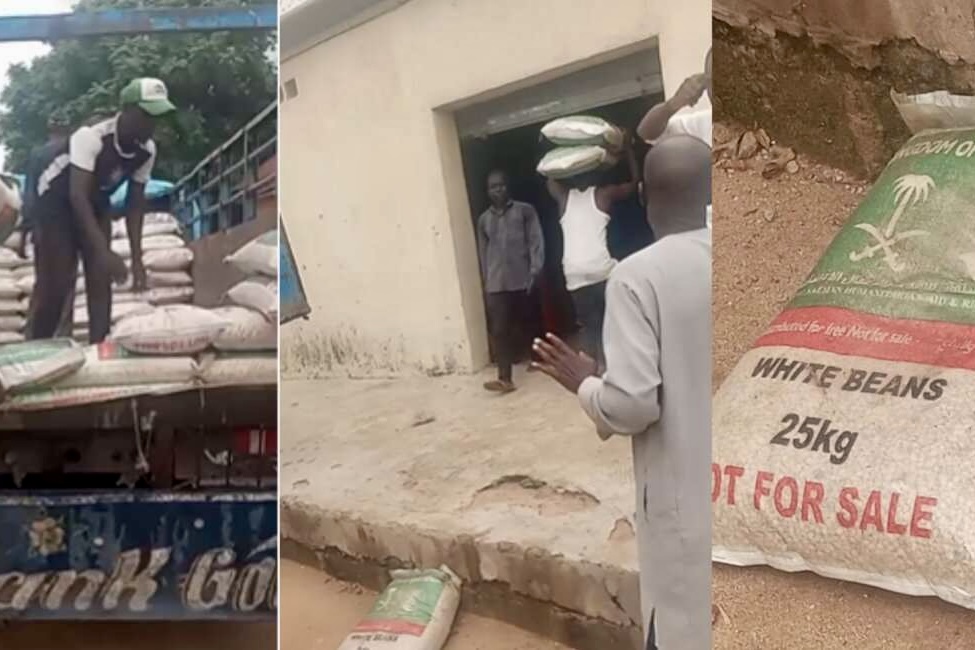
The bags carried a message that should have made their purpose unmistakable: “Not for Sale.”
Yet relief materials reportedly donated to help vulnerable residents of Taraba State were found inside a private warehouse in Sintali Ward, Jalingo Local Government Area, prompting the intervention of the Department of State Services (DSS).
The discovery raises questions that extend beyond the warehouse itself. Who authorised the movement of the supplies? Why were they stored at a private facility? Who was responsible for tracking the consignment? And can the authorities establish whether the intended beneficiaries received their share?
The questions matter because the food aid was reportedly part of a humanitarian intervention by Saudi Arabia’s King Salman Humanitarian Aid and Relief Centre (KSRelief), designed to support people affected by disasters and hardship.
But one critical distinction must be made at the outset: the reported arrests appear to relate to an incident already reported in June 2026, not necessarily a new operation in October. Contemporary reports published on 27 and 28 June described a DSS raid at the same location and the arrest of four suspects. The latest account supplied for this report does not establish that a fresh arrest operation has occurred.
What happened at the Jalingo warehouse?
According to reports published in June, DSS operatives raided a private warehouse in Sintali Ward after residents allegedly noticed relief materials being moved into the premises at night.
The materials reportedly included rice, white beans and other essential food supplies believed to have been donated by KSRelief to the Taraba State Emergency Management Agency (TSEMA).
Four people were reportedly arrested. They were identified in contemporaneous reports as the warehouse owner and three rice traders.
A resident of Sintali, identified as Hon. Inusa, told The Nation that residents alerted the authorities after noticing the movement of relief supplies.
“The whole saga started when residents living within Sintali area alerted the DSS after they noticed movement of items being taken into a private warehouse in the middle of the night,” he was quoted as saying.
A video obtained by SaharaReporters reportedly showed utility vehicles believed to belong to the DSS at the location, with bags of relief materials being loaded for removal.
Sources cited in the coverage said the supplies were being transported to the DSS headquarters in Jalingo.
The markings on some of the bags identified them as goods not intended for commercial sale.
Those details warrant scrutiny, but they do not, on their own, establish who authorised the storage, whether the movement was unlawful or whether any of the arrested individuals intended to sell the supplies.
Those questions require evidence from the people who handled the consignment, the officials who authorised its movement and the records documenting its intended destination.
Contemporaneous media reports said the DSS and TSEMA had not issued official statements on the warehouse operation at the time they were published. Atlantic Post could not independently establish from the publicly accessible material reviewed whether charges were subsequently filed or the investigation formally concluded.
The Saudi aid programme and its beneficiaries
The supplies matter because they form part of a wider humanitarian effort intended to reach vulnerable Nigerians.
On 22 June 2026, Nigeria’s Federal Ministry of Information and National Orientation announced the launch of a food aid project involving KSRelief and the National Emergency Management Agency (NEMA).
The government said the programme would distribute 24,302 food baskets, each weighing approximately 60 kilogrammes. The baskets contained essential items, including rice, cooking oil, white beans and salt.
The intervention was valued at more than US$1.5 million and was expected to benefit 145,812 people across five states: Yobe, Benue, Anambra, Kebbi and Taraba. Those figures cover the national programme, not Taraba State alone.
Earlier information supplied for this report also states that TSEMA, working with NEMA, flagged off distribution of KSRelief-donated materials in Jalingo on 20 June 2026.
At that ceremony, TSEMA Executive Secretary Dr Echuseh Audu reportedly praised the Saudi assistance and Governor Agbu Kefas’s commitment to vulnerable residents.
Audu assured stakeholders that the agency would maintain “transparency, accountability and fairness” in distributing the supplies.
That pledge is now an important benchmark for assessing the management of the aid.
A warehouse discovery is not proof that beneficiaries were denied assistance. Relief supplies may sometimes require temporary storage while officials arrange transport and distribution.
But when humanitarian goods intended for vulnerable households are discovered at a private facility, authorities need to explain the movement with records, not reassurance alone.
The central issue is whether the consignment was handled according to an authorised distribution plan and whether every movement can be accounted for.
What the “Not for Sale” markings establish — and what they do not
The markings provide a clear indication that the bags were designated for distribution rather than ordinary commercial sale.
They do not establish ownership of the warehouse, the identity of the person who delivered the goods, the purpose of their storage or whether anyone attempted to sell them.
Those are separate questions.
Investigators would need to establish the quantity of materials originally allocated to Taraba, how much was delivered to state authorities, where the goods were stored and which officials authorised their subsequent movement.
They would also need to compare the recovered supplies against warehouse registers, dispatch notes, truck manifests and distribution records.
If the goods were temporarily stored for legitimate operational reasons, the relevant documentation should help establish that.
If the supplies were diverted, investigators would need evidence showing how that happened, who was responsible and whether any intended beneficiaries suffered a loss.
A complete inventory would also help establish whether the recovered items represented the whole consignment or only a fraction of what had been moved.
Without that information, neither a finding of innocence nor a conclusion of criminal diversion would be justified solely by the presence of the goods in a private warehouse.
Earlier allegations against TSEMA chief
The warehouse incident has emerged against the background of separate allegations concerning the management of relief materials in Taraba.
In March 2026, social media allegations accused TSEMA’s leadership of diverting more than 10,000 bags of rice and over 1,000 cartons of groundnut oil intended for internally displaced persons and other vulnerable residents.
Audu denied wrongdoing and voluntarily presented herself to security and investigative authorities, including the police, DSS and Nigeria Security and Civil Defence Corps, seeking a thorough investigation.
Speaking during the controversy, she said:
“If I am guilty, I should be brought to justice. If not, I should be cleared because, in the future, it can be used against me if the allegation is not properly investigated.”
She also questioned the logistics of the alleged diversion, arguing that removing such large quantities would require a movement of goods that investigators should be able to trace.
“For over 1,000 cartons of groundnut oil and 10,000 bags of rice to leave SEMA stores, it would require at least two trailer loads. The movement and where the goods were sold should not be difficult to trace by the police,” she said, according to Tribune Online.
Her response is relevant to the public debate, but it does not settle the separate questions arising from the warehouse discovery.
Nor do the earlier allegations establish that the supplies found in Sintali were among the materials allegedly missing in the March controversy.
That connection would need to be demonstrated through inventory records, shipment details and the findings of investigators.
The ₦44 million hospital payments and the separate financial questions
A further controversy emerged in September, when a report published on 26 September raised questions about financial transactions involving accounts associated with Audu and Katuka’s Kitchen, a registered business name reportedly linked to her.
The report cited financial records showing a transaction of ₦12,190,726.80 on 28 October 2025 from the Taraba State Livestock Productivity and Resilience Support Project (LPRES) Draw Down Account to a Katuka’s Kitchen account. The same amount was reportedly transferred back to the LPRES account.
The report also listed three payments to Nizamiye Hospital in Abuja totalling ₦44 million.
Those transactions attracted scrutiny because of Audu’s public position and the questions surrounding her links to the business. But the existence of a financial transaction does not, without further evidence, prove that money was misappropriated or that it was connected to the alleged diversion of relief supplies.
The Taraba Integrity Network subsequently challenged the conclusions being drawn from the transactions.
In a statement reported by BusinessDay on 28 September, the organisation disputed the claim linking the hospital payments to the alleged use of diverted relief resources. It also challenged the reported claim about the identity of the deceased person whose treatment was said to have been paid for.
The group argued that the reversal of the LPRES transaction raised questions that required clarification rather than an immediate conclusion of wrongdoing.
“An inflow is not automatically government money. Government money is not automatically diverted money. And a financial transaction is not automatically evidence of fraud,” the statement said.
These are separate matters that should not be conflated.
The reported warehouse discovery warrants an investigation into the custody of humanitarian goods. The financial transactions warrant appropriate scrutiny of their purpose, source, authorisation and destination. Neither set of allegations automatically proves the other.
The public is entitled to explanations, but fairness requires investigators and journalists to distinguish documented transactions from conclusions that the records have yet to establish.
The evidence investigators need to publish
The warehouse case should be judged by what investigators can establish about the movement of the food supplies.
Several questions remain central.
Who authorised the movement? Records should identify the officials or individuals who released the goods, the transporter who moved them and the person who accepted delivery at the warehouse.
Was the storage arrangement authorised? Investigators need to establish who controlled the premises, why the goods were there and whether any official documentation approved the arrangement.
How much aid was recovered? An itemised inventory should record the type and quantity of each recovered supply and compare it with the consignment originally delivered to the state.
Did the intended beneficiaries receive their allocations? Distribution registers, delivery notes and beneficiary records could help establish whether the food was delivered as planned, delayed or diverted.
What happened after the arrests? The authorities should clarify the status of the investigation, whether the suspects were charged, whether the supplies were released for distribution and whether any findings have been reached.
The answers should come from documentary evidence and the outcome of a properly conducted investigation.
A public statement that supplies were recovered would be useful, but it would not answer the wider question of how they came to be stored at the facility in the first place.
Equally, an arrest should not be treated as proof of guilt. Those involved are entitled to due process, while intended beneficiaries are entitled to an accountable relief system.
A test of accountability, not just enforcement
The significance of the Jalingo warehouse case lies in the responsibility attached to humanitarian aid.
The purpose of the Saudi-funded programme was to provide essential food supplies to people facing hardship, including those affected by displacement, insecurity and disasters.
Its success cannot be measured solely by the number of food baskets purchased or the ceremony at which their distribution was announced. It must also be measured by whether the supplies reached the households for which they were intended.
If the warehouse was being used for legitimate temporary storage, transparent records should help establish that.
If the evidence points to diversion, the authorities should identify the responsible individuals and pursue the case through lawful channels.
Until then, allegations must remain allegations.
The most important question is not simply whether the DSS removed bags of rice from a warehouse. It is whether the authorities can account for the journey of those bags from donor to government custodian and, ultimately, to the intended recipients.
For Taraba’s vulnerable residents, the true test of accountability is whether the relief promised in their name actually reaches their homes.
Follow us on our broadcast channels today!
- WhatsApp: https://whatsapp.com/channel/0029VawZ8TbDDmFT1a1Syg46
- Telegram: https://t.me/atlanticpostchannel
- Facebook: https://www.messenger.com/channel/atlanticpostng



Join the debate; let’s know your opinion.