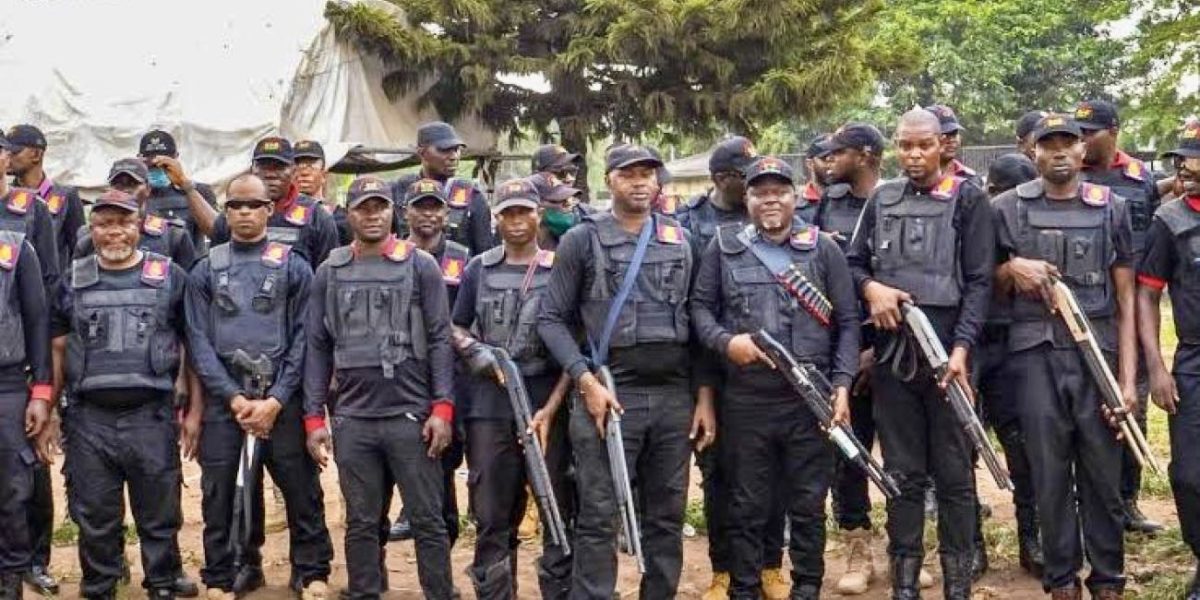
Armed men reportedly stormed the Nigeria Democratic Congress secretariat in Afuze, Edo State, destroying campaign materials and threatening occupants. Police have opened an investigation into suspected links to the state security outfit, raising fresh questions about political intimidation and the accountability of government-backed security personnel ahead of the 2027 elections.
The most disturbing question surrounding the reported attack on the Nigeria Democratic Congress (NDC) secretariat in Edo State is not simply who destroyed the party’s campaign materials. It is whether an organisation established to protect citizens could have been used, or impersonated, to intimidate those exercising their democratic rights.
On Thursday, 19 November 2026, armed men reportedly invaded the NDC secretariat in Afuze, headquarters of Owan East Local Government Area, while party candidates and members were holding a political meeting.
The Edo State Police Command said the assailants arrived carrying guns and machetes, destroyed political banners and other campaign materials, and threatened to kill occupants before fleeing after sighting police operatives.
The incident, which reportedly occurred at about 4pm, has triggered an investigation into the alleged involvement of men suspected to be associated with the Edo State Security Network, an organisation subsequently renamed the Edo State Security Corps (ESSC).
At the centre of the controversy is a question with implications beyond one political party: who controls armed personnel operating under the authority and identity of a state-backed security organisation?
Police Investigate Alleged Attack on NDC Candidates
In a statement issued on Friday, 20 November, the police spokesperson, ASP Eno Ikoedem, confirmed that the incident had been reported by NDC political aspirants, including Mrs Mariam Iseme and Professor Grant Eruhagan.
The police account stated:
“The assailants destroyed political banners and other materials within the Secretariat, while threatening to kill the occupants before fleeing upon sighting the Police.”
Ikoedem said the command had commenced investigations and was working to identify those responsible.
“The Command has commenced investigation into the incident and is making concerted efforts to identify, locate and apprehend all persons involved in the attack,” she said.
The police also disclosed that the Chairman of Owan East Local Government Area, Ernest Oyaole Aitalegbe, had been invited to assist with the investigation.
His invitation should not be interpreted as an admission of wrongdoing or proof of involvement. The police have not publicly established that he sponsored, authorised or participated in the alleged attack.
The command has also not disclosed whether anybody sustained injuries, whether any suspects have been arrested or what evidence initially pointed investigators towards the state security outfit.
Meanwhile, earlier reports identifying the NDC’s Edo North senatorial candidate give her full name as Maria Iseme Osaimoje, while the police statement refers to her as Mrs Mariam Iseme. This discrepancy should also be clarified in subsequent official records.
ESSN or ESSC? Why the Name Matters
There is an important distinction in the way the security outfit is identified in reports surrounding the incident.
The police account reproduced by Dateline Nigeria refers to men wearing Edo State Security Network (ESSN) uniforms. Other reporting, including Daily Post’s account, identifies the outfit as the Edo State Security Corps (ESSC).
Edo State officially renamed its former Security Network as the Security Corps in November 2024, following the reinstatement of the organisation after its suspension ahead of the September 2024 governorship election.
The distinction matters because investigators must establish whether the alleged attackers were serving members of the current security organisation, former personnel, individuals impersonating its officers or people using similar uniforms and insignia.
The Edo State Government has previously described the Corps as a supporting security organisation intended to assist the police and other conventional security agencies.
In June 2025, the state government announced that 1,472 personnel had completed training coordinated by the Nigerian Army.
The government’s description of the Corps is particularly relevant to the present controversy.
At the inauguration of trained personnel, Governor Monday Okpebholo acknowledged previous institutional problems, saying:
“Regrettably, the activities of the Corps were politicized, lacked professionalism, and have not met its set objectives.”
The governor said he had therefore decided to reorganise and restructure the organisation.
That admission does not establish any connection between the Corps and Thursday’s reported attack. Nor does it justify treating every member of the organisation as a suspect.
It does, however, make the need for transparent oversight particularly important.
An organisation entrusted with supporting public security must operate within clearly defined legal boundaries, maintain professional standards and remain accountable when allegations of misconduct arise.
The Danger of Turning Public Security Into a Political Weapon
The greatest danger in an incident involving suspected members of a state-backed security organisation is the possibility that the public could begin to perceive security personnel as political actors rather than neutral protectors.
That perception can be damaging even before criminal responsibility is established.
For opposition parties, the consequences of intimidation extend beyond physical safety.
Destroying campaign materials, disrupting meetings and threatening party members can weaken political organisation, discourage supporters and make participation increasingly difficult.
It can also create an atmosphere in which candidates question whether they can campaign freely without exposing themselves and their supporters to danger.
Nigeria’s Constitution provides important protections against such an outcome.
Section 40 guarantees every person the right to assemble freely and associate with others, specifically including the right to form or belong to a political party.
The Electoral Act 2026 goes further.
Section 95 places responsibility on state commissioners of police to provide adequate security for the peaceful conduct of political rallies and processions. It also states that registered political parties, their aspirants and candidates must not be prevented from holding meetings for legitimate constitutional political purposes.
Section 97 prohibits political parties, candidates, aspirants and other persons from directly or indirectly threatening people with force or violence during political campaigns to compel them to support or refrain from supporting a political party or candidate.
If the allegations in Afuze are substantiated and the legal requirements are satisfied, the conduct could raise serious questions under these provisions.
The responsibility of the authorities is therefore not merely to restore order after an attack. It is also to ensure that political participants can exercise their constitutional rights without intimidation.
Edo Already Faces Warning Signs Ahead of 2027
The Afuze incident comes against a troubling national background.
A report by the National Peace Committee, published in November, documented 109 breaches of the National Peace Accord across 26 states and the Federal Capital Territory during a ten-week monitoring period between 19 August and 27 October 2026.
Political violence and thuggery accounted for 33 incidents, while misinformation and disinformation accounted for another 29.
The committee identified Edo, Kaduna and Enugu among the states facing significant election-related security concerns.
Edo reportedly recorded seven breaches during the monitoring period.
These findings are significant because the monitoring exercise ended before Thursday’s alleged attack.
They suggest that the concerns surrounding election-related intimidation in Edo did not begin with the latest incident.
The situation also reflects wider concerns raised by opposition parties.
In early November, the Edo chapters of the African Democratic Congress and the Nigeria Democratic Congress publicly expressed concerns about alleged attacks, harassment and destruction of opposition campaign materials.
The parties called for impartial investigations and a political environment in which candidates could participate without intimidation.
Separately, the Socio-Economic Rights and Accountability Project recently urged INEC to obtain police investigation files and prosecute suspects where sufficient evidence exists in reported electoral violence cases.
Its concerns included the reported disruption of an NDC town hall meeting in Lagos on 12 November, during which journalist Samuel Adebanjo was allegedly assaulted and his equipment seized.
The emerging pattern deserves serious attention.
Political intimidation does not have to result in fatalities to undermine an election. Repeated threats, disrupted meetings, damaged campaign infrastructure and the fear of violence can gradually restrict democratic participation.
What the Edo Police Investigation Must Establish
The investigation into the Afuze incident should go beyond identifying individuals who allegedly entered the NDC secretariat.
There are several questions that require clear answers.
First, were the alleged attackers serving members of the Edo State Security Corps?
Investigators should establish the authenticity of their uniforms, insignia, weapons and any vehicles used during the operation.
Second, if the suspects were genuine personnel, were they operating under official instructions or acting independently?
Duty rosters, deployment records, communication logs and operational records could help determine whether the alleged attackers were officially deployed or had acted outside their authority.
Third, what was the connection, if any, between the attack and the political activities taking place at the secretariat?
Investigators should examine witness statements, available CCTV footage, physical evidence and the circumstances surrounding the destruction of campaign materials.
The reported flight of the assailants upon sighting the police also deserves examination. Investigators should establish when the police were alerted, how quickly officers arrived and whether any suspects were pursued.
Finally, the invitation extended to the Owan East council chairman requires clarification.
The police should explain what information they are seeking from him and whether the invitation is connected to any specific evidence.
Most importantly, the investigation must distinguish between individuals directly responsible for the alleged attack and anyone who may have authorised, facilitated or sponsored it.
Punishing those who carried out an operation without investigating possible organisers or sponsors would leave important questions unanswered.
Security Accountability Is Now an Election Issue
The 2027 general elections are approaching, with presidential and National Assembly elections scheduled for 16 January 2027 and governorship and State Assembly elections for 6 February 2027.
The credibility of those elections will depend on more than the deployment of personnel to polling units and the protection of ballot boxes.
It will also depend on whether political parties can organise meetings, display campaign materials, communicate with voters and mobilise supporters without fear.
The Commissioner of Police in Edo State, CP Patrick Daaor, has warned political actors against violence, intimidation and the use of thugs to advance political interests.
The command said anyone found sponsoring, perpetrating or aiding violence would be arrested and prosecuted, irrespective of political affiliation or status.
That warning must apply equally to everyone, including anyone who might be found to have abused the authority or identity of a government security organisation.
The allegation that armed men wearing security uniforms attacked an opposition party secretariat is serious enough to demand more than routine assurances.
If the attackers were impostors, the public deserves to know how they obtained the uniforms and why they could operate with apparent confidence.
If they were genuine security personnel, the authorities must establish who authorised their actions and ensure that those responsible face the law.
And if any political sponsor is identified, that person must not be shielded by office, influence or party affiliation.
Ultimately, the real test of Edo State’s security architecture is not how many personnel it can recruit, train or deploy.
It is whether those personnel can protect citizens without fear or favour, especially when the people they are expected to protect belong to the political opposition.
Democracy is not protected only when voters arrive at polling stations.
It is protected every time citizens can meet, organise, campaign and express political preferences without being threatened by the very institutions established to keep them safe.
Follow us on our broadcast channels today!
- WhatsApp: https://whatsapp.com/channel/0029VawZ8TbDDmFT1a1Syg46
- Telegram: https://t.me/atlanticpostchannel
- Facebook: https://www.messenger.com/channel/atlanticpostng



Join the debate; let’s know your opinion.