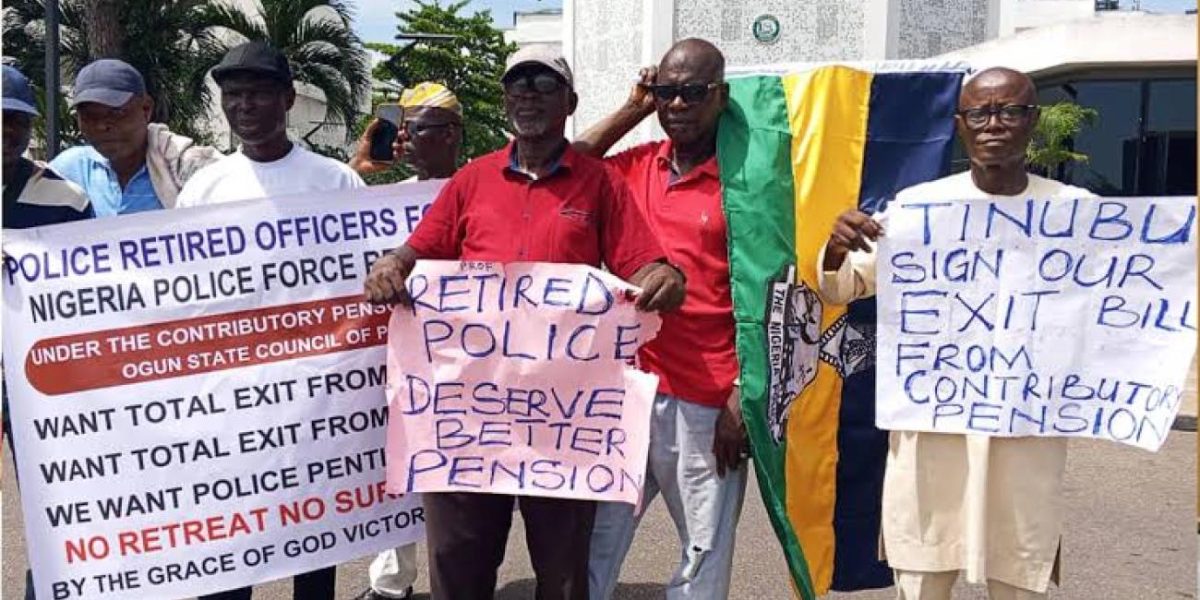
Police retirees will resume nationwide demonstrations on 30 November after a one-week break. Yet a second pension bill, unresolved arrears claims and the Federal Government’s cautious response raise questions about whether Nigeria is any closer to delivering retirement justice to former officers.
Nigeria’s retired police officers are taking a week away from the streets. Their demand for a dignified retirement, though, remains unresolved.
The Police Retired Officers Forum of Nigeria (PROF) has announced a temporary suspension of its nationwide protest from 23 to 29 November 2026, with demonstrations scheduled to resume on Monday, 30 November.
The decision follows appeals from members across the country who need time to attend to medical appointments, healthcare needs and other personal welfare concerns.
For a group of former law enforcement officers, the explanation carries a troubling irony. Having spent their careers protecting lives and maintaining public order, some now say they must interrupt their protest to attend to health and welfare problems that their retirement benefits should help them manage.
The protest began on 29 September in Abuja. Its temporary suspension does not represent a settlement, concession or withdrawal of the retirees’ demands.
In a statement signed by its National Coordinator, retired Chief Superintendent of Police Raphael I. Irowainu, the Forum said its leadership had approved the request for a one-week break.
It insisted that the decision was necessary to accommodate the needs of elderly members while allowing further consultations with relevant stakeholders.
The Forum was unequivocal about its position.
“This temporary break does not in any way signify a withdrawal from the struggle or a compromise on our legitimate demands,” the statement declared.
It added that the demonstration would resume “in a more robust, determined and result-oriented manner” until the government addressed its demands.
The dispute has now developed beyond an ordinary pension disagreement. It raises fundamental questions about the treatment of public servants after retirement, the management of Nigeria’s pension reforms and the government’s obligations to personnel who have served in one of its most demanding institutions.
Three Demands That Remain Unresolved
PROF has maintained three central demands.
First, it wants the complete withdrawal of serving and retired Nigeria Police Force personnel from the Contributory Pension Scheme (CPS).
Second, it wants the establishment of a separate Police Pension Board to administer retirement benefits and provide a dedicated welfare structure for former officers.
Third, it demands immediate payment of outstanding pension arrears which it says have accrued from 2004 to date.
The Forum has described the existing scheme as “exploitative, oppressive and obnoxious”.
These are the retirees’ characterisations of the arrangement, not findings established by an independent investigation.
Their argument is that policing involves risks, institutional demands and conditions of service that warrant a retirement arrangement different from the one applicable to ordinary public-sector employees.
The issue is not entirely new.
In April 2026, retired officers and their families protested at the Presidential Villa in Abuja, demanding that President Bola Tinubu assent to legislation intended to remove the police from the CPS.
At the time, Irowainu argued that the continued inclusion of police personnel in the scheme was indefensible when other security institutions enjoyed different pension arrangements.
He declared:
“The police, who are the father of them all, are trapped in this obnoxious Contributory Pension Scheme.”
The retirees have continued pressing the argument through demonstrations and engagements with government officials.
The Police Exit Bill: Why Is Another Bill Emerging?
One of the most important developments in the pension controversy is the apparent return of the Police Pension Board legislation to the House of Representatives, despite an earlier version having already passed through the National Assembly.
Official legislative records show that the original Nigeria Police Force Pension Board (Establishment) Bill, 2025, sponsored by House Leader Julius Ihonvbere, reached the third-reading stage in the House of Representatives on 21 October 2025.
The Senate’s order paper for 4 December 2025 subsequently listed the legislation for concurrence.
Retired police officers and several Nigerian news organisations have reported that the National Assembly passed the bill on 4 December and transmitted it to the Presidency on 16 March 2026 for presidential assent.
Yet the legislative story has taken another turn.
The House of Representatives’ official order paper for 11 November 2026 lists another Nigeria Police Pension Board (Establishment) Bill, 2026, identified as HB.2859 and sponsored by Jesse Okey-Joe Onuakalusi, representing Oshodi-Isolo II Federal Constituency of Lagos State.
It was listed for first reading.
The new proposal is separate from the earlier HB.979, which had been processed in 2025.
This development raises an important question that neither the retirees nor the Nigerian public should have to guess about.
Why is another police pension bill entering the legislative process when an earlier version was reportedly passed by both chambers and transmitted to the President?
Is HB.2859 intended to replace the earlier legislation, improve its provisions or address outstanding legal and administrative problems?
The publicly available legislative information reviewed for this report does not establish the relationship between the two proposals.
The distinction matters. Retired officers need clarity about which legislation is expected to resolve their grievances, what happened to the earlier bill and what action remains necessary before a separate pension arrangement can become operational.
The government and National Assembly should publish a clear explanation.
The Government Has Acknowledged the Problem, but the Solution Remains Unclear
The Federal Ministry of Police Affairs has publicly acknowledged the pension controversy.
On 5 October 2026, Minister of Police Affairs Ibrahim Gaidam, represented by Permanent Secretary Anuma Ogbonnaya Nlia, met with PROF leadership in Abuja.
The meeting focused on the Forum’s demand for the withdrawal of the Nigeria Police Force from the CPS and the establishment of a dedicated pension arrangement.
The Permanent Secretary disclosed that the Ministry had previously communicated its position to the Presidency and would send another reminder to emphasise the urgency of the matter.
He also acknowledged that moving the police from the CPS to an appropriate Defined Benefit Scheme would require “careful policy, legal and executive consideration”.
The Ministry further disclosed that a ministerial and stakeholders’ committee was reviewing several welfare matters, including salaries, allowances, housing, outstanding pension arrears, death benefits, group life insurance and group personal accident liabilities.
The Ministry’s acknowledgement is significant, but it is not the same as a binding commitment to implement the retirees’ demands.
The October meeting ended with assurances of continued engagement and a peaceful resolution. It did not announce a definitive timetable for the police pension exit or the payment of the disputed arrears.
The question now is whether these engagements will produce measurable action before the retirees return to the streets.
What Is Wrong With the Existing Pension Arrangement?
Understanding the controversy requires examining how Nigeria’s Contributory Pension Scheme works.
The Pension Reform Act 2014 establishes a contributory arrangement in which the employer contributes a minimum of 10 per cent of an employee’s monthly emoluments, while the employee contributes at least eight per cent.
The contributions are accumulated in the employee’s Retirement Savings Account (RSA), managed and invested through a licensed pension fund administrator.
The retirement benefits depend on the contributions accumulated and investment performance rather than a predetermined pension calculated exclusively from an officer’s final salary and years of service.
The controversy partly stems from the different treatment of security institutions.
Section 5 of the Pension Reform Act provides exemptions for specified categories, including members of the Armed Forces and intelligence and secret services. Police personnel are not expressly included in those exemptions and remain under the contributory arrangement.
The police already have a specialised pension fund administrator, NPF Pensions Limited, incorporated in 2013 and licensed by the National Pension Commission in August 2014.
This is an important distinction.
The retirees are not simply asking for a company that manages police pension accounts. They want a different pension structure and a separate statutory institution with responsibility for managing the retirement benefits of serving and former police personnel.
Their dissatisfaction must therefore be considered against both the adequacy of the existing benefits and the institutional arrangements governing their retirement.
The Arrears Question: Two Accounts That Need Reconciliation
Perhaps the most important unresolved aspect of the dispute concerns the outstanding pension arrears.
PROF’s latest statement demands payment of arrears accumulated from 2004 to date. It does not provide a consolidated naira figure, an account of the affected pensioners or a breakdown showing how the alleged liabilities accumulated.
There is also an official-side account that deserves scrutiny.
In February 2026, NPF Pensions Limited announced that outstanding pension arrears for retired police officers and death benefits owed to beneficiaries of deceased personnel had been settled since the assumption of office of former Inspector-General of Police Kayode Egbetokun.
According to figures reported by The Guardian, the company said it had paid more than ₦97.502 billion in pensions to 30,370 retired police officers since its establishment.
It also reported the disbursement of more than ₦39.572 billion in death benefits to 8,847 families of officers who died in active service.
At the time, 25,572 retirees were reportedly receiving a combined monthly pension of ₦1.563 billion.
Assistant Commissioner of Police Ameh Lydia, a director of NPF Pensions Limited, said:
“Before now, you would hear of people retiring for two or three years without receiving benefits.”
She added that officers retiring with complete documentation could receive their benefits within three to five working days.
These figures provide an important measure of the pension administrator’s reported performance. They do not, on their own, establish that every outstanding obligation dating back to 2004 has been settled.
The company’s statement referred specifically to arrears settled since Egbetokun assumed office. The Forum’s demand covers a much longer period.
The two positions therefore need to be reconciled rather than treated as proof that either side has settled the entire dispute.
The government should publish a comprehensive reconciliation of pension obligations, including the categories of arrears outstanding, the amounts paid, the amounts still owed and the pensioners affected.
Without that information, the public cannot determine the precise scale of the dispute.
A Separate Pension Board Must Not Become Another Financial Burden
The proposed Police Pension Board could provide a more specialised arrangement for police retirees.
But creating a new institution does not automatically guarantee better pensions.
The latest proposal reported by The PUNCH provides for the transfer of existing police pension assets and liabilities from PenCom to the proposed board within six months of the commencement of the new law.
It also envisages funding through Federal Government budgetary allocations, transferred pension funds, investment income and approved grants.
The proposal contains provisions for annual financial audits and the submission of reports to the President and National Assembly.
Its explanatory memorandum recognises what it calls “the peculiar, hazardous and essential nature of policing duties in Nigeria”.
It also promises “timely, dignified and adequate post-service welfare for police personnel”.
These are important safeguards on paper.
The real test will be the transparency of the transition, the accuracy of pension records, the valuation of existing assets and liabilities, and the availability of sufficient funding to meet future obligations.
Nigeria has historical reasons to approach the proposed transition carefully.
Before the introduction of the contributory system in 2004, the country’s previous Defined Benefit Scheme relied heavily on government budgetary provisions. Years of inadequate funding and administrative weaknesses contributed to substantial pension arrears and hardship among retirees.
A new Police Pension Board must not reproduce those failures under a different institutional name.
Its funding structure, investment responsibilities, governance arrangements and independent oversight will be as important as its establishment.
The transition must also protect the accumulated retirement savings and accrued rights of serving officers rather than transfer assets without a transparent account of individual entitlements.
November 30 Will Test the Government’s Commitment
The one-week suspension offers the Federal Government another opportunity to prevent the dispute from escalating.
The retirees have made clear that their decision to leave the protest grounds temporarily is driven by health and welfare needs, not satisfaction with the government’s response.
For Tinubu’s administration, the challenge is no longer simply to acknowledge their complaints.
It must clarify the status of the earlier Police Exit Bill, explain the emergence of HB.2859, establish the actual value of outstanding pension obligations and present a credible timetable for addressing the demands.
The National Pension Commission must also help provide transparent information about the assets, liabilities and payment records associated with police retirement accounts.
The National Assembly should clarify the relationship between the two pension bills and establish whether any outstanding legislative or executive obstacles remain.
Retirement should represent the beginning of a more secure chapter after years of public service. It should not become another struggle in which elderly citizens must repeatedly demonstrate to obtain recognition of their entitlements.
Nigeria’s retired police officers have already spent decades enforcing the law.
Their final demand should not be an endless confrontation with the institutions that once employed them.
When the nationwide protest resumes on 30 November, the government will face a question that goes beyond the pension scheme itself:
Can a country that depends on its police to protect citizens demonstrate that it can also protect those who have finished serving it?
Follow us on our broadcast channels today!
- WhatsApp: https://whatsapp.com/channel/0029VawZ8TbDDmFT1a1Syg46
- Telegram: https://t.me/atlanticpostchannel
- Facebook: https://www.messenger.com/channel/atlanticpostng



Join the debate; let’s know your opinion.