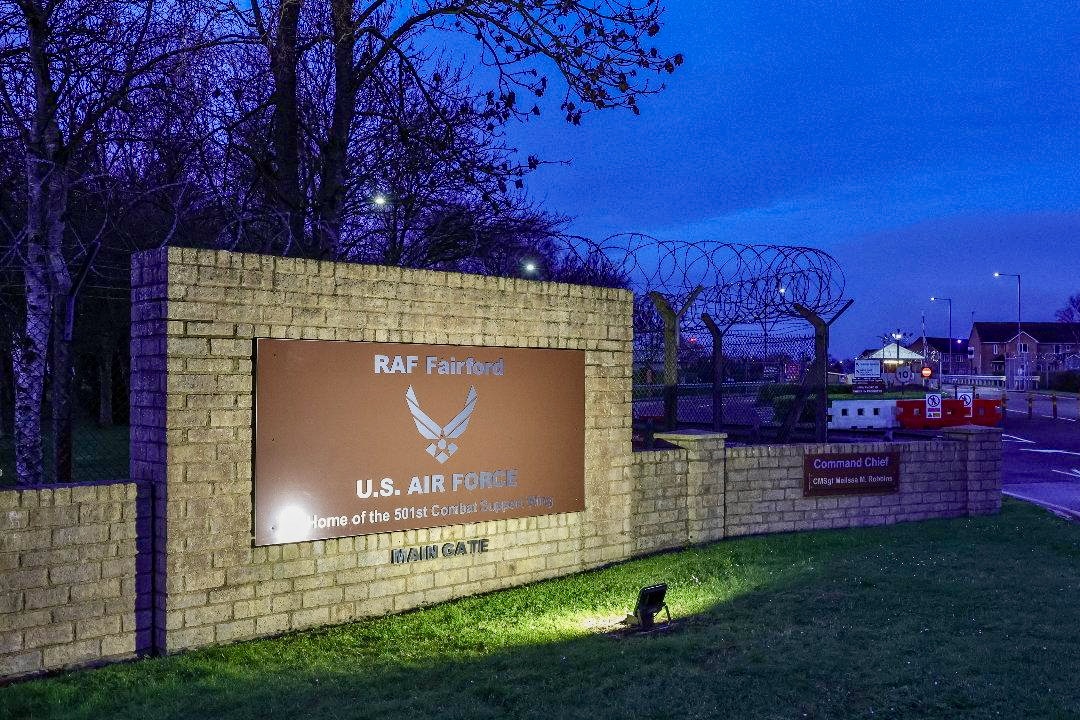
A seventh man has been arrested as British counter-terrorism investigators race to establish why suspicious vehicles appeared near a US-linked airbase. The biggest unanswered question is no longer whether the police response was justified, but what the men were actually preparing to do.
Seven men have now been arrested in Britain’s widening investigation into suspicious activity near RAF Fairford.
Yet after more than a week of raids, forensic examinations and counter-terrorism arrests, one question still hangs over the case.
What, exactly, were they preparing to do?
The latest development came on Tuesday, when Counter Terrorism Policing arrested a 22-year-old British man in Westminster, London, on suspicion of preparing terrorist acts under Section 5 of the Terrorism Act 2006. Officers also searched a property in the area.
His arrest takes the total number detained in the investigation to seven.
Six of the men, all in their 20s, are now on police bail. Five were arrested in Whelford, Gloucestershire, on 27 September after reports of suspicious vehicles near RAF Fairford. A 25-year-old dual British-Iranian national was arrested in Westminster on 1 October and was subsequently released on bail.
That timeline is important.
It means the investigation has expanded rather than produced a publicly established account of what the suspects intended.
Senior National Coordinator for Counter Terrorism Policing Vicki Evans said the operation remained active.
“This remains a live investigation and our specialist teams continue to pursue multiple lines of enquiry into the circumstances surrounding events near RAF Fairford.”
She added that officers were working “around the clock” to identify the motivation behind the events and remained committed to investigating “all possible angles”.
That language is unusually important.
Police are not publicly describing a completed terrorist plot.
They are investigating a set of circumstances that they regard as serious enough to engage counter-terrorism powers, while still trying to determine the motive.
The Evidence Gap at the Centre of the Case
The first arrests began after police received a report at about 12.45am on 27 September concerning three vehicles apparently travelling towards the airbase.
Armed officers responded and arrested five men in the Whelford area.
A 400-metre cordon was established and about 85 households were evacuated while military explosive ordnance specialists examined the vehicles.
The response was dramatic.
The initial physical evidence, at least from what authorities have publicly confirmed, has been considerably less dramatic.
Police said no improvised explosive devices were found.
They did recover a quantity of petrol.
That distinction is central to understanding the investigation.
The suspects were not publicly shown to have been carrying bombs when detained. Nor have police publicly disclosed an operational plan, target list, attack timetable or demonstrated capability that would establish precisely what the group intended.
Yet the terrorism suspicion remains.
Under Section 5 of the Terrorism Act 2006, a person can commit an offence by engaging in conduct in preparation for terrorist acts with the intention of committing or assisting terrorism. The offence carries a maximum sentence of life imprisonment on conviction.
The threshold for arrest and investigation is not the same thing as proof beyond reasonable doubt.
That is why the Fairford case should be watched through the evidence rather than through the increasingly combustible political language surrounding it.
The Iran Question
The geopolitical context has made that distinction much harder.
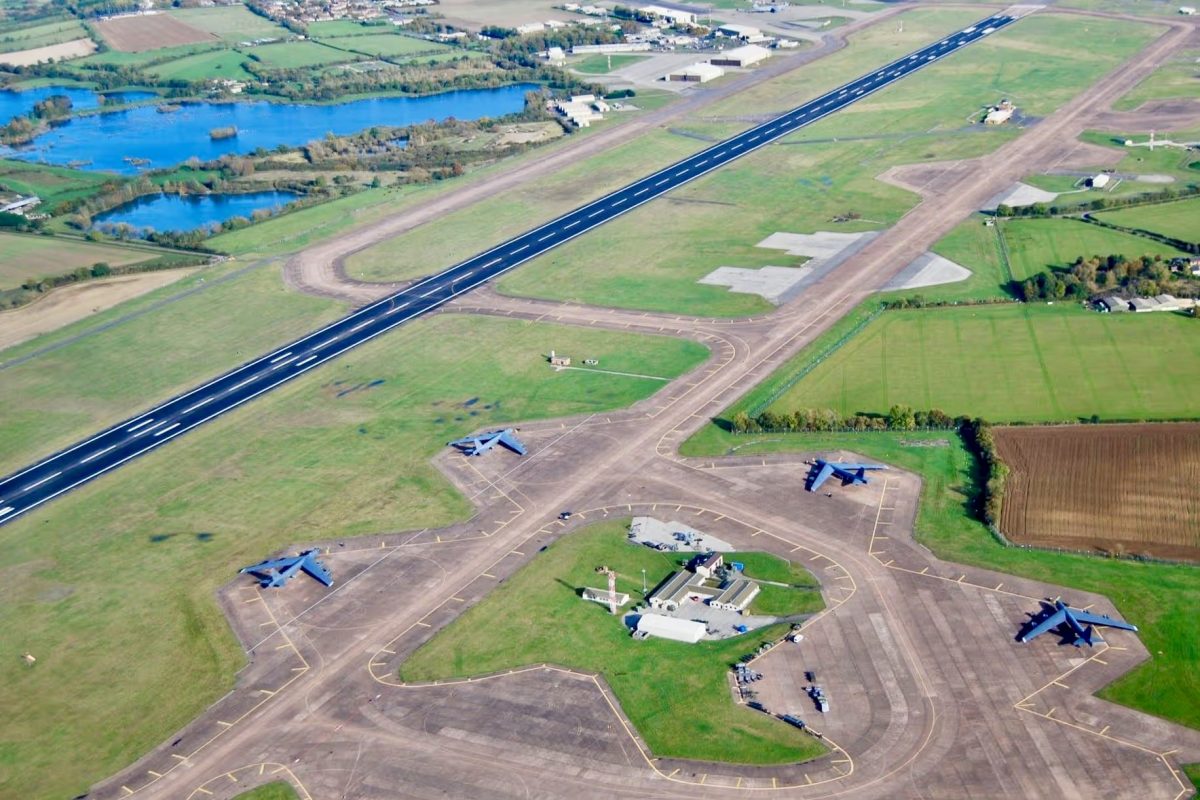
RAF Fairford is a major US-linked airbase and has been used by American heavy bombers during the conflict involving Iran. The base is therefore not simply a British military facility in a rural Gloucestershire setting. It sits inside a much wider confrontation involving Britain, the United States and Tehran.
In July, Iran’s Islamic Revolutionary Guard Corps warned that any British base used to attack Iranian territory would be regarded as a legitimate target. The warning explicitly referenced RAF Fairford and US bomber operations from the base.
That statement provides motive in the broad geopolitical sense.
It does not, by itself, prove who was behind the September incident.
British counter-terrorism investigators initially said they were considering the possibility of foreign-state involvement and whether individuals could have been acting as proxies, either knowingly or unknowingly.
Prime Minister Andy Burnham later said there were “strong indications” Iran had played a part in what happened.
That was a significant escalation in the political framing of the case, because it moved the discussion from a suspicious incident near an airbase to an alleged foreign-backed operation.
Iran has rejected the allegation.
Its embassy in London said it “categorically rejects and strongly condemns” attempts to connect Tehran with the arrests and accused critics of fuelling “Iranophobia propaganda” in Britain.
So far, the public evidence has not established the Iranian chain of command alleged in political and media speculation.
That remains an investigative question.
The Sixth Arrest Changed the Picture
The arrest of the 25-year-old dual British-Iranian national on 1 October inevitably intensified scrutiny of the Iranian theory.
Counter Terrorism Policing searched two London properties and explicitly said investigators were examining “possible foreign state involvement”.
But investigators have not publicly said that the man was an Iranian agent.
Nor have they disclosed evidence showing that he directed the five men arrested in Gloucestershire.
That distinction is vital.
Nationality is not evidence of espionage.
Association is not evidence of command.
And suspicion is not a conviction.
The same principle applies to the seventh suspect arrested in Westminster.
His arrest is significant because it suggests investigators believe the original incident may involve a wider network or additional participants.
But the public does not yet know what role, if any, he allegedly played.
Why Were the First Suspects Released?
Perhaps the most politically explosive part of the investigation has been the decision to release the six earlier suspects on police bail.
The move surprised sections of the public and attracted criticism from senior American figures, including Donald Trump.
British counter-terrorism police have defended the decision.
Assistant Commissioner Laurence Taylor said the five initial suspects remained under investigation and were subject to strict conditions concerning movement and contact.
He described the decision as one based on “experience and careful consideration of policing powers”.
That explanation exposes a fundamental difference between political expectation and criminal investigation.
A terrorism arrest does not automatically establish a prosecutable case.
Investigators must collect admissible evidence, identify what happened, establish intent and determine whether further detention is legally justified.
That process can be frustratingly slow when intelligence may be sensitive or when investigators are working across several jurisdictions.
It is also precisely why releasing a suspect on bail cannot automatically be interpreted as police deciding that nothing happened.
The men remain under investigation.
The B-1 Bomber Mystery
Then came the development that transformed a British police investigation into an international security story.
The United States removed its B-1 bombers from RAF Fairford amid reported concerns about a possible Iranian threat.
Trump said there had been a threat and later said the people behind it were linked to Iran.
“We had an idea that there might be a threat, and why would I leave them there?” he said.
US Secretary of State Marco Rubio was more cautious, saying there was no direct link between the bomber movement and the suspected Iranian plot and that the Pentagon regularly reallocates military resources.
That disagreement is revealing.
It means the public has been presented with two overlapping narratives.
One is a police investigation into suspicious activity around RAF Fairford.
The other is an intelligence-based US decision to move high-value bombers because of a perceived threat.
They may be connected.
They may also be connected only indirectly.
British authorities have not publicly supplied enough evidence to bridge that gap.
Could the Vans Have Been a Test Rather Than an Attack?
Investigators are also confronting another possibility.
Was the incident an intended attack?
Or was it reconnaissance?
A security test?
A dry run?
A diversion?
Or an operation designed to make the authorities react?
Reuters reported that one suspect was said to have called emergency services shortly before his arrest, although police have not publicly confirmed that detail. The possibilities being examined have included surveillance, testing security arrangements or trying to send a political message.
That uncertainty may explain why the case has remained active despite the absence of explosives.
In modern counter-terrorism investigations, the objective may not always be to detonate a device immediately.
Learning how a site responds can itself be valuable.
Observing patrol patterns, reaction times, access routes and security procedures can theoretically provide intelligence for a later operation.
That does not mean this happened at Fairford.
There is no public evidence yet establishing that it did.
It explains only why investigators may regard seemingly incomplete activity as serious.
Britain Is Now Better Equipped to Confront Foreign Proxies
The Fairford investigation also arrives at a significant moment in British national-security law.
In July, Britain designated the Islamic Revolutionary Guard Corps under new state-threat powers created by the National Security (State Threats) Act 2026.
The government said the legislation was designed to disrupt foreign state-backed activity and proxy networks.
The timing is difficult to ignore.
Britain has increasingly warned about foreign states using criminal networks, intermediaries and proxies to conduct intimidation, sabotage and other hostile activity on British soil.
The government said MI5 had tracked more than 20 potentially lethal Iran-backed plots in 2025.
The current national terrorism threat level remains SEVERE.
That background makes Fairford more credible as a national-security concern.
It still does not answer the central evidential question.
The Seven Arrests Are Not the Verdict
The danger in the Fairford case is that political certainty could outrun investigative certainty.
The British government has reason to take Iranian threats seriously.
The US has reason to protect aircraft and personnel.
The police have reason to investigate suspicious vehicles approaching a strategically important military facility.
And Iran has a direct interest in denying responsibility.
All four statements can be true at once.
What remains unresolved is the bridge between suspicion and attribution.
Who organised the operation?
Who financed it?
What was the intended objective?
Why were three vans there?
Why was petrol present?
Was there a planned attack?
Was someone testing the base?
Was there a foreign handler?
Did every suspect know what they were allegedly involved in?
And, perhaps most importantly, what evidence now sits in the hands of investigators that was not available when the first five men were released on bail?
Those are the questions that the seventh arrest makes more urgent.
For now, Counter Terrorism Policing says investigators are working “to identify the motivation”.
Until that motivation is established, the most defensible description of Fairford is not a proven Iranian terror plot.
It is a live counter-terrorism investigation into suspicious activity at one of Britain’s most strategically important military sites, against a backdrop of an established Iranian threat and a rapidly escalating security environment.
The difference matters.
Because seven arrests can tell Britain that investigators believe there is something worth pursuing.
They do not yet tell the public what that something was.
Follow us on our broadcast channels today!
- WhatsApp: https://whatsapp.com/channel/0029VawZ8TbDDmFT1a1Syg46
- Telegram: https://t.me/atlanticpostchannel
- Facebook: https://www.messenger.com/channel/atlanticpostng
Join the debate; let's know your opinion.