Nigeria’s security landscape is rarely captured by a single headline. Behind every announcement of a kidnapping, armed robbery, terrorist hideout or weapons recovery sits a larger network of money, movement, local intelligence, vulnerable communities and criminal logistics.
A fresh operational summary from the Nigeria Police Force offers an unusually revealing snapshot of that ecosystem.
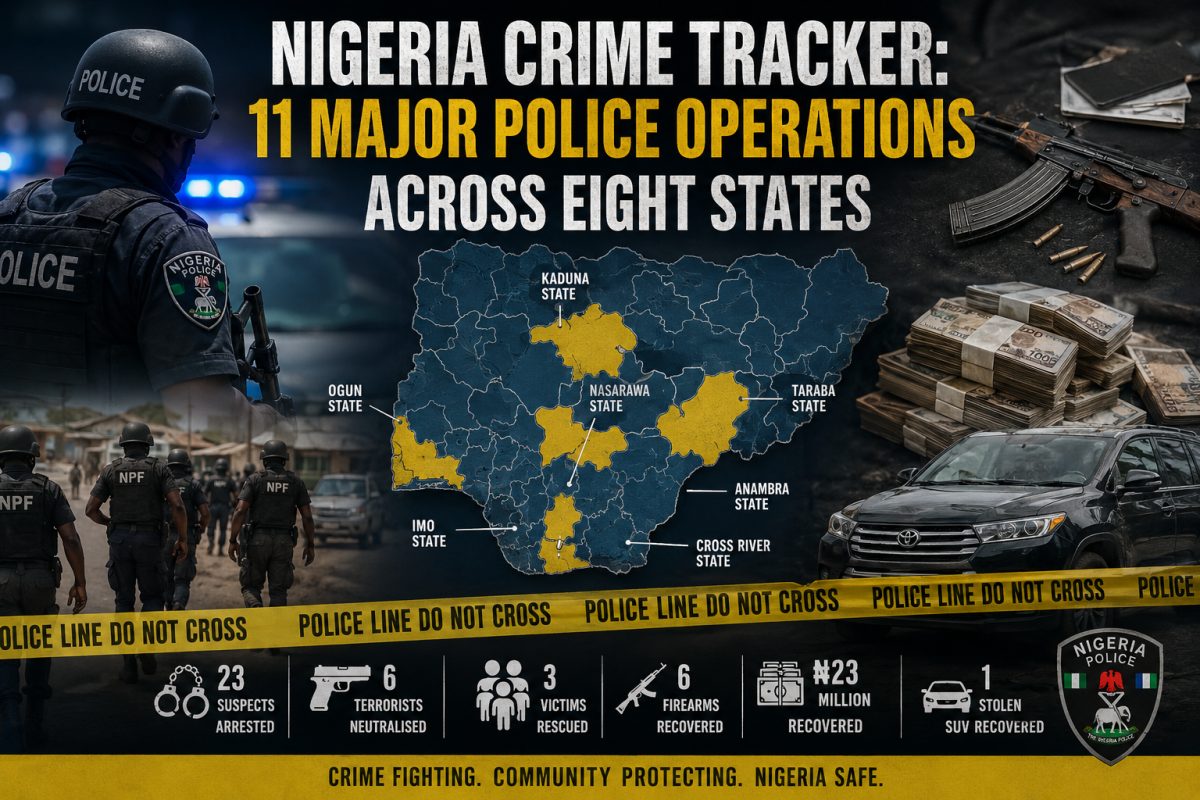
Between 21 and 23 August 2026, the Police reported 11 major operations across eight states — Anambra, Imo, Kaduna, Rivers, Ogun, Taraba, Cross River and Nasarawa. The incidents involved counter-terrorism raids, suspected terrorist collaboration, kidnapping, armed robbery, assassination-related violence, illegal firearms, cult-related activity, suspected money laundering and homicide.
Taken together, the police account records 17 arrests, six suspected criminals killed during the Anambra operation, three kidnapped victims rescued and at least seven firearms recovered, alongside the recovery of ₦12 million in suspected proceeds requiring investigation. One reported robbery in Ogun also involved an alleged forced transfer of ₦5 million, ₦6 million in cash and the theft of a Highlander SUV.
But the numbers tell only part of the story.
The more important finding is the geographic and economic spread of the threats. The operations stretch from the creeks and forests of the South-East and South-South to North-Central communities and commercial corridors in Ogun. They show that Nigeria’s security challenge is not one single phenomenon. It is a collection of interconnected criminal economies.
Eleven operations, eight states — and several different criminal economies
The Nigeria Police Force’s executive summary for 23 August listed a series of investigations and tactical operations conducted by state commands and joint security teams.
In Anambra, a counter-terrorism clearance operation targeted a suspected armed camp in dense forest at Amiyi, Ogbaru Local Government Area. Police said six suspected terrorists were killed after officers and their partners came under fire. Two pump-action guns, undetonated improvised explosive devices and charms were reportedly recovered, while camps and shrine structures associated with the group were destroyed.
The operation also illustrates the increasingly joint nature of serious security operations. Separate reporting by the Anambra command said the team included the Police Rapid Response Squad, Department of State Services personnel, the 302 Artillery Regiment, Nigerian Navy personnel and community-based Agunachamba operatives.
There is also an important discrepancy that deserves attention. While the Force headquarters summary supplied to journalists focused on the six suspected terrorists neutralised and the weapons recovered, local reporting on the operation said an explosive device believed to have been planted in the area detonated, killing one security operative and injuring another.
That distinction matters. Police operational statements are important primary sources, but they are not always the final account of a developing security incident.
Imo: following the support network
The second major operation moved the focus from fighters to alleged facilitators.
In Imo State, police said three suspected terrorist collaborators were arrested. The suspects reportedly included the alleged owner of a terrorist camp, an alleged informant and a suspected cook.
Two AK-pattern rifles were recovered. Police said one was an AK-49 allegedly linked to the killing of a Homeland Security Guard, while the second, an AK-47, was allegedly stolen from Agwa Police Station during an attack in 2022.
The significance is bigger than the arrests themselves.
A terrorist or armed criminal organisation cannot function on gunmen alone. It needs food, information, safe locations, weapons, transport, communications and access to local terrain. Arresting alleged support personnel can therefore be more consequential to an investigation than simply making arrests at the edge of an operational camp.
The Police said the investigation remains active and is aimed at identifying the wider network.
Kaduna: the human face of the security statistics
In Kaduna State, police and local vigilantes raided a suspected kidnappers’ hideout in Gidan Mijin Gwaggo Durum, Makarfi Local Government Area.
Three kidnapped victims were rescued, including Alhaji Hamza Shuaibu Gimi. A Boxer motorcycle was also recovered.
The rescue comes against a backdrop of persistent kidnapping pressure across Nigeria.
The National Bureau of Statistics’ Crime Experience and Security Perception Survey estimated 2,235,954 kidnapping incidents between May 2023 and April 2024, with households paying an estimated ₦2.23 trillion in ransom. The survey reported that 65 per cent of households affected by kidnapping paid ransom, with an average payment of about ₦2.67 million per incident.
Those figures provide an important economic lens. Kidnapping is not simply a security problem; it is a parallel financial market.
Every kidnapping can generate ransom payments, movement costs, negotiation expenses, security spending and lost working time. Businesses also face increased transport costs, insurance exposure and disruption when employees or supply routes are targeted.
The Kaduna rescue therefore represents more than three people returning to their families. It is an interruption of a criminal revenue chain.
Ogun: where violent crime meets household wealth
Two separate operations in Ogun State underline another dimension of Nigeria’s crime problem.
In Soyoye, Abeokuta, police responded to an armed robbery in which the victims allegedly lost ₦5 million through a forced bank transfer, ₦6 million in cash, mobile phones and a Highlander SUV.
That is a total reported financial exposure of ₦11 million, excluding the value of the vehicle and electronic devices.
The incident should concern businesses and households because it illustrates how criminals increasingly combine physical violence with digital financial extraction.
An armed robbery no longer necessarily ends with cash being taken from a safe. Criminals can compel victims to transfer funds electronically while simultaneously stripping them of mobile phones and vehicles.
That creates a crossover between traditional violent crime and financial crime — an area likely to become increasingly important for banks, fintech companies, insurers and corporate security managers.
A second Ogun operation involved the arrest of a suspect allegedly connected to an illegal installation capable of causing a breach of the peace. Police said officers recovered a locally fabricated pistol, a live cartridge and a charm.
Later, police also responded to an armed robbery during a church vigil in Sango-Ota. Injured victims were evacuated to hospital while detectives continued the search for fleeing suspects.
Together, the Ogun incidents show how security risks can move seamlessly from residential properties to religious gatherings and other crowded civilian spaces.
Cross River: the symbols of organised local crime
In Cross River, detectives acting on intelligence raided a suspected criminal hideout in Abini Community.
Ten suspects were arrested, while others reportedly escaped.
Among the items recovered were a locally made double-barrel short pistol, battle axe, dagger, cult insignia beret, police camouflage trousers and a PMF cardigan.
The presence of police-style clothing is noteworthy because uniforms can provide criminals with an element of deception during robberies, illegal checkpoints or other operations. That does not by itself establish how the clothing was obtained or how it was intended to be used, but investigators will need to establish the source and possible chain of possession.
The Cross River operation also demonstrates why intelligence-led policing is becoming increasingly important. Police did not simply stumble upon the hideout; they said detectives acted on actionable intelligence.
Taraba: one rifle, a much bigger warning
In Taraba State, detectives mobilised after a violent clash in Kashimbilla Bush, Takum Local Government Area.
One AK-47 rifle was recovered.
There were no reported arrests in the operation, and police said engagement with stakeholders was continuing to prevent further escalation.
That may appear modest compared with the larger Anambra or Cross River operations, but weapons recovered after violent clashes can provide investigators with an important lead.
The immediate objective is to prevent another confrontation. The investigative objective is to establish who owned or used the rifle, where it came from and whether it can be connected to previous attacks.
In other words, a single recovered firearm can potentially become a piece of evidence in a much larger criminal investigation.
Rivers: assassination investigation remains open
In Rivers State, police responded to an attack along Amadabo Residence in Finima following an ambush reportedly carried out by suspected assailants.
One suspect was arrested, while others were reportedly still at large.
Police classified the matter as an assassination investigation, but the available operational summary does not establish the full motive, identity of all victims or the precise role allegedly played by the arrested suspect.
That distinction matters.
In a country where social-media claims can rapidly turn a developing criminal investigation into a political narrative, the evidence available at the arrest stage should not be mistaken for a completed case.
The police said the investigation is ongoing.
Nasarawa: homicide at community level
In Nasarawa State, officers responded to a reported fatal machete attack at Ajaga Community in Loko Local Government Area.
The suspect was subsequently traced and arrested.
Unlike the terrorism and kidnapping cases elsewhere in the bulletin, this incident highlights a different but equally important policing challenge: violent crime at community level.
Not every major security threat comes from an organised armed group. Homicide, interpersonal violence and disputes can produce fatal consequences in communities far removed from the national headlines.
For the Police Force, the challenge is therefore twofold: responding to high-intensity organised crime while maintaining the investigative capacity to solve ordinary but potentially deadly criminal cases.
The wider warning behind the arrests
The 11 operations should not be interpreted as evidence that Nigeria’s security challenge is solved.
Quite the opposite.
They reveal just how many types of criminal activity security agencies must confront simultaneously.
The latest police operations cover:
Terrorism and armed groups.
Kidnapping.
Armed robbery.
Homicide.
Assassination-related violence.
Cultism.
Illegal firearms.
Explosive devices.
Suspected money laundering.
Criminal hideouts.
Vehicle theft.
That breadth is significant.
The Nigeria Police Force said earlier in 2026 that its April operations included arrests of 28 suspected terrorists, 85 suspected kidnappers, 62 armed robbery suspects, 51 murder and culpable homicide suspects and 54 suspected cultists. The figures illustrate how varied the Force’s operational burden has become.
Meanwhile, terrorism remains a major national concern. The Institute for Economics & Peace’s 2026 Global Terrorism Index placed Nigeria among the world’s most terrorism-affected countries, with Nigeria ranked fourth globally. The index also documented a sharp rise in terrorism-related deaths in 2025.
And the threat is not static.
On 24 August, Reuters reported that a video appearing to show hundreds of people abducted after attacks in Niger State had surfaced on social media, although authorities had not confirmed the number of captives and Reuters said it could not independently verify the precise location or timing of the footage.
That development is an important reminder that the operational successes announced by security agencies are unfolding alongside continuing mass-abduction threats.
The economic cost is becoming impossible to ignore
Nigeria’s crime story is also an economic story.
A kidnapped businessman is not merely a victim in a security report. He is potentially an employer, taxpayer, supplier or investor whose absence can disrupt an entire commercial chain.
A stolen vehicle is not merely property crime. It can interrupt logistics.
A robbery at a residence can destroy household savings.
An attack on a church vigil can affect public confidence in gatherings.
An armed criminal camp in a forest can restrict farming, transport and local investment.
This is why security should increasingly be understood as economic infrastructure.
The NBS ransom figures provide perhaps the clearest illustration. An estimated ₦2.23 trillion paid in ransom over a 12-month period represents money transferred from households into criminal networks rather than spent on food, education, housing, healthcare, investment or consumption.
For a country battling inflation, weak household purchasing power and high business costs, the diversion of resources into criminal economies is a major hidden tax.
What the 23 August operations reveal about policing
Three trends stand out.
First, intelligence is becoming central.
Several of the operations were triggered by what police described as credible or actionable intelligence. That is particularly evident in Anambra, Imo and Cross River.
Second, joint operations are increasingly unavoidable.
The Anambra operation involved police, intelligence, military, naval and community personnel. That reflects the reality that difficult terrain and heavily armed groups often exceed the capabilities of a single agency.
Third, community participation remains critical.
The Kaduna operation involved local vigilantes, while the Anambra operation included community operatives.
That model can provide local knowledge that is difficult for outside forces to replicate. But it also creates a continuing need for clear oversight, accountability, training and rules governing civilian participation in security operations.
The next question is not how many arrests were made
Nigeria often measures security performance through arrests, weapons recoveries and suspects neutralised.
Those figures are important, but they are not enough.
The harder questions are:
How many convictions followed?
How many criminal networks were actually dismantled?
Were recovered weapons traced to previous attacks?
Did rescued kidnapping victims return safely to normal life?
Were stolen assets recovered?
Did communities become safer after the operation?
Were the financiers and organisers — rather than only the foot soldiers — identified?
Those are the metrics that determine whether an operational success becomes a lasting security gain.
For businesses, investors and ordinary Nigerians, the difference matters enormously.
An arrest creates a headline.
A dismantled criminal network creates security.
Atlantic Post security assessment
The Nigeria Police Force’s 21–23 August operational summary shows a police organisation conducting simultaneous battles against terrorism, kidnapping, violent crime and financial crime across vastly different geographical environments.
But it also exposes the scale of the challenge.
Within just three days, police reported six suspected terrorists killed in one operation, 17 arrests across several investigations, three kidnapping victims rescued, at least seven firearms recovered and a suspected ₦12 million money-laundering case opened.
That is a significant operational footprint.
Yet Nigeria’s wider security environment remains volatile. Recent mass-abduction reports in Niger State, continuing kidnapping concerns and the country’s high position on the global terrorism index demonstrate that tactical victories do not automatically translate into strategic security.
The real test will be what comes next.
Whether the arrests produce prosecutions.
Whether weapons lead investigators to wider networks.
Whether intelligence improves before the next attack.
Whether communities become safer.
And whether the money currently feeding Nigeria’s criminal economy can be cut off at its source.
For citizens and businesses, that is the crime tracker that ultimately matters.
SEO title
Nigeria Crime Tracker: Police Operations Across 8 States
SEO description
Nigeria Police report 11 operations across eight states involving terror camps, kidnappers, armed robbery, firearms, arrests and cash recovery.
CMS tags
Nigeria Crime Tracker, Nigeria Police Force, Kidnapping in Nigeria, Terrorism in Nigeria, Armed Robbery, Nigeria Security
Captivating excerpt
From terrorist camps in Anambra to a kidnappers’ hideout in Kaduna and an ₦11 million armed robbery in Ogun, Nigeria’s latest police operations reveal a criminal economy spreading across regions, targets and revenue streams. Atlantic Post tracks the 11 operations, the arrests, weapons, rescues and money involved — and examines what they mean for public safety, businesses and the wider Nigerian economy.
Follow us on our broadcast channels today!
- WhatsApp: https://whatsapp.com/channel/0029VawZ8TbDDmFT1a1Syg46
- Telegram: https://t.me/atlanticpostchannel
- Facebook: https://www.messenger.com/channel/atlanticpostng