Britain has arrested seven men, released six on bail and watched America pull its B-1 bombers from RAF Fairford. The unanswered evidence may be more disturbing than the arrests themselves.
There is something deeply uncomfortable about the RAF Fairford investigation.
The police have arrested seven men.
The United States has removed its bombers.
Iran has been accused of involvement.
Britain says there are strong indications of an Iranian role.
And yet the most basic question remains unanswered.
What were the men actually going to do?
The latest arrest came on 6 October, when Counter Terrorism Policing detained a 22-year-old British man in Westminster on suspicion of preparing terrorist acts under Section 5 of the Terrorism Act 2006. A London property was also searched.
That brings the number of men detained in the investigation to seven.
Six are now on police bail.
Five were arrested after three suspicious vehicles were reported moving towards RAF Fairford during the early hours of 27 September. The sixth, a 25-year-old dual British-Iranian national, was arrested in Westminster four days later.
The case should be setting off alarms.
But not for the reason politicians and headlines might suggest.
The real alarm is the evidence gap.
The Police Found Petrol. Not Bombs.
The first incident unleashed a huge security response.
Armed officers moved in.
A 400-metre cordon went up.
About 85 households were evacuated.
Military explosive ordnance specialists were deployed.
The three vans were subjected to extensive forensic examination.
Then came the crucial finding.
No improvised explosive devices were found.
Police did recover petrol.
That is serious.
But petrol is not, by itself, proof of a terrorist attack plan.
It is a clue.
And clues require interpretation.
This is where the public conversation has become dangerously compressed.
Suspicious vehicles become a terror plot.
A British-Iranian suspect becomes an Iranian connection.
A US bomber withdrawal becomes confirmation.
But investigative reality does not work that way.
Each step requires evidence.
The Law Is Tough. The Evidence Still Matters.
The men were arrested under Section 5 of the Terrorism Act 2006.
The law criminalises conduct undertaken in preparation for terrorist acts with the necessary intention and allows a life sentence on conviction.
That is a formidable legal provision.
But being investigated under it does not mean the allegations have been proved.
The investigators know that.
Their language gives it away.
Vicki Evans, the senior national coordinator for Counter Terrorism Policing, said the investigation was still “live” and that specialist teams were pursuing multiple lines of enquiry.
That is police language for a case that has not yet resolved itself.
And there is a bigger question buried inside it.
What if Fairford was never about the attack the public has been imagining?
The Possibility Nobody Can Yet Rule Out
A group sitting near a military base with vehicles and petrol might be preparing an attack.
It might also be conducting reconnaissance.
Testing response times.
Watching security arrangements.
Looking for weak points.
Or creating a diversion.
One reported detail makes the mystery even harder to dismiss.
Reuters reported that one of the suspects was said to have called emergency services before his arrest, although police have not confirmed that publicly. Investigators have considered explanations ranging from surveillance and a “dry run” to an attempt to send a message.
There is no evidence yet establishing any of those theories.
But the fact that investigators are considering them is itself significant.
A failed terrorist attack and a successful intelligence-gathering operation can look very different from the outside.
From the inside, both can begin with suspicious people, vehicles and a target.
Then Iran Entered the Story
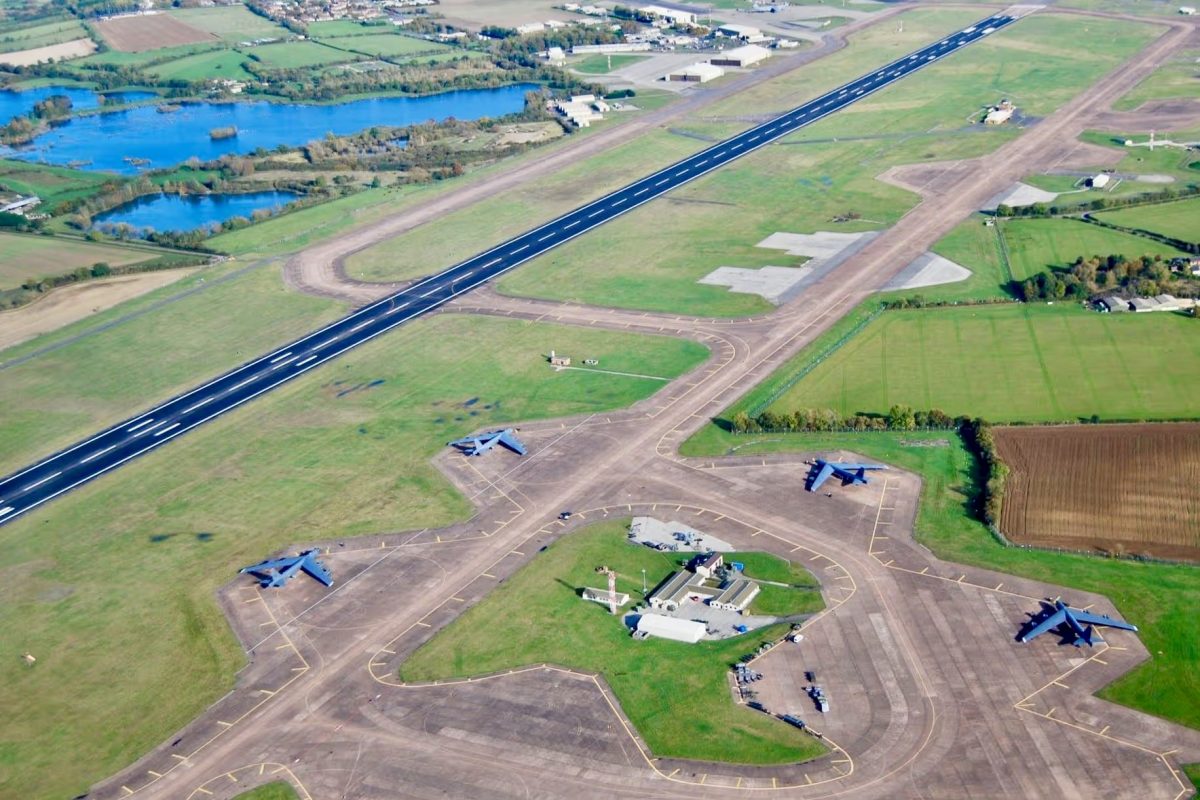
RAF Fairford had already been turned into a geopolitical bullseye.
The base has been used by US bombers during military operations against Iran.
In July, Iran’s Revolutionary Guard warned that any British base used to attack Iranian territory would be a legitimate target.
That warning makes the Iran theory plausible.
Plausible is not the same as proved.
British investigators initially said they were considering whether foreign-state proxies could be involved, including people who might knowingly or unknowingly be working for a foreign power.
Prime Minister Andy Burnham then said there were “strong indications” Iran had played a role.
Tehran responded with a categorical denial.
The Iranian embassy said it “categorically rejects and strongly condemns” attempts to connect Iran with the arrests.
The contest is now clear.
Britain says there are indications.
Iran says there is no connection.
The public still has not been shown the evidence that settles the argument.
Then America Moved the Bombers
That is the part that changes everything.
The US moved its B-1 bombers from Fairford after receiving what American officials described as threat intelligence.
Donald Trump said the move followed a threat and suggested those behind it were linked to Iran.
Marco Rubio was more guarded, saying there was no direct link between the bomber move and the suspected Iranian plot.
Two American officials separately told Reuters that fears of a possible Iranian drone attack had prompted the relocation.
So America acted as though the threat was serious.
That does not automatically prove the original five suspects were responsible.
It proves something else.
American intelligence judged that the risk to valuable aircraft had become unacceptable.
That is a major development.
But it still leaves open whether the threat came directly from the people arrested in Gloucestershire, from a wider Iranian network, from another hostile actor, or from intelligence that was only indirectly related to the arrests.
Six Men on Bail and the Political Revolt
Then came the decision that shocked Washington.
The first five suspects were released on police bail.
The sixth suspect was also later released on bail.
Trump criticised the decision.
British counter-terrorism police defended it.
Assistant Commissioner Laurence Taylor said it was an investigative decision based on experience and careful consideration of police powers.
That defence deserves attention.
Britain is not obliged to keep people behind bars merely because a case carries political weight.
Counter-terrorism investigations can involve sensitive intelligence, incomplete evidence and enquiries that continue long after an arrest.
The suspects remain under investigation.
They are not exonerated.
But they are not convicted terrorists either.
That distinction should not disappear simply because Washington is angry.
Britain’s Broader Iran Problem
Fairford is not happening in a vacuum.
Britain has been tightening its response to Iranian state activity.
In July, London designated the Islamic Revolutionary Guard Corps under the new National Security (State Threats) Act 2026. The legislation was created specifically to give Britain stronger powers against foreign-state organisations and proxy structures.
The government has also accused Iranian networks of supporting hostile activity in Britain and Europe.
Its state-threat factsheet says MI5 tracked more than 20 potentially lethal Iran-backed plots in 2025.
Britain’s terrorism threat level remains SEVERE.
So the suspicion surrounding Fairford does not come from nowhere.
But neither does suspicion become evidence merely because there is a hostile state with a known motive.
The Most Dangerous Possibility May Be the Simplest
Perhaps these men intended to attack RAF Fairford.
Perhaps investigators will eventually produce the devices, communications, instructions, payments and digital evidence that prove it.
Perhaps Iran will emerge as the source.
Or perhaps the final case will look very different.
Perhaps the vans were part of a reconnaissance operation.
Perhaps someone was testing the perimeter.
Perhaps the people involved were being paid without understanding the final purpose.
Perhaps there was a plan but no capability.
Perhaps there was a larger operation and the five men were only one part of it.
Perhaps the vehicles were intended to create chaos while something else happened elsewhere.
Or perhaps the entire incident turns out to be less than the geopolitical drama now surrounding it.
That is why the seventh arrest is important.
Not because seven arrests equal a terror network.
Because the seventh arrest suggests the investigation is still expanding.
The Question Britain Should Be Asking
The loudest argument around Fairford has been about Iran.
The more important question is about evidence.
What did investigators recover from the phones?
What communications were found?
Was there evidence of surveillance?
Was money transferred?
Were instructions issued?
Who knew whom?
Were the suspects connected before 27 September?
And why were three vehicles moving towards one of America’s most strategically important airbases in the first place?
Those are the questions that will determine whether this becomes one of Britain’s most significant foreign-state threat investigations of 2026 or a dramatic security scare whose evidence ultimately falls short of the political narrative.
For now, the facts are uncomfortable.
Seven men have been arrested.
Six remain on bail.
No explosive device has been publicly reported.
Petrol was found.
A strategically important US bomber fleet has been moved.
Iran denies involvement.
Britain suspects a foreign hand.
And counter-terrorism police are still trying to work out the motivation.
That is not a finished terror plot.
It is something more unsettling in its own way.
It is an unanswered investigation unfolding at the intersection of terrorism, foreign espionage, military vulnerability and great-power conflict.
Until investigators reveal the evidence connecting those dots, Britain has every reason to investigate Fairford aggressively.
It also has a duty not to confuse suspicion with proof.
Follow us on our broadcast channels today!
- WhatsApp: https://whatsapp.com/channel/0029VawZ8TbDDmFT1a1Syg46
- Telegram: https://t.me/atlanticpostchannel
- Facebook: https://www.messenger.com/channel/atlanticpostng