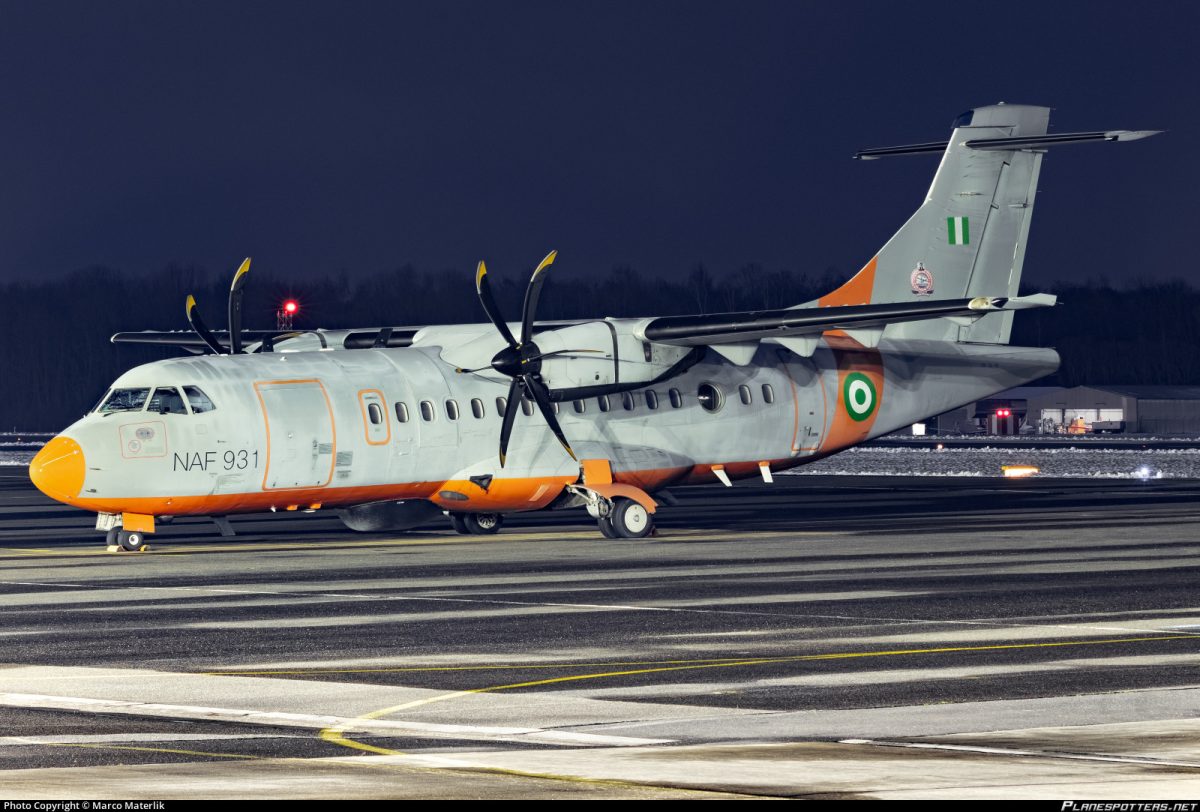
The Nigerian Air Force aircraft that crashed in Ondo had spent roughly 35 months undergoing maintenance in Germany before returning to service in late 2024. That history does not prove a mechanical failure. It does make the maintenance trail critical evidence.
The most important question after the Nigerian Air Force ATR-42 crash in Ondo may not be what happened in the final minutes of the flight.
It may be what happened to the aircraft during the nearly three years before it returned to Nigerian skies.
NAF 931, the aircraft identified by the Minister of Aviation and Aerospace Development, Festus Keyamo, as the military aircraft that disappeared from radar on Monday morning, had spent about 35 months in Germany for maintenance before returning to Nigeria in late December 2024. The aircraft crashed in the Igbokoda area of Ilaje Local Government Area, Ondo State, while on a routine mission from Benin to Lagos.
President Bola Tinubu has since mourned the personnel on board and ordered the Nigerian Air Force to investigate the cause of the crash. The Presidency said the aircraft was carrying 25 passengers and seven crew members.
“This is a painful moment for our Armed Forces and for the entire nation,” Tinubu said.
The significance of NAF 931’s maintenance history is not that a prolonged grounding automatically means the aircraft was unsafe.
It does not.
Aircraft can spend extended periods in heavy maintenance because of major inspections, component availability, structural findings, modifications, certification requirements or supply-chain problems. Age alone is not evidence of unserviceability.
The issue is different.
A 16-year-old military aircraft had an unusually long maintenance journey, returned to Nigeria only at the end of 2024 and was then operating a fatal mission less than two years later.
That creates a documentary trail investigators should now reconstruct in full.
What was found?
What was replaced?
What remained?
Who signed the aircraft back into service?
What post-maintenance tests were conducted?
And did everything that was supposed to be completed actually get completed?
Those questions are now part of the safety evidence surrounding one of Nigeria’s deadliest recent military aviation accidents.
The Aircraft At the Centre of the Inquiry
NAF 931 was not an ordinary transport aircraft.
It was one of two ATR-42-500MP maritime patrol and Intelligence, Surveillance and Reconnaissance aircraft acquired by Nigeria from Alenia Aeronautica, now part of Leonardo, under a contract signed in March 2007.
Contemporary defence reporting places the contract at about $73 million and says it covered two aircraft, pilot and operator training, logistics support, ground equipment and spare parts. Nigeria became the first export customer for the ATR 42 MP. The second aircraft, NAF 931, was formally delivered in Turin, Italy, on 29 March 2010.
That detail matters because the $73 million figure should not be interpreted as the purchase price of two bare airframes. It was a wider acquisition and support package.
The aircraft were designed to give Nigeria an airborne surveillance capability over a maritime environment where piracy, illegal bunkering, smuggling, pollution and other forms of criminal activity have long posed security problems.
The Nigerian ATRs were fitted with mission equipment including the ATOS airborne tactical observation and surveillance system, search radar and electro-optical sensors.
NAF 931 was operated from Benin by the 81 Air Maritime Group and was also deployed for military operations in the North-east.
In other words, the aircraft was not simply a passenger transport asset.
It was a national surveillance platform.
Its availability had operational value.
So did its maintenance.
The 35-Month Question
The clearest documented anomaly is the length of the aircraft’s German maintenance stay.
NAF 931 was sent to Rheinland Air Service, or RAS, in Mönchengladbach in January 2022.
It returned to Nigeria in late December 2024.
That is roughly 35 months.
Military Africa reported that the exact reason for the prolonged maintenance period had not been established publicly. Premium Times, in its review of the aircraft’s history after Monday’s crash, also reported that NAF 931 had gone to RAS in 2022 and returned in late 2024.
That timeline deserves to be compared with the history of its sister aircraft, NAF 930.
NAF 930 went to the same German facility in September 2019 after reaching 5,000 flight hours and undergoing the type’s major maintenance requirement.
The Nigerian Air Force said that work was originally expected to take six months.
The pandemic extended the schedule by another three months.
NAF 930 returned to Nigeria in July 2020.
The documented period was therefore roughly 10 months.
The first ATR PDM was conducted abroad because the NAF wanted to use RAS facilities and expertise while also exposing Nigerian engineers and technicians to the process. The Air Force described the aircraft as having been successfully reactivated.
NAF 931’s approximately 35-month stay was therefore more than three times the documented time NAF 930 spent at the same maintenance organisation.
That does not prove NAF 931 had a dangerous defect.
It does show that something substantially more complicated, delayed or prolonged occurred.
That “something” should now be part of the public record.
What Does a Three-Year Grounding Actually Mean?
This is where the crash investigation must resist the temptation to leap from chronology to causation.
A prolonged grounding can arise from many causes.
A major depot maintenance programme can uncover additional defects that require engineering assessment.
A component can be removed and await repair or replacement.
Parts can become difficult to source.
A repair may require specialist certification.
Military aircraft can also have unique mission systems that complicate maintenance compared with the commercial aircraft on which their airframes are based.
RAS itself specialises in heavy maintenance on ATR 42 and ATR 72 aircraft and says it has capabilities covering scheduled checks, modifications, structural work and component repairs. Its Mönchengladbach facility has multiple in-house component shops and non-destructive testing capability.
RAS has also stated that it is one of only three companies worldwide with ATR certification for flight-control repair and overhaul, including components such as landing flaps. ATR separately identifies RAS as an ATR maintenance network partner specialising in heavy maintenance of ATR aircraft.
That makes the German maintenance decision understandable.
It makes the duration more, not less, important.
If a specialist facility was selected because of its expertise, investigators should be able to determine exactly what work was commissioned, what additional findings emerged and what drove the prolonged delay.
The public should not have to infer that from aircraft-spotting photographs and scattered maintenance references.
The Photograph That Raises Another Question
Open-source photographs documented NAF 931 at Mönchengladbach during its long stay, including images showing the aircraft with an engine removed.
That photograph does not establish why the engine was removed.
It does not establish that the engine was defective.
It does not establish that the engine contributed to Monday’s crash.
But it demonstrates why the maintenance file matters.
Investigators should be able to establish the engine’s identity, its serial number, the work performed, the parts replaced, the reason for removal, the source of replacement or repaired components, and the certification attached to the completed work.
The same should apply to propellers, flight controls, landing gear, avionics and the aircraft’s special-mission systems.
A crash investigation that examines only the wreckage and not the aircraft’s maintenance history would leave out a critical part of its operational story.
The Money Trail Needs An Audit Too
The financial side of the maintenance story is another area where caution is necessary.
Reports citing aviation industry benchmarks have suggested that NAF 931’s long stay in Germany could have cost several million dollars.
A historical Aircraft Commerce guide for ATR 42/72 maintenance gives a much lower commercial benchmark for the first base-check cycle, while putting all-inclusive rotable support for a small fleet at around $25,000 per aircraft per month. It also places the exchange cost for an ATR 42-500 landing-gear set at about $240,000.
Those are useful benchmarks.
They are not an invoice for NAF 931.
A military ATR-42MP carries special surveillance equipment and may require work beyond the scope of a commercial passenger aircraft. That means any serious estimate must separate standard airframe maintenance from military mission-system maintenance, engineering work, specialist components, transport, storage and certification.
There is also an important arithmetic issue.
The itemised figures contained in the maintenance cost estimate supplied for this investigation produce a lower combined range of roughly $4.1 million and an upper range of about $6.0 million, depending on the assumptions used.
That does not independently establish a $7 million bill.
The higher figure could only be justified if there were additional costs not captured in the itemisation.
That is precisely why Nigeria should publish the actual numbers.
How much was contracted?
How much was paid?
Were there variations?
Were there supplementary contracts?
Were components procured separately?
Were exchange units used?
How much was spent on storage and preservation?
How much did the return-to-service process cost?
And were there delays linked to payment, procurement or approval?
Until those documents are produced, the dollar estimates should be treated as estimates rather than established expenditure.
The Question of What Was Signed Off
The most consequential document in the entire maintenance chain may eventually be the aircraft’s return-to-service certification.
The aircraft returned to Nigeria in late 2024.
That means there should be records showing what condition it was in when it left Germany and what acceptance process took place afterwards.
A serious investigation should be able to follow the chain from:
maintenance work order
to inspection findings
to component replacement
to technical sign-off
to ground testing
to flight testing
to release to service
to operational deployment.
That chain is especially important because NAF 931 was a military special-mission aircraft rather than a standard commercial ATR.
The mission equipment itself should form part of the inquiry.
Investigators should establish whether all mission-system modifications, electrical systems, sensors, antennas and avionics performed according to specification and whether their integration introduced any maintenance or operational issue.
The question is not only whether the engines were serviceable.
It is whether the entire aircraft, as configured for the Nigerian Air Force, was fit for the mission it was flying.
The Final Flight
The known sequence on Monday is stark.
The aircraft was travelling from Benin towards Lagos on what the Nigerian Air Force described as a routine mission.
Air traffic controllers lost contact at about 9:13 a.m.
The wreckage was later located in a swampy riverine area close to the Naval Base in Igbokoda.
Keyamo said:
“All efforts to raise the aircraft on radio proved abortive.”
The Nigerian Air Force said:
“The aircraft was on a routine mission from Benin to Lagos when the accident occurred.”
The crash location presents obvious investigative challenges.
A swampy site can complicate recovery.
Debris may be dispersed.
Water can affect some forms of evidence.
Access can be difficult.
The first hours after a crash are therefore crucial.
The wreckage must be secured.
Components must be tagged.
Flight recorders must be protected.
Engine and propeller damage must be documented before recovery changes the evidence.
Witness accounts must be recorded while memories are fresh.
And the aircraft’s maintenance records must be secured before any document can disappear, be altered or become difficult to obtain.
Then There Is the Flight Recorder
The Nigerian Safety Investigation Bureau has already offered to assist the Air Force with the recovery and analysis of flight-recorder data.
That could become one of the most important developments in the inquiry.
NSIB said it was prepared to deploy its Flight Safety Laboratory for the recovery, readout and analysis of flight data and cockpit voice recordings if the Nigerian Air Force formally requested its assistance.
That offer matters because the first confirmed facts about the flight are limited.
The aircraft lost communication.
The reason is unknown.
There is no established public finding yet showing whether the loss of radio contact was the result of an electrical problem, cockpit event, communications failure, rapidly developing emergency or something else.
Flight data can help reconstruct speed, altitude, engine parameters, warnings, aircraft configuration and pilot inputs.
The cockpit recorder can potentially reveal what the crew knew, when they knew it and what actions they took.
Until that evidence is analysed, almost every theory about the cause remains premature.
A Structural Problem With the Investigation
There is another issue that deserves public attention.
The NSIB is Nigeria’s independent transportation safety investigation body, but it cannot automatically take over an accident involving a military aircraft.
Section 42 of the Nigerian Safety Investigation Bureau (Establishment) Act 2022 states that the Bureau shall not investigate a transportation occurrence involving a military carrier without a written request from a relevant authority of the Nigerian Armed Forces.
The NSIB confirmed that position on Monday.
“This occurrence involves a military aircraft,” the Bureau said, adding that it would support the Air Force if formally invited.
This is not a claim that a military investigation cannot be competent.
It is a question of institutional independence.
The agency responsible for the aircraft is also the agency that controls the primary investigation unless it invites the civilian safety body to participate.
That structure is lawful.
It also means transparency will matter enormously.
If the NAF investigation is comprehensive, the public should eventually see a detailed factual account.
If independent technical support is used, that should be disclosed.
If flight-recorder analysis is conducted by NSIB, the chain of custody and technical findings should be clearly documented.
If foreign manufacturers or maintenance organisations are consulted, their roles should be stated.
Nigeria should not be left with a report that simply says “pilot error”, “technical fault” or “unknown” without showing the evidence that led investigators there.
What Investigators Should Be Looking For
The crash inquiry now needs to go beyond the wreckage.
It should reconstruct the aircraft’s entire final operational cycle.
The maintenance history should be examined alongside the flight log.
The investigators should identify the aircraft’s total hours and cycles at the time of the crash.
They should determine when its engines were last inspected, overhauled or replaced.
They should establish the condition and maintenance history of its propellers.
They should review outstanding defects and deferred maintenance items.
They should examine recurring defects recorded before and after the German maintenance period.
They should inspect technical-log entries from the aircraft’s return from Germany to the final flight.
They should examine whether there were abnormal indications on previous flights.
They should determine whether the aircraft underwent a post-maintenance acceptance flight and what abnormalities, if any, were found.
They should analyse the flight path, weather, terrain, radio communications and air-traffic-control data.
And they should compare Monday’s flight profile against normal operating patterns for the aircraft.
None of this assumes that maintenance caused the crash.
It establishes a proper investigative method.
The 2024 Return Is a Critical Date
December 2024 should now become one of the anchor points in the crash timeline.
Before that date, NAF 931 had spent almost three years in Germany.
After that date, the aircraft returned to Nigerian operations.
The question is what changed.
A full investigation should identify the precise maintenance scope completed in Germany and distinguish scheduled work from additional corrective work.
It should also establish whether any parts were still awaiting installation when the aircraft returned.
Military maintenance systems can involve complex supply chains, and the fact that an aircraft has physically returned to its home country does not by itself tell the public the extent of work actually completed.
That evidence should be made clear.
What the Public Record Establishes
The basic chronology is no longer seriously in doubt.
Nigeria acquired two ATR-42MP aircraft under a $73 million package agreed in 2007. NAF 931 was delivered in March 2010.
The aircraft operated for years in maritime surveillance and intelligence roles.
NAF 931 was sent to RAS in Germany in January 2022.
It returned to Nigeria in late 2024 after roughly 35 months.
The exact reason for the unusually long maintenance stay has not been publicly established.
The aircraft crashed in Igbokoda on 5 October 2026 while travelling from Benin to Lagos.
The Presidency said 25 passengers and seven crew members were involved and ordered a full investigation.
The cause of the accident has not been established.
Those facts are enough to justify scrutiny.
They are not enough to assign blame.
What Remains Unanswered
The unanswered questions are now more important than the speculation circulating online.
Why did NAF 931 remain in Germany for about 35 months?
What was the original maintenance scope?
What additional work was discovered?
Which major components were removed?
Were either engines overhauled or replaced?
Were propellers replaced or overhauled?
Were there mission-system defects?
What was the final maintenance bill?
Were there contract variations?
Did the aircraft pass a complete post-maintenance test programme?
Who signed the final release to service?
Were there technical-log warnings after its return?
When was it last inspected before Monday?
Were any defects deferred?
What did the crew report during the flight?
What do the flight recorder and cockpit voice data show?
And crucially, did the aircraft experience a failure before the crew lost contact, or did the loss of contact occur after another event had already compromised the flight?
Those are questions for evidence.
Not opinion.
The Paper Trail Could Matter as Much as the Wreckage
In major aviation accidents, investigators reconstruct not only the last minutes of an aircraft’s life but the system that put it into the air.
For NAF 931, that system stretches from a 2007 procurement agreement to a 2010 delivery, years of operational use, a 2022 departure for Germany, a prolonged maintenance period, a late-2024 return to service and a fatal flight on 5 October 2026.
That makes the maintenance documents more than administrative paperwork.
They are potential safety evidence.
The public does not yet know whether the German overhaul made NAF 931 safer, whether it exposed deeper structural problems, whether the long delay was caused by parts and logistics, or whether any issue remained unresolved after the aircraft returned.
The crash cannot answer those questions by itself.
The investigation can.
And the most important test of that investigation will not be how quickly it produces a cause.
It will be whether it can account, document by document and component by component, for the aircraft’s journey from Germany back into Nigerian service.
Follow us on our broadcast channels today!
- WhatsApp: https://whatsapp.com/channel/0029VawZ8TbDDmFT1a1Syg46
- Telegram: https://t.me/atlanticpostchannel
- Facebook: https://www.messenger.com/channel/atlanticpostng