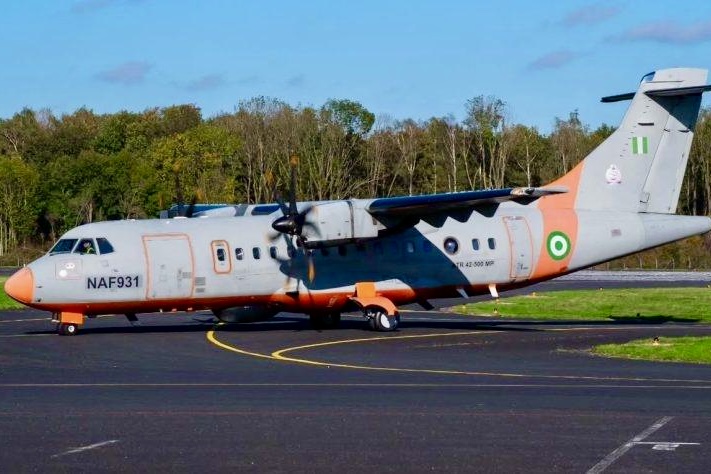
Fresh accounts say NAF 931 was grounded in Benin after an engine fault before the Ondo crash. What investigators must now establish is who cleared it to fly.
The most important moment in the NAF 931 crash may not have been when the aircraft vanished from radar over Ondo State.
It may have come several hours earlier, on the ground in Benin City.
Fresh accounts from people familiar with the aircraft’s final movement say the Nigerian Air Force ATR-42, NAF 931, developed an engine fault after flying from Abuja to Benin on Sunday, October 4, and was kept overnight at Benin Airport while technicians worked on it.
The aircraft then left Benin for Lagos on Monday morning.
Minutes later, it disappeared from air traffic control communications and crashed into the Obe-Rebby swamp in Igbokoda, Ilaje Local Government Area of Ondo State.
The reported engine problem has not been established by the Nigerian Air Force as the cause of the crash. Nor is there yet evidence showing that the reported repair failed.
But the disclosure fundamentally changes the question investigators need to answer.
It is no longer enough to ask why NAF 931 came down.
They must establish what happened between the alleged engine fault, the overnight maintenance and the decision to release the aircraft for its final flight.
The missing day in the official timeline
The Nigerian Air Force has consistently described the fatal flight as a routine mission from Benin to Lagos.
After the crash, NAF said the aircraft had 25 people aboard, comprising five crew members and 20 passengers. It later released the names of those on board and said no survivors had been found.
President Bola Tinubu ordered a thorough investigation into the cause of the accident and declared three days of national mourning.
The President said: “This is a painful moment for our Armed Forces and for the entire nation.”
He added that, following a briefing from the Chief of the Air Staff, he had directed that “an investigation would be conducted to determine the cause of the accident.”
There is nothing inherently contradictory about describing a flight as a routine mission simply because it was carrying people.
The problem is what the description leaves out.
Accounts reported on Wednesday indicate that the aircraft had not simply appeared in Benin for a Monday morning departure.
The reported movement was Abuja to Lagos, with passengers destined for Benin dropped off first.
One important correction is necessary. The original account referred to Sunday, October 5. October 5, 2026 was Monday. The preceding Sunday was October 4.
That matters because the sequence is central to any reconstruction of the aircraft’s final 24 hours.
An engine fault, then an overnight repair
SaharaReporters reported on Wednesday that people familiar with the flight said NAF 931 developed an engine fault after landing in Benin on Sunday.
One source told the publication that the aircraft had been expected to continue to Lagos but could not proceed after the technical problem emerged.
Another source, described as a military source, said technicians worked on the aircraft throughout Sunday.
“The technicians in Benin said they had fixed it,” the source said.
The same source said the aircraft spent the night in Benin and departed the following morning before crashing a few minutes after take-off.
A relative of one of the passengers separately told SaharaReporters that the passenger had informed the family that the aircraft had developed a fault in Benin and that he was waiting for it to be declared fit to continue to Lagos.
That account is significant because it does not come solely from a military insider.
It suggests that passengers or their relatives may have been aware of the technical problem before the final departure.
Yet it remains an account from sources, not an official technical finding.
That distinction is critical.
A mechanical fault the previous day does not automatically mean the aircraft was unsafe when it left Benin.
Aircraft routinely develop defects, undergo maintenance and return to service.
The forensic question is whether the fault was correctly identified, whether the corrective action was adequate and whether the aircraft was properly cleared for flight.
Who signed off NAF 931?
This may become the most important question in the investigation.
If the reported fault occurred, investigators should be looking for the aircraft’s technical log, the defect or “snag” entered after the Benin landing, the maintenance action taken, the parts or systems examined, inspection records, test results and the identity of the personnel who authorised the aircraft’s return to service.
They should establish whether an engine ground run was conducted.
They should establish whether the flight crew were briefed about the defect and the rectification.
They should establish whether any recurring warning or abnormal engine indication had been recorded before Sunday.
They should also compare the aircraft’s condition before departure with the final communications and radar information from Monday morning.
Those records matter more than speculation.
If the reported engine problem is ultimately shown to have no connection with the crash, the evidence should demonstrate that.
If investigators find a connection, the same paper trail should show precisely how.
At present, neither conclusion can responsibly be reached.
The Defence Headquarters has urged Nigerians to avoid speculation while the formal investigation proceeds.
That caution is justified.
It is also why the eventual investigation must be unusually transparent.
The “routine mission” question is more complicated than it sounds
Another issue raised by the fresh accounts concerns the purpose of the flight.
One source quoted by SaharaReporters questioned why the Air Force described the trip as a routine Benin-to-Lagos mission when some passengers had apparently boarded in Abuja.
The source also alleged that NAF 931 and its sister aircraft, NAF 930, were used to transport VIPs around Nigeria.
That allegation has not been independently established.
More importantly, the official description of the aircraft does not support a simplistic choice between “surveillance aircraft” and “passenger aircraft”.
The NAF’s two ATR-42 platforms have been used for intelligence, surveillance and reconnaissance, maritime patrol and limited transport duties.
Military Africa reported that the aircraft were operated from Benin by the 81 Air Maritime Group and routinely deployed with the 75 Strike Group in Yola.
The official record on NAF’s sister ATR, NAF 930, is even clearer.
When NAF received that aircraft back from major maintenance in Germany in 2020, the Air Force said the platform was intended to increase the availability of ISR aircraft for operations against insurgency and other criminality. NAF said the work was undertaken at Rheinland Air Service in Germany after the aircraft had reached 5,000 operating hours.
So carrying personnel does not, by itself, disprove the Air Force’s description of a routine military mission.
The real question is different.
What was NAF 931 scheduled to do?
Who were the passengers?
Why were they travelling?
What was the aircraft’s approved route?
And did the actual flight match its authorised operational task?
Those are documentary questions.
They should be answerable from flight plans, passenger manifests, operational orders and aircraft records.
The maintenance history that investigators cannot ignore
NAF 931 was not a new aircraft.
It was an ATR 42-500MP Surveyor, manufacturer serial number 800, and aviation records show a long history of overseas maintenance.
It was photographed at Edinburgh Airport in Scotland in 2013 during a maintenance visit.
It was later photographed at Rheinland Air Service in Mönchengladbach, Germany, where it spent a prolonged period undergoing maintenance.
Here the public record contains an important discrepancy that the Air Force should clarify.
Military Africa reported that NAF sent NAF 931 to Germany in January 2022 and that the aircraft returned to Nigeria in late December 2024 after almost four years at the facility.
But an aviation photograph dated January 25, 2021 places NAF 931 at Mönchengladbach much earlier.
The ICIR likewise reported aviation records placing it at the facility in January 2021, with photographs showing components including the right engine removed.
This does not prove anything went wrong.
It does raise a basic documentary question:
When exactly did NAF 931 enter maintenance, what work was authorised, and why did the aircraft remain there for such an unusually long period?
The ICIR found that NAF 931 was still at Mönchengladbach in September 2024 and returned to Nigeria in late December 2024.
The publication also stressed that the prolonged stay, by itself, does not establish that the aircraft was defective or that maintenance caused the crash.
That distinction should remain at the centre of this investigation.
A long grounding is not evidence of an unsafe aircraft
Aircraft can remain in service for decades when maintenance, inspections and component replacement are properly managed.
Nor does a major maintenance visit mean an aircraft is permanently safe once it leaves the workshop.
What matters is the continuing maintenance chain.
That is why the most valuable evidence may now be found in documents few members of the public will ever see.
Investigators need the complete maintenance history of NAF 931 from its return to Nigeria in December 2024 to the night before the crash.
They need scheduled inspection records.
They need unscheduled defect reports.
They need engine and propeller maintenance records.
They need component replacement histories.
They need records of deferred defects, where applicable.
They need the aircraft’s most recent airworthiness and serviceability releases.
And they need the documentation generated in Benin on Sunday, October 4.
The critical issue is not whether NAF 931 had a long maintenance history.
It did.
The critical issue is whether the maintenance history was being translated into safe operational decisions.
The dollar figures need proof too
Claims have circulated that the prolonged German maintenance period could have cost millions of dollars.
SaharaReporters published estimates putting the potential total between $4.5 million and $7 million, based on assumed costs for maintenance, parts, hangarage, rotables and other expenses.
Those figures should not be presented as an established government expenditure.
NAF has not publicly disclosed the actual maintenance bill.
There is a straightforward way to settle the issue.
Release the contract.
Release the approved work scope.
Release variations and change orders.
Release invoices and payment schedules.
Release records showing which components were replaced or overhauled.
The financial trail should be treated as evidence, not as an argument.
The same principle applies to the alleged overnight repair in Benin.
There should be a maintenance record.
There should be a sign-off.
There should be an identifiable chain of responsibility.
The swamp is now part of the evidence
The crash site presents another problem.
The aircraft came down in extremely difficult terrain near Igbokoda, with much of the wreckage submerged in swamp and mangrove terrain.
Recovery teams have been working with divers, security agencies, local authorities and specialised equipment.
On Wednesday, the military expanded the operation with sonar equipment, drones and amphibious access machinery to locate and recover the submerged aircraft.
Ondo State Governor Lucky Aiyedatiwa visited the site on Wednesday and said the main wreckage had not yet been located, with the aircraft believed to be deeply submerged.
The state deployed two amphibious swamp machines to improve access.
That is more than a rescue problem.
It is an investigation problem.
Every hour that major wreckage remains underwater can make the recovery of critical components, instruments and other evidence more difficult.
That makes the recovery operation part of the accident investigation itself.
The contradiction that investigators must resolve
By Wednesday, the public record contained two different levels of certainty.
The Nigerian Air Force had confirmed that all 25 people on board died.
Yet the physical recovery of the aircraft and victims was still incomplete.
Police officers at the scene reported seeing body parts and clothing while much of the wreckage remained inaccessible beneath the swamp.
The distinction matters.
The death toll is an official personnel count.
The recovery operation is a physical evidence exercise.
One does not replace the other.
The final identification of remains, recovery of the main wreckage and examination of the aircraft should therefore proceed with the same care expected of any major aviation investigation.
What the investigation must establish
There are several questions now hanging over NAF 931.
What exactly was the reported engine fault in Benin?
When was it detected?
Who diagnosed it?
What work was performed?
Which components were removed, tested or replaced?
Who certified the aircraft fit for flight?
Was a post-maintenance test conducted?
What information was passed to the crew?
What was the aircraft’s exact departure weight and configuration?
What were the weather conditions?
What did the crew say in the final minutes of flight?
What did air traffic control record?
What does the radar track show?
What do the flight recorders, where fitted and recoverable, show?
And why did an aircraft that had reportedly undergone major maintenance less than two years earlier require an overnight engine intervention immediately before its final flight?
That last question is not an accusation.
It is simply the question the evidence must answer.
The danger of an investigation that stops at “pilot error”
Nigeria has experienced repeated military aviation accidents in recent years, and the latest crash comes amid renewed calls for stronger military aviation safety oversight. A Punch analysis published on Wednesday counted at least 10 military aircraft crashes between 2021 and October 2026, with dozens of deaths.
That wider record makes the NAF 931 investigation more important than one aircraft.
A credible inquiry should not begin with a preferred explanation.
It should work backwards from evidence.
If the cause was mechanical, the public should know.
If it was operational, the public should know.
If it involved weather, human factors, maintenance or a combination of failures, the public should know.
And if no single cause can be established, that should also be said plainly.
The worst outcome would be an investigation that produces a conclusion without reconstructing the decisions that placed NAF 931 in the sky that morning.
President Tinubu has already ordered a thorough investigation, while Defence Headquarters has confirmed that an inquiry will determine the cause of the accident.
Now the burden shifts to the investigators.
The swamp has hidden the aircraft.
It must not be allowed to hide the paper trail.
The central question is no longer simply why NAF 931 crashed.
It is why everyone involved believed it was safe to fly after the events in Benin — and what evidence supported that decision.

Join the debate; let's know your opinion.