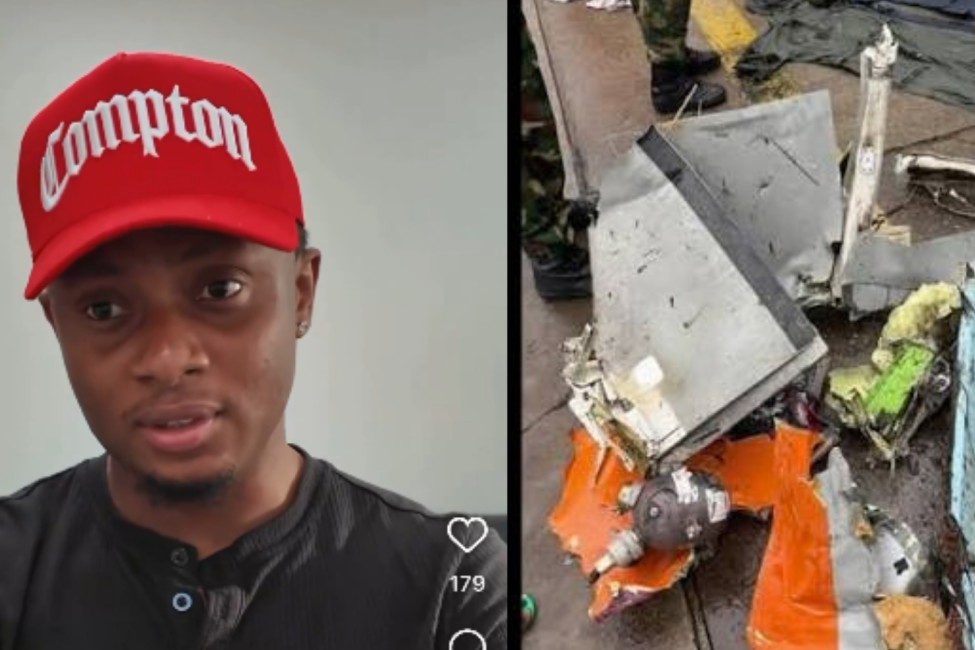
A Nigerian Air Force sergeant’s final messages, her brother’s allegations and the aircraft’s maintenance history have intensified scrutiny of the fatal Ondo crash. The investigation must establish what happened in Benin City, who authorised the aircraft’s departure and whether every necessary safety check was completed.
The most troubling question surrounding the Nigerian Air Force aircraft that crashed in Ondo State may have been waiting in a family member’s phone before the tragedy happened.
A sergeant serving in the Nigerian Air Force allegedly told her brother that the aircraft carrying her had developed a technical problem and stopped in Benin City, Edo State, for repairs. According to him, their final exchanges included a request for money and a conversation about the aircraft’s condition.
Days later, she was among 25 people killed when the Air Force ATR-42 aircraft, designated NAF 931, crashed near the naval base at Igbokoda in Ilaje Local Government Area of Ondo State on Monday, 5 October 2026.
Her brother is now demanding answers from the institution his sister served for more than 11 years. He alleges that the military has downplayed the circumstances surrounding the flight and is attempting to manage public perceptions of the disaster.
“There is damage control everywhere,” he said in a video circulating on social media.
The allegation is serious, but it is not yet proof of a cover-up. Whether the aircraft developed a fault, whether repairs adequately addressed it and whether the aircraft was safe to fly remain questions for investigators to resolve.
What makes the brother’s account particularly significant is his claim that he possesses messages exchanged with his sister before the crash. He says he is prepared to provide them to investigators alongside other material gathered after the incident.
Those records, if authenticated and corroborated by technical evidence, could help establish what the crew knew, what was communicated to personnel on the ground and what decisions were made before the aircraft took off from Benin.
The central issue is no longer simply what caused NAF 931 to crash. It is whether investigators can reconstruct the decisions that preceded its final flight and give grieving families an account supported by evidence rather than assurances.
The final messages that could change the investigation
According to the bereaved brother, his sister told him that NAF 931 had experienced a technical problem during its journey from Abuja towards Lagos and had stopped in Benin City on the night before the crash.
He alleged that the aircraft could not immediately continue its journey and that the personnel had to wait while technicians worked on it.
The brother said he received a request for money from his sister during this period.
“I have evidence that this aircraft was coming all the way from Abuja. It stopped in Benin on Sunday night so that it can be fixed,” he said.
He continued: “And it was unfixable because my sister told me on that call that she does not know what was wrong with this aircraft. I should just send her money, and I sent her money immediately.”
He claimed that the transfer was completed approximately five to 10 minutes before the aircraft departed, raising the question of how much time was available between the final exchanges and the resumption of the flight.
That interval is an allegation requiring verification against banking timestamps, telephone records and the aircraft’s recorded movement. It does not independently establish when the decision to depart was made or whether the flight crew knew of an unresolved defect.
The distinction matters. An aircraft may experience a technical fault, undergo repairs and be cleared to fly if the fault is properly diagnosed and rectified under the applicable maintenance procedures. Conversely, a departure following maintenance does not establish that the repairs were adequate.
Investigators must establish which of those circumstances, if either, applied to NAF 931.
The most important evidence will include the aircraft’s technical logbook, the original defect report, engineering work records, details of any components replaced or adjusted, and the certification or release authorising the aircraft to return to service.
Investigators should also establish whether the crew conducted the required pre-flight checks, whether the defect recurred and whether any warnings or abnormalities were recorded before take-off.
The brother’s messages could provide an important lead. They cannot, by themselves, determine the technical cause of the crash.
Abuja, Benin, Lagos: What happened before the final take-off?
The Nigerian Air Force initially described the aircraft as being on a routine mission from Benin City to Lagos when the accident occurred.
Its statement, issued after the crash, did not establish the aircraft’s full journey during the preceding day.
A subsequent report by SaharaReporters, published on 7 October, cited sources who said NAF 931 had travelled from Abuja to Benin City before developing an engine problem. The sources alleged that technicians worked on the aircraft overnight before it departed for Lagos the following morning.
That account broadly reflects the sequence described by the sergeant’s brother.
The two descriptions of the route are not necessarily mutually exclusive. An aircraft that begins a journey in Abuja, stops in Benin and subsequently departs for Lagos could accurately be described as operating the final leg from Benin to Lagos.
The outstanding issue is whether the public account adequately reflects the events preceding that final leg.
The military needs to establish the aircraft’s complete movement history, including its departure from Abuja, arrival in Benin, time spent on the ground, engineering inspections and final departure.
Flight plans, operational orders, air traffic control records, crew reports and maintenance documentation could help reconcile the different accounts.
Investigators should also establish who was responsible for determining that the aircraft could continue its journey. That requires more than identifying the last person to authorise a departure. It means reconstructing the safety decisions and confirming that each person involved acted within the applicable procedures.
The brother posed the question directly to the Air Force leadership, including Chief of the Air Staff, Air Marshal Sunday Kelvin Aneke.
“Who gave that command for them to manage the aircraft to Lagos?” he asked.
It is a question investigators should answer through documentary evidence. It should not be treated as proof that any particular commander ordered an unsafe flight.
NAF 931’s maintenance history raises further questions
The investigation also needs to examine the aircraft’s longer maintenance history.
An investigation by the International Centre for Investigative Reporting, published on 6 October, found that NAF 931 had spent almost four years at Rheinland Air Service, an aircraft maintenance facility in Mönchengladbach, Germany.
Aviation records reviewed by the organisation indicated that the ATR 42-500MP aircraft arrived at the facility in January 2021. It remained there for more than three years and returned to Nigeria in late December 2024.
The ICIR reported that photographs and aviation records showed several components, including the aircraft’s right engine, removed during its time at the facility.
That history is relevant to the investigation, but it must be interpreted carefully.
A prolonged maintenance period does not, by itself, demonstrate that an aircraft was unsafe when it returned to service. Nor does the removal of an engine prove that the same component later caused an accident.
The important questions concern the scope of the work undertaken, the defects identified, the parts repaired or replaced and the checks completed before the aircraft returned to operational service.
Investigators should compare the aircraft’s maintenance records in Germany with its subsequent operating history in Nigeria. They should establish whether any significant defects recurred after its return and whether the reported Benin incident, if confirmed, was connected to a previous fault.
They should also examine whether the maintenance programme and subsequent inspections complied with the relevant technical requirements.
The public needs evidence-based answers, not a presumption that the aircraft’s earlier maintenance difficulties caused the crash.
What investigators must establish about the alleged fault
The brother says he is willing to submit his sister’s messages and other evidence to investigators. That offer creates an opportunity to establish a detailed timeline.
At least five strands of evidence deserve particular attention.
First, the original defect report. Investigators should establish what malfunction was reported in Benin, when it occurred, whether it affected an engine or another system, and what the crew and engineers recorded.
Second, the repair and release documents. The inquiry needs to identify the work performed, the personnel responsible, the tests carried out and the basis on which the aircraft was considered fit to continue its journey.
Third, the departure decision. Investigators should examine the operational and engineering approvals, the crew’s assessment of the aircraft’s condition and any communication concerning outstanding technical concerns.
Fourth, the aircraft’s recorded performance. The flight data available from onboard systems, relevant electronic records and recovered components should be examined alongside the wreckage. The extent to which such data can be recovered will depend on the condition of the equipment and the evidence preserved at the crash site.
Fifth, the final flight. Investigators should reconstruct the aircraft’s departure, its brief period in the air and the sequence leading to impact. Witness accounts are important, but conclusions about the cause should be grounded in technical findings.
These lines of inquiry must be considered together. A fault reported before take-off could be relevant, but investigators must still establish whether it existed, how it was addressed and whether it contributed to the accident.
The wreckage, maintenance records and communications may tell different parts of the same story.
The Air Force has promised a thorough investigation
Air Marshal Aneke visited the crash site in Igbokoda on Thursday, 8 October, as recovery and investigative operations continued.
The Air Force announced a high-level panel comprising military and civilian aviation safety experts, representatives of the Nigerian Safety Investigation Bureau, accident and emergency management authorities, retired senior military officers and experienced Air Force personnel.
Aneke said the inquiry would establish the circumstances surrounding the accident.
“This is not the time to start speculating, and I plead with you, the general public,” he said. “We’ve lost people who are fighting for the nation.”
He added that the Air Force would “leave no stone unturned” in determining the cause of the crash.
Those assurances establish the service’s stated position. The credibility of the process will ultimately depend on the evidence examined, the questions pursued and the findings disclosed.
There is also an important institutional issue to resolve.
On 5 October, the Nigerian Safety Investigation Bureau said it would not investigate the military aircraft crash directly unless formally invited by the military authority, explaining that military aviation accidents fell outside its statutory mandate. The bureau said it was prepared to provide technical assistance, including support with recovering and analysing flight data and cockpit voice recordings.
The Air Force subsequently said representatives of the NSIB would be included in its high-level panel.
The NSIB’s reported inclusion is relevant, but the precise role it will play needs to be clear. Will its experts have access to all relevant evidence? What technical work will they undertake? How will their findings be documented? And will the final report explain any differences of opinion among investigators?
These questions do not establish that the panel lacks independence or that the military is withholding evidence. They identify the safeguards and disclosures that would help the public assess the inquiry’s credibility.
A second crisis: Families say they are waiting for answers
The tragedy has produced a crisis beyond the crash investigation itself.
The brother said that, despite being his sister’s next of kin, he had received no meaningful information from the Air Force about the recovery of remains, the investigation or arrangements for affected families at the time he recorded his video.
“Meanwhile, it’s five days and I am the next of kin. I’ve not gotten any information. I’ve not gotten any news. Nothing from you guys,” he said.
He was also struggling to console their mother, for whom his sister was the first child.
“My sister is the best thing that ever happened to me,” he said.
His anguish is not unique to his family. On 10 October, Punch reported that families of other victims were still awaiting the recovery of remains and, in some cases, meaningful updates from the authorities.
The Air Force said during its 8 October site visit that recovery teams were working in difficult terrain of thick mangroves, murky water and deep mud. It also said that investigators were seeking to retrieve aircraft components that could help establish the cause of the accident.
Those challenges are significant. They do not remove the need for consistent communication with families.
The military should provide designated family liaison officers, regular updates on recovery efforts and clear information about what can and cannot yet be established. Families should not have to rely on circulating videos, unofficial messages or media reports to learn the status of an investigation involving their relatives.
That obligation is especially important when the victims include military personnel whose families depend on the institution for official information.
The welfare allegations deserve scrutiny, too
The brother’s account raises concerns about the financial circumstances of his sister, who he says had served for more than 11 years.
He alleged that she had less than ₦17,000 in her bank account shortly before the crash and that her annual income was approximately ₦3.5 million or less.
“How does a sergeant in the Nigerian Air Force not have ₦17,000 in their account?” he asked.
He also alleged that salaries were not always paid consistently and claimed that the previous month’s salary remained unpaid when he recorded the video.
These allegations have not been independently substantiated by payroll records or official remuneration data. The amount in an individual’s bank account at a particular time does not, on its own, establish the adequacy of their salary or the regularity of their payments.
Nevertheless, the concerns merit a separate response from the authorities.
The Air Force should clarify the relevant salary payment arrangements, the welfare support available to serving personnel and the benefits payable to the dependants of those killed while on duty. If payroll irregularities are alleged, documentary evidence should be examined rather than allowing the claims to remain unresolved.
The welfare issue should not be conflated with the technical investigation. An officer’s financial difficulties cannot establish the cause of an aircraft crash. Equally, the fact that a service member was on duty does not make questions about remuneration and family support irrelevant.
Both issues concern the institution’s responsibilities to the people who serve in it and to the families who bear the consequences when tragedy strikes.
What accountability should look like
The immediate task is to establish why NAF 931 crashed. The wider responsibility is to ensure that any safety failures identified by investigators are addressed.
That requires an inquiry capable of distinguishing between a fault that was properly repaired, a defect that remained unresolved, a malfunction that developed unexpectedly in flight and any other factors that may have contributed to the accident.
It also requires the authorities to identify the limits of what the available evidence can establish. Where a record is missing, an explanation should be provided. Where an allegation is not substantiated, that should be stated. Where a safety breach is identified, the relevant authorities should explain the corrective action and any further proceedings that follow.
The brother has offered to provide the messages he says he exchanged with his sister. Investigators should preserve and authenticate any material submitted, assess it alongside technical evidence and document how it informs their conclusions.
The Air Force, for its part, should make the investigation’s terms of reference clear, explain the roles of participating agencies and publish its findings when the process permits. It should also communicate with the bereaved families without requiring them to make public accusations to obtain updates.
The brother has not proved that the Air Force covered up a mechanical fault. But neither can his allegations be dismissed merely because an official investigation has been announced.
His questions are capable of being tested against records, testimony and technical evidence. That is precisely why they deserve a clear response.
Twenty-five people died on NAF 931. Their families are entitled to know what happened, what the authorities knew before the aircraft took off and whether any decisions or failures contributed to their deaths.
The most credible answer will not be a promise that nothing was overlooked. It will be an evidence-backed account showing what investigators examined, what they established and what must change to reduce the risk of another tragedy.
Follow us on our broadcast channels today!
- WhatsApp: https://whatsapp.com/channel/0029VawZ8TbDDmFT1a1Syg46
- Telegram: https://t.me/atlanticpostchannel
- Facebook: https://www.messenger.com/channel/atlanticpostng

Join the debate; let’s know your opinion.