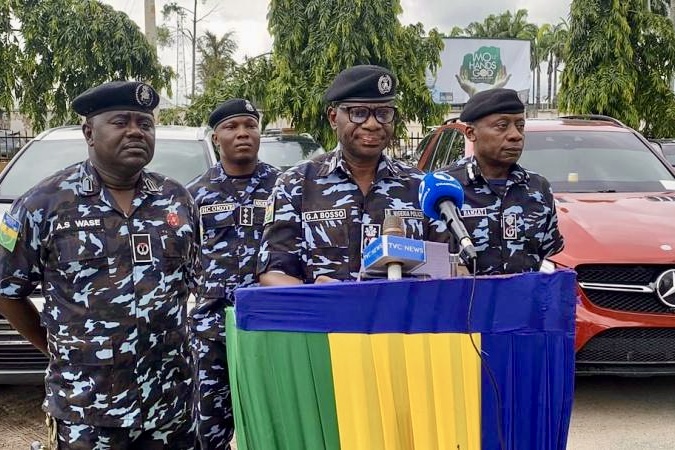
Police say sustained security pressure forced kidnappers to release the captives. A victim’s family says it raised and delivered N6 million in ransom. Both accounts cannot fully explain the same release.
The 20 prospective National Youth Service Corps members abducted on their way to orientation camps in Imo State are home.
That should have been the end of the story.
Instead, their release has opened a more troubling question.
Were they rescued by security forces, released under pressure from the kidnappers, or freed after families paid ransom?
The Imo State Commissioner of Police, Audu Bosso, says security agencies did the job.
He says police, military, the Department of State Services and the Nigeria Security and Civil Defence Corps mounted a sustained operation, combed the forest and put enough pressure on the kidnappers to make them release the captives.
Asked directly whether ransom was paid, Bosso gave an answer that was less categorical than the headline now circulating.
“To my knowledge, no,” he said. “I am not aware whether a ransom was paid.”
Hours earlier, a mother of one of the abducted graduates had provided a strikingly different account.
Alirat Wahab said her family raised N6 million, after the kidnappers reduced their demand from N50 million per victim, and sent relatives to Imo State with the money. She said the money was converted into US dollars before it was taken to the abductors.
Her husband went further.
“The parents gathered that money together,” he said, insisting that their family contributed N6 million while some other families paid N5 million.
Then came the accusation directed at the government’s position: “They lied!”
This is no longer simply a kidnapping story.
It is now a story about who controls the facts after a rescue, who gets to define success and whether families can believe official accounts when their own experience tells them something different.
The seven-day ordeal
The prospective corps members were travelling from Ibadan, Oyo State, towards NYSC orientation camps in Abia and Akwa Ibom when gunmen attacked two buses along the Owerri-Onitsha Road around Umunoha in Mbaitoli Local Government Area on October 1.
The police said the attack occurred at about 6:30am.
The two buses were travelling towards Bende in Abia State and Uyo in Akwa Ibom State. The attackers took passengers into the surrounding bush. The police initially said 10 victims had been rescued at the scene while the exact number of those abducted was still being verified.
As the days passed, the number at the centre of the operation settled at 20 prospective corps members.
Then the money demands emerged.
Relatives told the media that the kidnappers initially demanded N50 million for each victim, potentially putting the total demand at about N1 billion.
The demand was later reduced following negotiations.
PUNCH reported that the total demand was eventually reduced to N100 million for the 20 victims, while other reports carried different figures as negotiations continued.
That variation matters.
Kidnappers rarely operate like transparent businesses. Their demands change according to time, perceived pressure, access to victims and the ability of families to raise money.
The initial figure is often less important than the eventual amount actually paid.
And that is precisely where the Imo story has become difficult to reconcile.
The police found the kidnappers’ camp
Before the captives were released, Bosso said security agencies had found the suspected camp.
The breakthrough came through intelligence and drone surveillance.
But locating the camp did not mean security forces could simply storm it.
Bosso said the intelligence indicated that the area had been planted with improvised explosive devices.
“The drone actually showed us exactly their location,” he said, adding that the reported IEDs prevented an immediate advance.
Security agencies then prepared additional equipment, including bulldozers and armoured personnel carriers, according to the police account.
The tactical dilemma was obvious.
A direct assault could kill the very people the operation was designed to save.
That detail gives the official account a degree of operational logic.
If the camp was genuinely mined, a slower containment strategy could have been safer than a dramatic raid.
But it also creates another question.
If security agencies already knew where the victims were, why were they still in captivity when the families say ransom negotiations were taking place?
There is no public answer yet.
Then, on October 7, everyone was suddenly free
The Nigeria Police Force announced on October 7 that the 20 prospective corps members had been rescued at Amakohia Ubi Village in Owerri West Local Government Area.
The Force said the operation followed sustained search-and-rescue efforts involving sister security agencies.
It also said the victims were taken for medical assessment and necessary care, while efforts continued to arrest those responsible.
The Voice of Nigeria reported that the rescue occurred at about 4:28pm local time.
The victims were subsequently taken for medical attention.
A separate account said another abducted person was also released with them.
For the authorities, it was an operational success.
For the families, it was something more elemental.
Their children were alive.
The NYSC Director-General, Brigadier General Olakunle Oluseye Nafiu, visited the freed graduates at the DSS facility in Owerri alongside the Imo police commissioner, the state DSS director and the commander of the 34 Artillery Brigade.
Governor Hope Uzodimma praised the security agencies and the cooperation between the Imo and Oyo governments.
He also explained why little information had been released while the victims remained in captivity, saying authorities deliberately kept operational details out of the public domain because human lives were at stake.
That explanation is reasonable.
But it does not settle what happened during the final hours.
The family account is remarkably specific
The most consequential challenge to the official narrative has come from inside the victims’ families.
Wahab did not merely say money was discussed.
She described a chain of events.
According to her, the kidnappers initially demanded N50 million for each child.
The families pleaded.
The demand fell to N5 million, she said, before being raised again to N15 million.
Her family ultimately agreed to N6 million.
“They insisted on N6m,” she said.
Raising the money itself became another ordeal.
Wahab said relatives, friends and other contributors provided N5,000, N20,000, N50,000 and other amounts. The family borrowed the balance.
The money was collected through an account belonging to her sister, she said.
Then came the most striking part.
She said representatives of the families travelled to Imo State, where they were instructed to convert the money into dollars before handing it over.
Her elder son was among those who travelled.
After the money was delivered, she said, he called to tell the family that the children had been handed over.
The International Centre for Investigative Reporting independently reported the same central allegation after interviewing the family, saying Wahab told News Central that N6 million was paid to secure her son’s release.
That does not prove that every abductee was released in exchange for ransom.
It does, though, make it impossible to responsibly write the ransom allegation off as social-media speculation.
At least one family has gone on record describing an actual payment and a delivery process.
The key distinction the public needs
There is an important difference between saying:
“The victims were rescued by security agencies.”
and saying:
“The kidnappers released the victims because of security pressure.”
There is also a difference between:
“The police did not pay ransom.”
and:
“No ransom was paid.”
Bosso’s wording is significant.
He did not say no family paid ransom.
He said he was not aware that any ransom had been paid.
That leaves an important gap between institutional knowledge and what may have happened outside the command structure.
His fuller explanation was that the joint security operation “galvanised” resources, combed the bush and eventually put enough pressure on the kidnappers to release the prospective corps members.
There is no contradiction in the possibility that security pressure and ransom negotiations occurred simultaneously.
A kidnapper can release a hostage because armed forces are closing in.
A family can still pay money to hasten that release.
Both can be true.
What remains unverified is whether that is what happened here.
The unanswered question is not only “Was ransom paid?”
It is more complicated.
Who negotiated the release?
Who communicated with the kidnappers during the final stage?
At what point did the captors agree to release the victims?
Were any of the families paying money while security agencies were simultaneously preparing an intervention?
Did the kidnappers abandon the camp because of military pressure, or did they collect money and then release the captives?
Did the security agencies physically enter the camp, or did they recover the victims after the abductors had already moved or surrendered them?
The police have not publicly provided that chronology.
The families have provided fragments.
The kidnappers, obviously, have provided none.
That leaves a crucial evidentiary gap.
What happened to the kidnappers?
There is another piece missing from the victory narrative.
The police say efforts are continuing to apprehend those responsible.
That means the operation produced the captives but, at least publicly, has not yet produced the kidnappers.
The Force’s October 7 statement said efforts were ongoing to bring the perpetrators to justice.
This matters because rescuing hostages without dismantling the network that abducted them does little to change the economics of the next kidnapping.
If those behind the attack are still free, the operation may have saved 20 young Nigerians without actually degrading the criminal system that targeted them.
That should be the next security objective.
The ransom economy makes this dispute bigger than Imo
Nigeria’s kidnapping problem has become increasingly commercial.
A recent SBM Intelligence assessment found that 7,825 people were abducted in Nigeria between July 2025 and June 2026 in 1,713 kidnapping and related incidents.
At least 1,142 people were killed.
The researchers estimated that about N22.9 billion was demanded in ransom and approximately N7.78 billion was actually paid, producing a collection rate of roughly 34 per cent.
That was a sharp increase from the previous reporting cycle.
Reuters, reporting on the same research, described ransom kidnapping as a growing source of criminal finance with consequences for education and public confidence in government.
The Imo case therefore sits inside a much larger national problem.
A kidnapping may begin with a gun on a highway.
The real transaction begins later.
It happens in bedrooms where parents sell property.
In WhatsApp groups where relatives borrow money.
In bank accounts where friends send emergency contributions.
And, according to the Wahab family’s account, in journeys to another state to convert money into dollars for delivery to criminals.
That is the underground economy Nigeria has to defeat.
The human cost is larger than N6 million
For Wahab, the N6 million was not simply a figure.
It was the price her family believed it had to find to keep a son alive.
She described borrowing, receiving contributions and being unable to sleep during the ordeal.
Her family’s story is a reminder of how kidnapping shifts the burden of national insecurity onto individual households.
The state owns the weapons.
The kidnappers own the forests.
But the family owns the bill.
That is why the question of ransom cannot be treated as a public-relations detail.
It goes to the heart of whether Nigeria’s anti-kidnapping strategy is actually changing the incentives of the criminals.
Government secrecy can protect an operation. It can also create suspicion.
Uzodimma was right about one thing: authorities cannot broadcast the movements of an ongoing hostage-rescue operation.
Doing so could put lives at risk.
But secrecy should have an expiry date.
Once the victims are safe, the public should be told enough to understand what happened.
That does not require revealing tactical methods, intelligence sources or classified capabilities.
It requires a basic timeline.
When were the victims located?
When did negotiations occur?
Did security forces establish physical control over the area?
Were the abductors fleeing?
Were any suspects identified?
Were any weapons or explosives recovered?
Was ransom money paid by families?
Did the government know?
The answers would help determine whether this was an exemplary intelligence-led rescue or another example of families quietly negotiating with criminals while official agencies take public credit for the outcome.
At present, the evidence does not justify either extreme conclusion.
The police have strengthened the highway
Bosso says the Inspector-General of Police has deployed additional tactical teams, mobile police personnel and intelligence-response teams to Imo.
He said the deployments are intended to secure the road where the abduction occurred as well as other identified flashpoints.
“We’ve fortified access,” Bosso said, extending the assurance beyond the affected stretch of road to wider high-risk areas.
That is necessary.
But the incident exposes an obvious weakness.
The two buses were carrying young Nigerians travelling to fulfil a national civic obligation.
They were not entering a war zone.
They were travelling on a major inter-state highway.
The fact that 20 prospective corps members could be taken from that corridor raises questions that go beyond their rescue.
Why was the route vulnerable?
What intelligence existed about kidnapping activity on the corridor?
Were transport operators warned?
Was there regular police patrol coverage?
Were the buses travelling at a predictable time?
Did the criminals exploit a known security gap?
These are the questions that could prevent the next convoy of graduates from becoming another bargaining chip.
A rescue is not complete until the truth is complete
The most comforting version of this story is simple.
Security agencies found the kidnappers, applied pressure and saved 20 young Nigerians.
The most disturbing version is equally simple.
Families raised millions, delivered ransom and their children came home.
The available evidence does not allow either version to be declared the whole truth.
What is clear is that the victims were abducted on October 1 and freed on October 7.
What is clear is that security agencies identified a suspected hideout.
What is clear is that police say the location was reportedly mined with IEDs.
What is clear is that the police have attributed the release to sustained security pressure.
And what is now also clear is that at least one victim’s family says it paid N6 million to secure a child’s release.
The next step should not be another celebration.
It should be reconciliation of the evidence.
The Nigeria Police Force, Imo State Government and other agencies involved in the operation have an opportunity to do something more valuable than claim victory.
They can explain how the victory happened.
Because Nigerians do not merely need to know that their children can be brought home.
They need to know what it takes to bring them home — and whether the price of their freedom is quietly financing the men who will kidnap the next group.
Investigative Findings
Confirmed: 20 prospective NYSC members were abducted in Imo on October 1 and later released at Amakohia Ubi on October 7.
Confirmed: Police and other security agencies carried out a sustained operation and had reportedly located the kidnappers’ camp through drone surveillance.
Reported by police: The suspected camp was reportedly mined with IEDs, complicating a direct assault.
Police position: CP Audu Bosso said he was not aware of ransom payment and attributed the release to security pressure.
Family allegation: Alirat Wahab said her family raised and paid N6 million and described taking the money to Imo and converting it into dollars for delivery.
Still unresolved: Whether ransom was paid for some or all of the victims, whether the payment influenced the release and precisely how the final handover occurred.
Follow us on our broadcast channels today!
- WhatsApp: https://whatsapp.com/channel/0029VawZ8TbDDmFT1a1Syg46
- Telegram: https://t.me/atlanticpostchannel
- Facebook: https://www.messenger.com/channel/atlanticpostng

Join the debate; let's know your opinion.