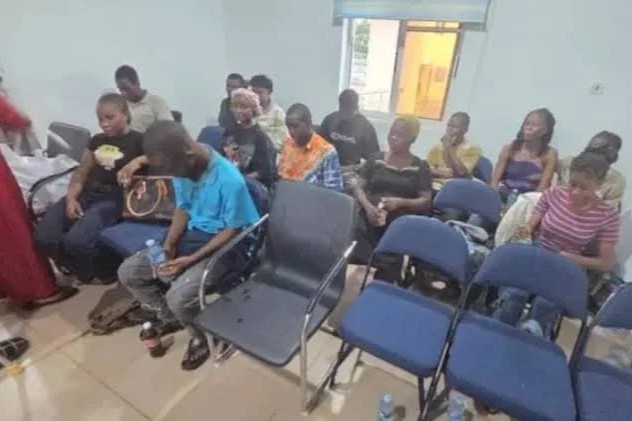
Five suspects have reportedly been arrested over the abduction of 20 prospective corps members in Imo State, but three alleged gang members remain on the run. The case raises urgent questions about how Nigeria protects young graduates travelling to compulsory national service.
Five suspected members of a criminal gang allegedly linked to the abduction of 20 prospective National Youth Service Corps (NYSC) members in Imo State have been arrested following intelligence-led operations in Rivers and Abia states.
But with three other suspects reportedly escaping with gunshot injuries, the operation has exposed a difficult question for Nigeria’s security authorities: can the country dismantle the criminal networks threatening young graduates on the highways, or will each successful rescue be followed by another journey into danger?
Security sources cited in reports published on Friday said the arrests were made during operations conducted between 10 and 14 October in Port Harcourt, Rivers State, and Aba South Local Government Area of Abia State.
The suspects are alleged to have been involved in the abduction of 20 prospective corps members on 1 October, Nigeria’s 66th Independence Day. The victims were subsequently rescued on 7 October in a joint security operation at Amakohia Ubi in Imo State.
The arrests mark progress in an investigation that has crossed state boundaries. They do not, by themselves, establish the suspects’ guilt. The reports reviewed by Atlantic Post did not identify the arrested individuals, set out the evidence against each person or specify when charges would be filed.
There is also a discrepancy in the reporting about the number of suspects who escaped. PUNCH and TVC reported three injured escapees, while some other accounts used a figure of five. An authoritative clarification from the security agencies would resolve the inconsistency.
How 20 prospective corps members disappeared on Independence Day
The abduction occurred along the Owerri–Onitsha Expressway in Imo State, where armed men intercepted vehicles carrying prospective corps members travelling from Ibadan, Oyo State, towards their assigned orientation camps in Abia and Akwa Ibom states.
Earlier reports placed the attack at about 6.30 am around Umunoha and Ogbaku in Mbaitoli Local Government Area. The travellers were reportedly taken into nearby bushland, triggering a search-and-rescue operation involving the Nigeria Police Force, the Department of State Services (DSS), the military and other security personnel.
The first public updates reflected uncertainty over the scale of the incident. Police initially reported that 10 victims had been rescued while the total number of abducted people was still being established. Subsequent reports confirmed the release of the 20 prospective corps members and one other victim on 7 October.
The rescued victims were taken for medical assessment and care at a DSS facility in Owerri.
Their eventual recovery was a major relief to their families. Yet the sequence of events deserves scrutiny beyond the outcome.
A group of young Nigerians travelling towards a government-organised national service programme was vulnerable to a mass abduction on a major inter-state highway. The incident raises questions about journey monitoring, route-specific threat assessments, emergency communication and the availability of rapid-response protection for travellers moving through areas exposed to kidnapping.
The available reporting does not establish whether the passengers had access to any journey-monitoring arrangement, whether a specific risk assessment had been conducted for their route or whether transport operators were connected to a coordinated emergency-response system.
Those questions remain important even after the victims have been brought to safety.
The rescue operation faced a dangerous obstacle
The security response was complicated by the reported location of the kidnappers’ camp.
In the days following the abduction, the Imo State Police Command said operatives had located the suspected hideout through drone surveillance but could not immediately enter the area because intelligence indicated that it had been planted with improvised explosive devices.
Authorities subsequently deployed additional operational assets as the search continued. The hostages were rescued on 7 October.
The reported presence of explosives highlights the difficult choices facing security personnel during hostage-rescue operations. An immediate assault could put captives and officers at risk, while waiting for specialist capabilities can prolong a hostage situation.
The public-safety question is therefore not simply why officers did not storm the camp earlier. It is whether the security system had sufficient bomb-disposal capability, specialist tactical support and safe operational alternatives to act quickly after locating the victims.
Finding a suspected hideout is only one stage of a rescue. Turning intelligence into a safe recovery requires the personnel, equipment and coordination to act on it.
The subsequent arrests in Port Harcourt and Aba South suggest the investigation has expanded beyond the scene of the abduction. Investigators now need to establish the suspected network’s structure, identify the role allegedly played by each arrested person and determine whether other kidnappings or criminal activities are connected to the case.
Why the warning against night travel is not enough
The timing of the attack is particularly significant.
NYSC guidance published for its June 2026 orientation exercise warned prospective corps members against night travel and advised them to stop travelling at 6 pm, spend the night at an appropriate safe location and continue their journeys the following morning.
That remains a sensible precaution. But the Imo incident occurred at approximately 6.30 am, according to earlier reports.
In other words, a measure designed to reduce the dangers of night travel could not, on its own, protect these passengers.
This does not mean the NYSC advisory caused the failure or that daylight travel is inherently unsafe. It means that personal travel precautions need to be supported by a broader public-security system.
Prospective corps members often travel long distances to unfamiliar destinations. Their movement is shaped by orientation schedules, official postings and the need to reach designated camps. Those arrangements can make journeys predictable, although there is no publicly established evidence in this case that an insider supplied information to the attackers.
A stronger system would assess risks along major routes, provide reliable emergency contacts, monitor registered journeys with appropriate safeguards and establish clear procedures for responding when a vehicle fails to check in or reports an attack.
Where intelligence identifies a credible threat on a particular corridor, security agencies and the NYSC should be able to issue timely warnings and consider proportionate protective measures for affected travellers.
The responsibility for safety cannot rest on telling young graduates to be more careful when the risks also require a coordinated public response.
A wider pattern of danger for corps members
The Imo case is not an isolated warning.
A report by Sunday Vanguard published on 11 October said at least 40 serving and prospective corps members had been reported abducted in separate incidents over the preceding year. The publication also highlighted the abduction of 16 corps members in Kogi State on 26 August as they returned to Abuja after completing their orientation in Bayelsa. They were subsequently rescued in a coordinated security operation.
The figure of 40 is a media-reported tally, not a comprehensive official national record. Nevertheless, the incidents point to a recurring vulnerability that warrants a coordinated response.
Security governance expert Professor Al Chukwuma Okoli, quoted by Vanguard, linked the vulnerability to predictable postings, dangerous rural routes and inadequate real-time security. He argued that government, the NYSC and security agencies should develop a system to protect corps members throughout their journeys.
The point is important: protection should not begin only after a kidnapping has been reported.
A more effective approach would include route-risk assessments before each orientation exercise, confidential journey registration, reliable check-in procedures and clearly designated agencies responsible for responding to distress calls. Where circumstances justify it, authorities should assess whether targeted escorts or coordinated transit arrangements are necessary.
Such measures would not eliminate kidnapping. They could, however, reduce exposure and improve the chances of intervention before an attack develops into a prolonged hostage crisis.
The ransom question still needs careful handling
The circumstances of the victims’ release also deserve continued scrutiny.
Reports following the rescue said the abductors had allegedly demanded ₦50 million for each victim. Imo State Commissioner of Police Audu Bosso subsequently told Channels Television that he was not aware that ransom had been paid.
Bosso attributed the release to pressure from security forces operating in the forest. His statement records the police position, but it does not independently establish whether any payment was made.
The distinction matters. Reliable investigations must separate verified facts from allegations, particularly where ransom payments, possible intermediaries and wider criminal networks may be involved.
The latest arrest announcement has not publicly answered whether investigators have recovered weapons, traced financial transactions, examined relevant communications or established connections between the suspects and other abduction cases.
Those questions should form part of the investigation wherever the evidence supports them. They should not be treated as proof of wrongdoing before the facts are established.
Five arrests are progress. Prosecution is the test.
A security source welcomed the latest development, saying: “This is a huge sigh of relief. Security agencies have been on a manhunt for the abductors.”
The relief is understandable. But a successful arrest operation is one stage of a longer process.
Investigators must build cases supported by credible witness testimony, properly handled forensic evidence, relevant digital records and other admissible material. Prosecutors must then establish the allegations in court.
The three reported escapees also remain a concern. Their alleged injuries may assist investigators in tracing them through credible leads, but authorities must establish their identities and whereabouts through lawful investigative methods rather than speculation.
The public is entitled to updates on the progress of the manhunt, the status of the arrested suspects and any charges filed, subject to legitimate investigative and legal constraints.
There is also a broader institutional responsibility.
Okechukwu Nwanguma, executive director of the Rule of Law and Accountability Advocacy Centre, told Vanguard that the state has “a corresponding duty to take reasonable measures to protect them from foreseeable harm”.
That obligation is particularly relevant to national service, which requires graduates to travel and work in unfamiliar parts of the country as part of a federal programme.
The protection of prospective corps members should therefore be treated as a public-safety responsibility shared by the NYSC, security agencies, transport operators and relevant federal and state authorities.
The immediate priority is to locate the remaining suspects, establish the full extent of the alleged criminal network and bring credible cases before the courts. The longer-term task is to make journeys to orientation camps safer before another group of young Nigerians becomes the subject of a rescue operation.
The 20 prospective corps members are back in safety. The more demanding measure of success will be whether the authorities can secure justice for them and reduce the likelihood of another mass abduction.
Follow us on our broadcast channels today!
- WhatsApp: https://whatsapp.com/channel/0029VawZ8TbDDmFT1a1Syg46
- Telegram: https://t.me/atlanticpostchannel
- Facebook: https://www.messenger.com/channel/atlanticpostng


Join the debate; let’s know your opinion.