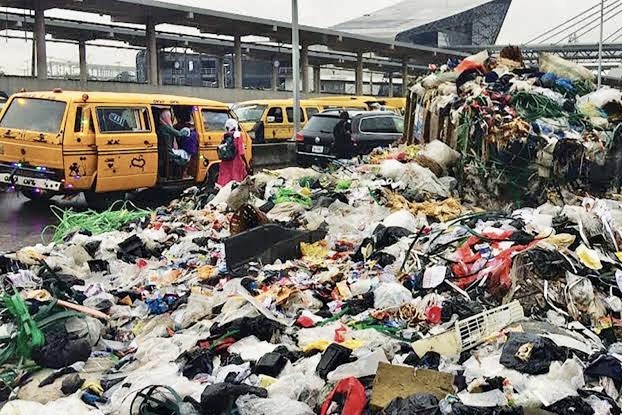
LAGOS, Nigeria — A fresh political and public-health controversy is brewing over Lagos State’s worsening refuse crisis, with the Youth Rights Campaign (YRC) accusing the ruling political establishment of allowing waste-management failures to reach what it describes as a dangerous tipping point.
In a statement issued on Friday, August 28, 2026, YRC warned that Lagos could face preventable deaths and serious disease outbreaks unless accumulated refuse is urgently evacuated from residential neighbourhoods, roads, markets and school environments.
The organisation’s warning is politically explosive because it comes after weeks of mounting evidence that the state’s waste-collection system is under severe pressure. But the available evidence also complicates any attempt to reduce the crisis to a simple story of government neglect: Lagos officials have acknowledged major operational failures, while pointing to rising waste generation, ageing or inadequate trucks, private-sector financial pressures, inaccessible disposal facilities, illegal dumping and residents’ payment and disposal habits.
In other words, the argument now confronting Lagos is not whether there is a waste crisis. There is ample evidence that there is. The more difficult question is why a city with one of Africa’s largest economies and a sophisticated public-private waste-management structure is struggling to move refuse from neighbourhoods to disposal and treatment facilities quickly enough.
And that question has consequences far beyond aesthetics.
YRC: ‘Lagos Is Sitting On A Public Health Time Bomb’
YRC National Coordinator, Michael Adaramoye Lenin, and National Secretary, Francis Nwapa, said refuse had accumulated around homes, streets, businesses and schools across the state.
“Lagos State is sitting on a public health time bomb,” the group said, warning that residents could soon be forced to “start counting the dead” unless the accumulated waste was evacuated.
The organisation wants residents across Lagos’ 20 local government areas and 37 Local Council Development Areas to organise mass, peaceful protests against the state government.
Its foremost demand is an emergency clearance of refuse from residential areas, streets and major highways.
YRC also wants an end to open dumping, the development of engineered sanitary landfills, mandatory separation of organic, recyclable and residual waste at source, greater investment in recycling, composting and waste-to-energy systems, and a fundamental restructuring of the state’s waste-collection model.
It goes further, calling for the scrapping of the existing Private Sector Participation, or PSP, arrangement and the transfer of waste evacuation directly to a properly funded and professionally managed Ministry of Environment.
Those are substantial political demands, but they collide with a more complicated operational reality.
The 17,000-Tonne Question
On August 11, Lagos Deputy Governor Obafemi Hamzat acknowledged that the waste problem had become substantially more difficult than the government had anticipated.
Speaking on Nigerian Info 99.3FM, Hamzat said the state had initially estimated daily waste generation at approximately 13,000 tonnes but had subsequently discovered that it was closer to 17,000 tonnes.
“Well, so, you know, it’s easy for me to just throw the agency under the bus, but I won’t do that,” Hamzat said, explaining that LAWMA had been given a task whose scale had not been properly predicted.
His explanation matters because the figures reveal the size of the planning gap.
If the 17,000-tonne estimate is used as the current benchmark, the difference between the old estimate and the new one is about 4,000 tonnes a day — roughly a 31 per cent increase.
But there is another important number.
LAWMA reported that its network of licensed PSP operators evacuated 418,500 tonnes of waste in May 2026, equivalent to approximately 13,200 tonnes per day.
The comparison suggests a potentially significant capacity gap if Hamzat’s 17,000-tonne figure and LAWMA’s May evacuation average are measured on a comparable basis: about 3,800 tonnes of waste per day.
That does not, by itself, establish that 3,800 tonnes are being left on Lagos streets daily. Waste generated, collected, transferred, treated and disposed of are not necessarily measured at exactly the same point in the waste chain.
But it does expose the central problem: the system is operating under pressure while the volume entering it is rising.
Truck Shortages Are A Major Part Of The Story
Hamzat said Lagos has roughly 420 PSP operators, with contractual requirements for operators to have at least two trucks each.
That would imply more than 800 trucks under the PSP arrangement. But he said many operators no longer had the required number because vehicles had become unusable and some businesses had shut down. Rising diesel costs had also put additional pressure on operators.
The state, he said, had ordered additional trucks.
However, delivery had been delayed.
“We were supposed to get delivery in July. Unfortunately, they now said it’s going to be September,” Hamzat said.
He subsequently accepted that government had some responsibility for the delay, saying: “Maybe we should have ordered earlier. Maybe. I mean, we must take responsibility.”
That admission is significant.
YRC’s charge of “institutional failure” is therefore not occurring in a vacuum. Senior officials themselves have acknowledged weaknesses in fleet capacity, planning and operational preparedness.
But the state’s defence is also grounded in evidence.
LAWMA Says The System Is Being Rebuilt
The Lagos Waste Management Authority has spent much of 2026 attempting to address the bottlenecks.
In May, LAWMA withdrew the licences of several underperforming PSP operators and realigned collection routes, saying some operators had failed to meet required service standards.
The Authority has also been dealing with one of the most serious physical constraints in the system: disposal-site access.
A June investigation by The PUNCH found long queues of refuse trucks at Olusosun, ageing equipment, deteriorating internal roads and machinery breakdowns that were slowing the disposal process.
The consequences were cascading.
When a compactor cannot discharge its load, it cannot promptly return to a community for another collection round.
LAWMA subsequently rehabilitated an access road and disposal platforms at Olusosun in July, saying the intervention was designed to improve truck turnaround times and ease the backlog.
The authority has simultaneously outlined a longer-term transition away from dependence on traditional dumpsites.
LAWMA management says it is planning transfer loading stations, material recovery facilities, biogas production, waste-to-energy infrastructure and a substantially larger fleet. Its managing director, Muyiwa Gbadegesin, said the agency’s target is eventually to have 2,000 trucks.
The state is also developing a 2,500-tonne-per-day transfer loading station at Olusosun intended to move waste towards the material recovery facility at Ikorodu.
That means the government cannot fairly be portrayed as doing nothing.
The stronger criticism is different: whether the pace, scale and execution of those interventions are adequate for Lagos’ present needs.
The PSP Model Is Now At The Centre Of The Political Fight
YRC has accused Lagos’ PSP model of functioning less as a public-health mechanism and more as a system of political patronage.
That is a serious allegation.
Atlantic Post found no independent evidence establishing YRC’s specific claim that PSP contracts have systematically been awarded to political loyalists as a patronage mechanism. The allegation should therefore remain attributed to YRC rather than presented as established fact.
What can be established is that PSP is not a new experimental structure.
LAWMA says private-sector participation in waste collection dates back to 1997, with expansion during the subsequent years and the appointment of PSP operators across the state’s 20 LGAs and 37 LCDAs.
And the model is currently being reviewed.
On August 14, LAWMA and the Association of Waste Managers of Nigeria began a reform process covering performance-based regulation, route rationalisation, financial sustainability, fleet renewal, service monitoring, enforcement, landfill operations and recycling.
Then, in a statement published on August 28, Lagos Environment Commissioner Tokunbo Wahab said the government was examining improved financial arrangements for PSP operators while insisting that higher costs must be matched by accountability and service delivery.
“No PSP operator should use the challenges at the dumpsites or other operational difficulties as an excuse for failing to provide the required services,” Wahab said.
That response is important because it directly addresses one of YRC’s central arguments: the idea that operational difficulties cannot become a perpetual excuse for poor service.
The Health Warning Is Not Political Fiction
The most dangerous mistake would be to dismiss the controversy as merely another pre-election political confrontation.
The public-health risks associated with poor waste management are real.
A recent investigation into Lagos’ waste crisis quoted public-health experts warning that accumulated rubbish provides breeding conditions for rodents and insects, while rainfall can carry pathogens from waste sites into surrounding communities and water sources.
Professor Tanimola Akande warned that rodents and insects, including mosquitoes, can proliferate in environments where refuse is inadequately collected.
Dr Rotimi Adesanya similarly described the accumulation of refuse as a public-health emergency and warned about diseases including cholera, dysentery and amoebiasis.
That does not mean every refuse heap will produce an outbreak, nor does it establish that Lagos is currently experiencing a cholera epidemic.
But it does establish why public-health officials take accumulated refuse seriously.
The risk becomes more acute during periods of heavy rainfall.
The Nigeria Centre for Disease Control and Prevention has repeatedly linked proper refuse disposal and sewage management to cholera prevention. In a public-health advisory issued during the 2024 outbreak, NCDC specifically warned against indiscriminate refuse dumping and urged proper waste disposal and clearing of sewage.
The 2026 situation is already a reminder of Nigeria’s vulnerability. WHO reported that Nigeria recorded 26,848 cholera cases and 181 deaths between January 1 and June 28, 2026, with inadequate sanitation, rainfall and displacement identified among the factors increasing transmission risk in heavily affected areas.
The implication for Lagos is straightforward: the state has little room for complacency.
Refuse And Flooding Are Becoming The Same Problem
Lagos’ waste crisis is also a flood-management problem.
In July, the National Emergency Management Agency reported that flooding in parts of Surulere was driven by intense rainfall, blocked drainage channels and inadequate drainage infrastructure.
The Lagos State Government has itself acknowledged that refuse dumped into drains can obstruct storm-water flow and worsen flooding.
LAWMA management has made the same connection.
Gbadegesin said waste that is not cleared promptly can enter drainage channels and contribute to flooding, while also damaging roads when water remains pooled for prolonged periods.
This creates a costly urban cycle:
uncollected waste → blocked drains → flooding → damaged roads and property → slower movement of waste trucks → even greater collection delays.
For traders, manufacturers, transport operators, landlords and households, that is not an environmental issue alone. It is an economic issue.
Businesses lose operating hours when roads become impassable. Flooding damages stock and equipment. Commuters lose productive time. Households face increased cleaning and repair costs. Government then spends more money repairing infrastructure that could have been protected by better drainage and waste management.
The School Question Could Intensify The Pressure
YRC has specifically warned about schools reopening in the coming weeks and demanded that refuse be cleared from school environments.
That demand places additional pressure on the government because schoolchildren are a particularly vulnerable population in any sanitation crisis.
Even without a disease outbreak, accumulated waste around schools creates health, safety and environmental concerns while worsening the public perception that authorities have lost control of basic urban services.
The political consequences could also be substantial.
The 2027 Lagos governorship contest is already taking shape, with Hamzat emerging as the APC’s governorship candidate after the party’s primary in May.
That makes the refuse crisis more than a municipal management problem.
Every uncollected pile is potentially becoming a campaign photograph.
Every blocked drainage channel can become an opposition talking point.
And every week of delayed waste collection gives political opponents an opportunity to challenge the ruling establishment’s central argument that decades of continuity have produced an efficiently managed megacity.
But Is This Really ‘27 Years Of APC Failure’?
YRC’s political attack deserves one important correction.
The current ruling political tradition has controlled Lagos continuously since 1999, but it is not technically accurate to describe the entire 27-year period as 27 years of the APC.
Bola Tinubu won the governorship in 1999 under the Alliance for Democracy. The political structure later moved through the Alliance for Democracy/Action Congress/Action Congress of Nigeria lineage before the formation of the All Progressives Congress in 2013.
Tinubu was succeeded by Babatunde Fashola, then Akinwunmi Ambode, and Babajide Sanwo-Olu.
The more accurate political description, therefore, is 27 years of uninterrupted control by the political bloc that evolved into today’s APC.
That distinction matters in an investigative report because political criticism should be forceful without sacrificing factual precision.
What Lagos Must Now Prove
The central test for Sanwo-Olu’s administration is no longer whether the government has plans.
It has plans.
There is evidence of truck procurement, landfill rehabilitation, route realignment, sanctions against underperforming PSP operators, transfer stations, material-recovery infrastructure, recycling initiatives and proposals for biogas and waste-to-energy systems.
The test is whether those interventions can close the gap between the amount of waste Lagos generates and the amount its collection-and-disposal system can reliably process.
And the government itself has acknowledged that residents paying for waste collection expect results.
The debate must therefore move beyond blame.
Residents have responsibilities: proper storage and disposal, payment for legitimate collection services and avoidance of indiscriminate dumping.
PSP operators have responsibilities: maintain fleets, collect according to contract and dispose of waste legally.
LAWMA has responsibilities: regulate, monitor, enforce and publish meaningful performance data.
The state government has the ultimate policy responsibility: ensure that the infrastructure, financing, regulation and institutional architecture are large enough for the city it governs.
That is the real issue behind YRC’s warning.
Lagos does not merely have a rubbish problem.
It has a capacity problem, an infrastructure problem, a governance problem, a financing problem and, increasingly, a public-health problem.
The difference between a temporary sanitation backlog and a full-blown urban crisis will be determined by how quickly those weaknesses are corrected.
For now, the political argument is raging.
But beneath the politics is an uncomfortable physical reality: 17,000 tonnes of waste do not disappear because governments issue statements, and they do not become harmless because residents stop looking at the piles.
The refuse has to be collected.
The drains have to remain open.
The disposal sites have to function.
And the system has to work every day.
That is the standard Lagos residents are entitled to demand — irrespective of party.
Follow us on our broadcast channels today!
- WhatsApp: https://whatsapp.com/channel/0029VawZ8TbDDmFT1a1Syg46
- Telegram: https://t.me/atlanticpostchannel
- Facebook: https://www.messenger.com/channel/atlanticpostng