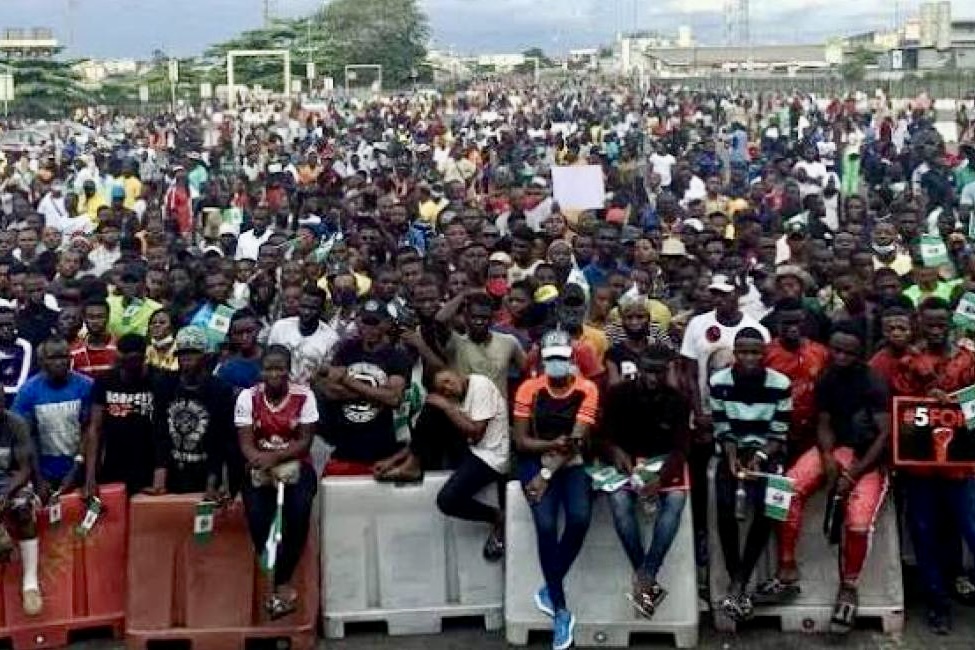
The Youth Rights Campaign has named Lagos Governor Babajide Sanwo-Olu, former Army chief Tukur Buratai and other officials in renewed demands for accountability. The unresolved dispute over the Lekki Toll Gate shootings raises a deeper question: why have years of investigations failed to produce a transparent criminal accountability process?
Recommended length: 1,300–1,600 words. Reporting angle: the gap between official investigations, individual criminal responsibility and justice for survivors.
Six years after Nigerian soldiers opened fire on protesters at Lagos’s Lekki Toll Gate, the demand for justice has returned to a question that successive authorities have yet to answer convincingly: what happened to the evidence gathered after the shootings, and why has it not produced a publicly accountable process for establishing individual criminal responsibility?
The Youth Rights Campaign (YRC), marking the sixth anniversary of the October 20, 2020, #EndSARS protests, has called for the prosecution of Lagos State Governor Babajide Sanwo-Olu, retired Lieutenant-General Tukur Buratai, former police commanders and other senior officials.
The organisation is also demanding accountability from the management of the Lekki Concession Company (LCC), the then Inspector-General of Police and security officials it believes should answer questions about the shootings and their aftermath.
In a statement dated October 20, 2026, and signed by its National Coordinator, Michael Adaramoye, and National Secretary, Francis Nwapa, the group said the failure to prosecute those responsible had entrenched impunity and denied victims and their families justice.
Its demand places renewed pressure on the authorities to explain the gap between the investigations conducted after the shootings and the criminal accountability sought by victims and rights campaigners.
The allegations against the named individuals remain allegations, not criminal convictions. Establishing individual responsibility requires credible evidence, an independent investigation and due legal process. Yet the absence of a clear, publicly documented account of the accountability process remains a central issue six years after the incident.
What Happened at Lekki Toll Gate?
The #EndSARS demonstrations began as a nationwide movement against police brutality, extortion, torture, unlawful arrests and alleged extrajudicial killings associated with the now-disbanded Special Anti-Robbery Squad (SARS).
The protests soon expanded into wider demands for accountable government, respect for civil liberties and improved living conditions.
On the evening of October 20, 2020, soldiers arrived at the Lekki Toll Gate, where protesters had gathered for days. Witness accounts, video footage and subsequent investigations documented gunfire as the confrontation unfolded.
Amnesty International reported on October 21, 2020, that its investigation had confirmed at least 12 deaths at two locations in Lagos, Lekki and Alausa. That figure covered both locations and should not be misrepresented as the death toll at Lekki alone. Amnesty also reported that soldiers had fired at protesters at Lekki without warning.
The organisation received reports that electricity had been cut and CCTV cameras removed shortly before the shootings, raising concerns about the preservation of evidence.
Those claims became central to the debate over what happened at the tollgate and whether authorities had adequately preserved material that could help establish responsibility.
The Nigerian Army initially disputed allegations of lethal shootings. But reporting by CNN subsequently examined footage, eyewitness accounts and ammunition recovered from the scene.
During proceedings before the Lagos judicial panel, Brigadier-General Ahmed Taiwo acknowledged that soldiers deployed to the protests had been issued both live and blank ammunition. CNN reported that its investigation included ballistic analysis and assessments from military sources indicating that ammunition casings recovered from the scene were consistent with live rounds used by the Nigerian Army.
The significance of that evidence is substantial, but it has limits. Establishing that live ammunition was present does not, by itself, determine which individual fired a particular round, who authorised the use of force or whether a specific senior official bears criminal responsibility.
Those questions require further evidence, not simply the repetition of competing public statements.
The Judicial Panel’s Findings—and the Government’s Rejection
The Lagos State Judicial Panel of Inquiry on Restitution for Victims of SARS-Related Abuses and Other Matters was established to investigate complaints of police abuse and provide a route towards restitution.
Its mandate was expanded to cover the Lekki Toll Gate incident.
In November 2021, the panel found that security forces had shot, injured and killed unarmed protesters at the tollgate. Its report listed at least 48 casualties, including nine people recorded as dead, four missing and presumed dead, and 21 people wounded by gunfire. The casualty categories should not be treated as interchangeable, and the reported figures became the subject of a major dispute.
The Lagos State Government subsequently issued a White Paper rejecting central findings of the panel’s report.
The government disputed the finding that nine people had died at Lekki from military gunfire, describing that conclusion as based on “assumptions and speculations”. It also rejected the characterisation of the incident as a massacre.
At the same time, the state accepted or partially accepted numerous recommendations and indicated that recommendations involving federal institutions would be forwarded to the relevant authorities.
This unresolved disagreement is one of the most important elements of the case.
The panel produced findings. The government challenged key parts of them. Yet rejecting a finding is not the same as conducting and publishing a comprehensive criminal investigation that addresses the evidence, identifies any offences and establishes whether identifiable suspects should face charges.
Nor does a judicial panel automatically determine criminal guilt. It is an investigative and fact-finding mechanism, not a substitute for a criminal trial.
The central accountability question is therefore broader than whether officials accept the word massacre. It is whether the state can produce a transparent explanation of the evidence, the decisions made after the inquiry and the steps taken to determine individual responsibility.
Human Rights Watch reported in May 2022 that police and military authorities had not taken further steps to independently investigate or respond to the panel’s findings and recommendations. It called for the implicated officers to be held accountable and victims to receive compensation.
YRC’s anniversary statement renews that challenge. The group wants the authorities to move beyond official disagreement and demonstrate what, if anything, has been done to establish criminal accountability.
Why YRC Wants Sanwo-Olu and Buratai Investigated
The campaign’s demand brings political authority and military command into the centre of the debate.
Sanwo-Olu was Lagos governor when the shootings occurred and his administration established the judicial panel. YRC wants him to answer questions about the state’s conduct during the incident and its response afterwards.
Buratai was Chief of Army Staff when soldiers were deployed to Lekki. The organisation argues that his position warrants scrutiny over the military operation and the subsequent response to allegations against soldiers.
The group has also demanded accountability from the then Inspector-General of Police, Mohammed Adamu, other senior police officials and the management of LCC.
These demands raise important questions about accountability at the highest levels of government. But holding an office when an alleged abuse occurs does not, by itself, establish criminal liability.
Any case against a governor, a former service chief or another senior official must identify the applicable offence and demonstrate, through admissible evidence, the individual’s own conduct or legally relevant responsibility. Investigators must distinguish between issuing an order, knowingly facilitating unlawful conduct, failing to fulfil a specific legal duty and simply occupying a position of authority.
The same standard must apply to every person named by the campaign.
The proper response to the demand is neither automatic prosecution nor automatic exoneration. It is a credible process capable of testing the evidence, establishing what each person did or failed to do, and determining whether prosecution is justified.
For Sanwo-Olu, the questions include how the state responded to the shootings, whether evidence was preserved and what steps were taken to implement the inquiry’s recommendations.
For Buratai and the military chain of command, the outstanding questions include the orders governing the deployment, the rules of engagement, the use of live ammunition and the investigations conducted afterwards.
For LCC, the campaign wants answers about its alleged role and the circumstances surrounding the CCTV system and tollgate lighting. Those questions should be assessed against technical records, witness testimony and other available evidence, rather than assumed to establish wrongdoing.
A Fact-Check on the Police Officers Named
YRC also identified former police officer James Nwafor and Dolapo Badmus among those it believes should face scrutiny over allegations raised in testimonies and public petitions.
The descriptions of the two officers require precision.
Contemporaneous reporting identifies Nwafor as the former commander of the Awkuzu SARS unit in Anambra State, where allegations of torture, unlawful detention and extrajudicial killings were raised by victims and their families.
Badmus, by contrast, was a police spokesperson for the Lagos State Police Command and later the Zone 2 Command. Available biographical reporting does not establish that she was a former SARS commander.
That distinction matters. Naming an officer in an advocacy statement does not establish that the officer participated in the Lekki shootings or committed a criminal offence. Nor should allegations associated with a particular police unit automatically be treated as proof of involvement in a different incident.
If YRC is relying on specific evidence linking either individual to the events under investigation, that evidence should be identified and examined by the appropriate authorities. Any prosecution would need to meet the applicable legal standard.
Survivors Allegedly Threatened for Demanding Justice
The accountability dispute extends beyond the shooting itself.
YRC alleges that survivors and witnesses have faced intimidation, threats and violence because of their participation in the protests and subsequent judicial proceedings.
The organisation cited the case of Kamsi Ibeh, whom it described as a coordinator of the Lekki Toll Gate barricade. It alleged that she was followed for months and attacked with machetes by suspected state-backed thugs because she participated in the judicial panel proceedings.
It also cited a protester identified only as Patrick, alleging that police officers at Maroko Police Station repeatedly harassed him, forcing him to leave Lagos over fears for his family’s safety.
The campaign further said that DJ Switch, the Nigerian disc jockey and activist whose livestream became an important public record of the Lekki shootings, remained in exile.
These allegations require independent verification. The statement supplied for this report does not, by itself, establish who carried out the alleged attacks or whether those responsible had links to state authorities.
But the allegations identify a separate public-safety concern: whether witnesses can participate in an investigation into security-force conduct without exposing themselves and their families to further danger.
If witnesses fear retaliation, investigators may struggle to obtain testimony, preserve evidence and test competing accounts. Survivors may also be discouraged from seeking legal remedies.
The authorities should investigate specific, credible allegations of threats and violence, provide appropriate protection to witnesses and publish the outcomes of those investigations where legally permissible.
YRC also wants Nigerians who left the country because of threats linked to the protests to be able to return safely. Such a guarantee would require more than a public assurance; affected individuals would need credible protection against intimidation and reprisals.
Six Years On, Have the Grievances Changed?
YRC argues that the conditions that triggered #EndSARS have not been resolved.
Its statement cites continuing allegations of extortion, unlawful detention, torture and extrajudicial killings, alongside economic pressures arising from higher living costs, petrol subsidy removal and increases in school fees.
Those concerns cannot all be reduced to the Lekki case. They nevertheless point to a common institutional question: whether citizens can peacefully challenge government conduct and obtain an effective remedy when security personnel are accused of abusing their powers.
The August 2024 #EndBadGovernance protests provide a more recent measure of the problem.
Amnesty International reported in November 2024 that at least 24 protesters were killed by security forces during the demonstrations, which took place from August 1 to 10. The organisation documented the deaths across Borno, Kaduna, Kano, Katsina, Jigawa and Niger states, alongside the detention of more than 1,200 people, including minors.
In August 2025, Amnesty said the authorities had failed to ensure justice for the 24 people it documented as killed during those protests and reported that no member of the security forces had been prosecuted over the deaths at that point.
These were separate events from the Lekki shootings, and their facts should not be conflated. But the repeated allegations of lethal force against protesters, followed by demands for accountability, make the implementation of human-rights safeguards a continuing national concern.
A government cannot demonstrate respect for peaceful assembly through announcements alone. The test is whether security personnel are trained to respect the right to protest, whether the use of force is investigated independently and whether credible evidence of criminal conduct leads to appropriate legal proceedings.
YRC also called for an investigation into alleged abuses in Rivers State, including its allegations concerning the military operation in Obigbo, also known as Oyigbo, during unrest under former governor Nyesom Wike, now Minister of the Federal Capital Territory. Those allegations require a separate, evidence-based investigation and should not be treated as established findings.
What Accountability Should Look Like Now
The YRC statement sets out demands that go beyond prosecution. It wants public acknowledgement of responsibility for killings and brutality, compensation for victims’ families, medical support for injured survivors, memorials for those killed and protection for witnesses.
It has also called for the release of anyone still detained over the protests and for better access to jobs, education, housing and healthcare for young Nigerians.
The distinction between criminal accountability and wider reform is important.
Compensation can provide some measure of restitution, but it cannot replace an independent investigation into alleged unlawful killings. A memorial can preserve public memory, but it cannot determine criminal responsibility. Police reforms can reduce the risk of future abuses, but they cannot resolve outstanding allegations about past conduct on their own.
Nor should a demand for prosecution be confused with a presumption of guilt. A credible justice process must protect victims while respecting the rights of every accused person.
The unanswered questions at Lekki therefore require a practical response from the relevant authorities.
They should publish a clear account of the status of the panel’s recommendations, identify any subsequent investigations or disciplinary proceedings, explain which matters were referred to federal authorities and disclose the outcomes that can lawfully be made public.
Where the evidence supports criminal charges, the appropriate authorities should pursue them through due process. Where allegations cannot be substantiated, the reasons should be explained transparently, subject to legitimate restrictions protecting witnesses and sensitive information.
The evidence concerning the deployment of soldiers, the use of live ammunition, the tollgate’s CCTV system and the treatment of survivors should be examined within a process that is independent, credible and capable of withstanding scrutiny.
The named officials and institutions should also have an opportunity to answer specific allegations against them.
Without these steps, the dispute risks remaining trapped between a panel’s findings, official rejection and recurring public demands for justice.
As the statement put it: “The best honour to their memory is to continue the struggle which they died for.”
Six years after the Lekki shootings, that struggle also requires answers that can be tested against evidence. Remembering the victims is essential. Establishing responsibility, protecting witnesses and ensuring that the law applies equally to those who wield state power are the measures by which the promise of justice will ultimately be judged.
Follow us on our broadcast channels today!
- WhatsApp: https://whatsapp.com/channel/0029VawZ8TbDDmFT1a1Syg46
- Telegram: https://t.me/atlanticpostchannel
- Facebook: https://www.messenger.com/channel/atlanticpostng

Join the debate; let’s know your opinion.