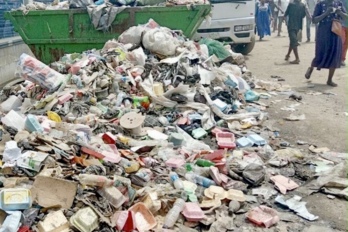
Lagos is once again facing a stark warning over the intersection of governance failure and public health. The Citizens Action Network’s allegation that the Lagos Waste Management Authority (LAWMA) and its Private Sector Participation (PSP) operators are billing households for refuse collection not being rendered has landed at a sensitive time for Africa’s most populous city, where sanitation lapses have already triggered repeated disease scares.
LAWMA says it remains responsible for municipal and industrial waste collection and commercial waste services in Lagos, while the state is simultaneously pushing ahead with a broader 2026 parking regime that shows how deeply the city is leaning on user charges to manage urban services.
In a press statement issued by its National Public Relations Officer, Ade-Adewunmi Adeoye, the group accused the waste agency and its contractors of charging residents despite months of no collection in several communities.
It described the practice as “illegal, unethical, and amounts to extortion.” The group also argued that Lagos is “fast turning into a dumping ground” and insisted that the city must stop expecting residents to carry the cost of a broken system.
It added: “We cannot continue to subsidize inefficiency and failure with our pockets.” The demand is clear: either refuse is collected, or the bills stop.
That warning is not mere activist theatre. Public-health agencies have repeatedly made the link between poor sanitation and disease outbreaks. The World Health Organization says cholera is caused by consuming food or water contaminated with the bacterium Vibrio cholerae, and that unsafe sanitation is a major driver of transmission.
Nigeria’s Centre for Disease Control and Prevention warned in June 2024 that the country had recorded 1,141 suspected cholera cases and 65 confirmed cases, with 30 deaths across 96 LGAs in 30 states, including Lagos. Lagos’s own HEFAMAA says cholera is a significant public-health concern in communities with inadequate water treatment, poor sanitation and poor hygiene practices.
The malaria danger is equally real. The World Health Organization says malaria is transmitted by Anopheline mosquitoes and that vector-borne diseases remain a major global health burden.
WHO’s urban malaria guidance also notes that stagnant water supports mosquito breeding and that water management, drainage and the removal of standing water are central to prevention.
In a city where refuse piles, blocked drains and stagnant runoff often travel together, residents are not exaggerating when they say the waste crisis can become a mosquito crisis in a matter of days.
The parking complaint thrown into the same statement widens the argument. The Citizens Action Network accused LAWMA of abandoning the globally accepted “Park and Pay” model in favour of compulsory monthly parking tickets, saying residents are being forced to pay for parking spaces they do not use.
That grievance comes as Lagos State has already signalled a formal move towards a regulated on-street parking scheme in 2026, with the Lagos State Parking Authority saying the pilot will begin in selected local government areas, including Ikeja.
The issue, therefore, is not whether Lagos wants to monetise parking; it is whether residents are being asked to pay more while already doubting the quality of the services tied to those charges.
The group has called for a “No Service, No Pay” policy, restored digital pay-per-hour or pay-per-day parking, and monthly public reports showing which areas were serviced and how much revenue was collected.
That is a politically dangerous demand for the state because it shifts the burden from slogans to measurable delivery.
If LAWMA and its PSP network are indeed collecting payments while skipping communities for months, the argument will no longer be about sanitation alone; it will become a test of public trust, billing transparency and regulatory enforcement.
The state government now has a narrow window to respond, not with public relations noise, but with documentary proof of service delivery.
If refuse trucks have been missing, the records should show why. If billing has continued, the basis should be published. And if enforcement is being used as a revenue machine rather than a service guarantee, Lagos residents deserve to know before the next outbreak, not after it.
Follow us on our broadcast channels today!
- WhatsApp: https://whatsapp.com/channel/0029VawZ8TbDDmFT1a1Syg46
- Telegram: https://t.me/atlanticpostchannel
- Facebook: https://www.messenger.com/channel/atlanticpostng