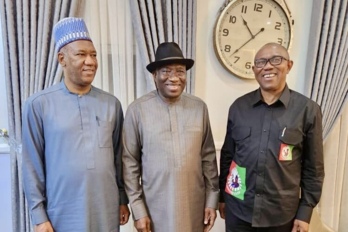
The recent open letter from Dr. Ben Chukwu urging former President Goodluck Jonathan not to run in 2027 claims to speak in the name of South-East Nigeria’s “sacred love” for him. However, a close examination of Jonathan’s record – economic, security, foreign policy, and human rights – versus those of his successors reveals this letter’s manipulative tone and selective reasoning.
In this investigative critique, we fact-check Dr. Chukwu’s claims, review Jonathan’s performance as president (2010–2015) and compare it with Buhari’s and Tinubu’s administrations, and assess Jonathan’s nationwide appeal for 2027. We find that Jonathan’s achievements are significant, his legacy widely respected, and that the open letter’s narrative is self-serving and misleading.
Jonathan’s Economic Record vs His Successors
Under Jonathan, Nigeria’s economy was strong. By 2014 Nigeria’s GDP was rebased and became the largest in Africa – about $510 billion – with per capita income near $3,000. BusinessDay notes this was “the culmination of the economic progress” and reforms during Jonathan’s tenure.
This growth followed steady post-2000 expansion that his administration helped consolidate. Key initiatives like the Agricultural Transformation Agenda and support for entrepreneurs (e.g. YouWiN) aimed to boost jobs and diversify the economy.
In contrast, under President Buhari (2015–2023) and President Tinubu (2023–present), growth has stumbled and living costs risen. By 2016 Nigeria even fell into recession when oil prices collapsed.
Analysts report that inflation surged from roughly 9% in 2015 to near 18% by 2022, and GDP per capita fell significantly (indicating Nigerians on average became poorer). Public debt has soared (from ~₦12 trillion in 2015 to ~₦42 trillion by early 2022). The Tinubu government’s removal of fuel subsidies in 2023 further drove inflation and poverty.
In short, Jonathan presided over an expanding, reclassified economy, whereas his successors have overseen economic hardship. This contrast partially explains why many Nigerians recall the Jonathan era fondly: his “tone and tempo” appear safer and more familiar to citizens dismayed by current woes.
As one analysis notes, Jonathan’s famous 2015 concession speech – “My ambition is not worth the blood of any Nigerian” – is still viewed as a sign of democratic maturity, and his administration’s GDP gains remain in public memory.
Security and Foreign Policy Performance
Security challenges defined Jonathan’s tenure (notably Boko Haram’s rise), but his government took significant steps to address them. He launched a multi-national offensive in 2013–14 that recaptured vast areas once held by insurgents (with help from Chad, Cameroon, Niger).
Crucially, Jonathan ordered the military high command reshuffle in January 2014 and coordinated an international effort to rescue kidnapped victims (though the Chibok girls abduction was tragically botched). These actions arguably blunted Boko Haram temporarily.
Under Buhari, Boko Haram fractures (ISWAP) and new banditry in the northwest and Middle Belt have expanded. Now under Tinubu, violence is epidemic: bandit gangs and Fulani militants massacre villages, ISIS-affiliated militants surge, and the menace of killer herdsmen on farming communities persists.
The Human Rights Watch 2024 report warns of “multiple armed groups” killing across Nigeria and continuing sectarian attacks, while security forces often commit grave abuses (indiscriminate airstrikes, extrajudicial killings) without accountability.
On foreign policy, Jonathan kept Nigeria engaged globally. He welcomed world leaders (for example President Xi Jinping in 2013) and deepened Nigeria’s strategic partnerships in infrastructure and trade. He represented Nigeria in regional peace efforts (through ECOWAS, African Union etc.) and later became a respected international mediator.
The letter claims Jonathan has a “hard-earned global legacy”, which is partly true: he has been appointed UN special envoy on crises and chairs African leadership forums, reflecting that world leaders still value his statesmanship.
By comparison, Buhari often stayed domestic (even declaring a 2017 “strictly duties only” vow to avoid Southern trips), and Tinubu is still establishing his foreign credibility.
Thus, Jonathan has an enviable diplomatic network that could benefit Nigeria if he re-enters politics.
Human Rights and Religious Freedom
Jonathan’s administration was not without criticism on human rights. Yet, by some measures his record was comparatively better than his successors’. Under Buhari and Tinubu, religious and ethnic tensions have flared. The US Commission on International Religious Freedom notes that “religious freedom conditions in Nigeria are particularly severe,” with attacks on Christian, Muslim, and traditional communities ongoing and few perpetrators held accountable.
In Jonathan’s time, insurgencies targeted many groups too, but there was less state-directed persecution. In contrast, Buhari’s government cracked down heavily on Muslim Shi’a protesters (Imam Ibrahim El-Zakzaky was arrested in 2015) while imposing bans on Christian gatherings. Tinubu has similarly drawn criticism (e.g. banning Shi’a rallies in 2023).
Security forces under all administrations have been implicated in abuses. HRW highlights that Nigerian soldiers and police under current leadership are accused of indiscriminate bombings and summary executions. A US State Department report on 2023 also documented unlawful killings and torture by security agents.
While Jonathan faced some allegations (e.g. forceful dispersals of protests), he was widely praised for guaranteeing a peaceful power transition in 2015. Jonathan’s famous 2015 concession—refusing to shed blood for power—elevated his standing as a rights-respecting leader. That legacy suggests he values peaceful democracy.
Summary: The letter casts Buhari’s and Tinubu’s governments as inflicting “unbearable pains” on the South-East. Indeed, groups like Ohanaeze (the Igbo leadership forum) did accuse Buhari of marginalisation. But all Nigerians have suffered under rising insecurity and economic hardship in recent years.
Jonathan’s record, by contrast, includes no communal massacres on his watch and a relatively open political space. On religious freedom, Nigeria’s situation has deteriorated since Jonathan left office. Considered collectively, Jonathan’s tenure compares favourably to the alternatives, reinforcing arguments in his favour.
The South-East’s Support and 2015 Results
Dr. Chukwu’s letter hinges on South-East loyalty. It boasts that in 2015 each South-East state gave Jonathan over 80% of the vote: Enugu 96.48%, Anambra 95.96%, Abia 94.18%, Ebonyi 88.94%, Imo ~80%. Official INEC figures confirm this overwhelming support.
For example, Jonathan beat Buhari 553,003 to 14,157 in Enugu (96.48% vs 2.47%)and 559,185 to 133,253 in Imo (79.5% vs 18.9%). These were indeed “statements of pure, undiluted love” from Igbo voters in 2015. (Nationwide, Jonathan carried 15 states plus the FCT, largely in the South and Middle Belt – a very respectable national coalition.)
But 2023 election results tell a new story: the South-East overwhelmingly backed Labour Party’s Peter Obi, not Jonathan or the PDP. Obi won Anambra (95.2%) and Enugu (93.9%), with Imo (76.8%) and Ebonyi (79.8%) also going to Obi. In other words, the same voters that gave Jonathan near-total support in 2015 turned en masse to another Igbo candidate in 2023.
This shows South-East Igbo voters remain fiercely partisan, but their allegiance shifted from PDP/Jonathan to Obi when a fresh choice emerged. In 2015, Jonathan was one of the few Igbo favoured figures on a national stage; today Peter Obi is that figure. Therefore, the claim that South-East love for Jonathan is “historic” and monogamous is out of step with reality.
South-East voters have demonstrated loyalty to the best available candidate, not to Jonathan personally forever. To argue Jonathan must now deny democracy (by stepping aside) to “protect” Igbo fortunes is condescending. The Igbo are quite capable of deciding whom to support. If Jonathan runs legitimately, he could well carry the South-East again on merit – but if not, the region will rally around their own instead.
The letter’s warning that Jonathan would “dilute” his 2015 legacy by running is a false dichotomy: democratic engagement itself proved Jonathan’s commitment to Nigerians’ welfare, as his concession showed.
Deconstructing Dr. Ben Chukwu’s Open Letter
Dr. Chukwu’s letter is artfully written, but it is self-serving pandering. It lavishes praise (“leader who saved millions”) and guilt (“Do not let 2027 dilute that sacrifice”), all while pressuring Jonathan to play kingmaker for Peter Obi. Key points of critique:
• Emotional Hyperbole: The letter uses dramatic metaphors (“dared the poison of vipers…escaped the jaws of a mad lion”) to paint Jonathan as a beleaguered hero. This sets up a “you owe us” narrative. But politics is always rough, and Jonathan faced no fiercer enemies than those he mentions only as “masters” behind INEC and “poisonous vipers.” In fact, Jonathan beat those challenges in 2015. The suggestion that he now deserves sacred immunity from another campaign is unrealistic.
• Sacred South-East Love: It portrays the South-East’s 2015 support as an unbreakable bond. Yet this ignores that democracy allows voices to change. The Igbo electorate chose a new leader (Obi) in 2023. The letter’s conceit – that their “love … remain[s] pure” – doesn’t reflect the dynamic nature of politics. South-East leaders like Ohanaeze and even some members of Jonathan’s PDP (e.g. Ebonyi’s governor) have affirmed their communities seek true representation, not blind loyalty to one man.
• Misplaced Priorities: Dr. Chukwu warns Jonathan that running will force “ugly political compromises, mudslinging, and alignments.” But this is just the nature of electoral politics. By this logic, no virtuous elder should ever contest office again – which guts democracy. Jonathan has every right to test his agenda again, just as Obi or Atiku do. The letter treats Jonathan’s reputation as fragile and his conscience scarred by politics. Yet, in 2015 Jonathan’s concession – “my ambition is not worth the blood…” – proved his moral standing. Engaging in peaceful competition in 2027 need not shatter that image; rather, it could reinforce his commitment to democratic choice.
• Contradictions: If Jonathan’s legacy must remain untarnished by “another campaign,” why then lobby him to support one candidate? The letter essentially tells him: “Don’t run, help our preferred candidate win.” That is political pressure to endorse a particular outcome. It also overlooks that Jonathan’s nationwide appeal might transcend regional interests. Why should the South-East exclusively dictate his decision? The open letter acts as though Jonathan owes his career to the South-East alone. But remember: Jonathan is from Bayelsa (South-South) by birth and only became the South-East’s champion by circumstance. Nigerians beyond the Igbo also respect him.
• Self-Interest: Dr. Chukwu identifies himself as convener of the Professionals for Good Governance and Social Justice, but the letter reads more like a campaign memo for a younger South-East politician (likely Peter Obi). It attempts to garner Jonathan’s moral authority for Obi (“majority of Nigerians across all regions are passionately rooting for this younger brother”). Ironically, the letter counsels Jonathan to preserve a “pristine image” by staying out – yet it expects him to dirty himself by aligning with another campaign. Who benefits here? Not Jonathan, who would be sidelined; but a rival campaign that wishes to use his “sacred” support. This is classic political blackmail: “Step aside or the South-East’s love will turn to dust,” though in reality that love has already moved on.
Jonathan’s Enduring Appeal and 2027 Prospects
Despite the letter’s urgings, many analysts see Jonathan as a potential unifying force. The fragmented PDP and disillusioned electorates across regions have floated his name as someone who could reconcile factions.
If people want “options they trust,” Jonathan’s reputation as a peaceful elder statesman indeed looks attractive compared to the bitterness of today’s campaigns. Polls and talk in 2024/2025 suggest that some Nigerians view Jonathan as a “safe, familiar option”.
The South-East’s stance, far from being an immovable monolith, is itself up for grabs. Leaders and voters in the region have publicly debated Jonathan’s role. Some Igbo politicians support Obi, others hint that Jonathan could rejuvenate PDP fortunes.
The notion that South-East love must be “preserved” by shutting Jonathan out is, frankly, a fiction of a faction, not the people. If Jonathan chooses to run, South-East voters will decide if their loyalty lies more with an indigenous candidate or with Jonathan’s pan-Nigerian vision.
Importantly, Jonathan’s ambitions are constitutional and democratic. After court rulings confirmed he remains eligible to contest (the Constitution’s term limit applies only to sitting terms), Jonathan has a right to weigh running again like any citizen.
The open letter implies eligibility isn’t Jonathan’s problem, but rather his personal image. In truth, walking away isn’t how one “retains the highest crown” (as the letter flirts). It is by continuing to serve Nigeria.
His post-presidential peace efforts and charity work have given him stature, but elections can also be a platform for that elder-statesman role – or at least for influencing policy and unity from within.
Conclusion: The Facts vs. the Rhetoric
Goodluck Jonathan’s record – a booming GDP, peaceful power handover, and ongoing global respect – stands in marked contrast to Nigeria’s woes under the APC. His tenure saw the economy grow into Africa’s largest, and although Boko Haram terrorism surged then, Jonathan rallied a regional coalition that eventually recaptured lost territories.
His successors have presided over worsening insecurity, rampant kidnappings, and economic decline. This context makes Jonathan’s potential return appealing to many across Nigeria, not just the South-East.
Dr. Chukwu’s open letter tries to confine Jonathan to the interests of one region by appealing to guilt and nostalgia. But Nigerians – Igbo and non-Igbo alike – remember Jonathan not as a sectional politician but as a democrat who once stepped aside to keep Nigeria whole.
The idea that Jonathan must pay the South-East back by withdrawing is not a noble sacrifice; it is a spurious demand. In a healthy democracy, aspirations to lead must compete on ideas, not be thwarted by intrigue-laden open letters.
In sum, Jonathan retains significant nationwide goodwill and a record to defend his ambitions. The South-East’s past support was genuine, but not unconditional or eternal. A new campaign should invigorate public engagement, not freeze it.
Jonathan’s candidacy (should he choose to run) would subject him to the same democratic contest as any contender. That does not diminish his legacy – it enriches it by testing it anew. In the end, Nigerians themselves will decide if they want Jonathan back, not the self-appointed guardians of his reputation.
Follow us on our broadcast channels today!
- WhatsApp: https://whatsapp.com/channel/0029VawZ8TbDDmFT1a1Syg46
- Telegram: https://t.me/atlanticpostchannel
- Facebook: https://www.messenger.com/channel/atlanticpostng