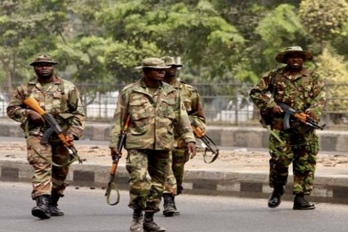
OSOGBO, Osun State — The Osun governorship election descended into a fresh security controversy on Saturday after Governor Ademola Adeleke’s Imole Campaign Council accused soldiers of entering Ijebu-Ijesa in Oriade Local Government Area and arresting members of the Accord Party during voting.
The campaign council also accused Senator Francis Fadahunsi, who represents Osun East Senatorial District in the National Assembly, of directing All Progressives Congress supporters at his polling location to monitor how voters cast their ballots and, allegedly, to act against those who did not support the APC.
The twin allegations have intensified scrutiny of the conduct of security personnel and political actors during an election that had already entered polling day under a cloud of concern over political violence.
Crucially, however, the allegations concerning the soldiers have not, as of publication time, been independently confirmed by the Nigerian Army, the Nigeria Police Force, INEC or an independent election observer. The claims concerning Senator Fadahunsi have been widely reported from the campaign council’s statement and social-media video claims, but the senator’s own response to Saturday’s specific allegation had not been established in the sources reviewed for this report.
That distinction matters.
In an election as politically charged as Osun 2026, an accusation involving armed soldiers and alleged voter intimidation can have consequences far beyond one polling unit. It can shape public confidence in the results, trigger competing claims of rigging and potentially become material in any subsequent electoral dispute.
Soldiers accused of entering Ijebu-Ijesa polling locations
According to the Imole Campaign Council, the alleged incident occurred around noon in Ijebu-Ijesa, where soldiers purportedly moved into polling units and arrested Accord Party members who were present to vote.
The council’s spokesman, Pelumi Olajengbesi, alleged that the soldiers were being led by persons associated with the APC and claimed they were not part of the troops officially deployed for election duties in Ijebu-Ijesa or the wider Oriade area.
The campaign council said it had attached a video which it described as showing soldiers carrying out what it called arbitrary arrests of Accord members.
The allegation was framed not merely as a security operation but as an alleged attempt to suppress a particular bloc of voters.
“The Imole Campaign Council finds this development unacceptable. Soldiers must not make themselves tools in the hands of desperate power-seeking politicians,” Olajengbesi said.
The campaign council subsequently appealed directly to the Chief of Army Staff, asking him to intervene.
“We call on the Chief of Army Staff to stop the targeted arrest and intimidation of Accord Party members by soldiers manipulated by the APC,” the spokesman said.
The wording represents a serious allegation against serving military personnel and political actors. Yet, without an official military response establishing who the soldiers were, why they were present and whom they arrested, it would be premature to conclude that the Nigerian Army carried out a partisan operation.
The evidentiary questions are therefore straightforward but important: Were the personnel genuinely soldiers? Were they formally deployed to the area? Were those arrested actually Accord members? What offence, if any, was alleged? Who ordered the arrests? And were the detainees subsequently released or transferred?
Those questions remain unresolved at the time of filing.
Military presence was planned — but its role was supposed to be tightly controlled
The allegation cannot be examined in isolation from the security architecture established for the election.
More than 25,000 security personnel were deployed across Osun ahead of the poll, including 15,000 police officers and 10,210 personnel of the Nigeria Security and Civil Defence Corps.
INEC had also said the military would provide what it described as “back-end and outer-ring support” in areas identified as vulnerable to violence. The commission’s Director of Voter Education and Publicity, Victoria Eta-Messi, said security deployment was being guided by a risk assessment conducted under the Inter-Agency Consultative Committee on Election Security.
That distinction is central to the controversy now unfolding.
A military presence somewhere within an election environment does not, by itself, establish political interference. But the alleged movement of armed military personnel directly into polling locations, followed by alleged arrests of members of one political party, would raise a fundamentally different question — particularly if such action occurred outside the authorised election-security chain of command.
The credibility of the military response will therefore depend heavily on whether the authorities provide a factual account of the personnel involved.
A pre-election history of security neutrality disputes
The allegations are also significant because the Accord Party had already raised repeated concerns about the neutrality of security agencies before polling day.
In July, Accord accused the Osun Police Command of selective arrests and alleged that security personnel were shielding individuals linked to political violence.
The police rejected the allegations as false and misleading.
Police spokesman Abiodun Ojelabi said arrests were intelligence-driven and based on evidence capable of supporting prosecution. He insisted that political affiliation neither guaranteed immunity nor automatically made a person a target.
The disagreement established a pattern that has now followed the election into polling day: one side warning of politically selective enforcement, and security authorities insisting that their operations are based on law, intelligence and evidence.
The arrest controversy involving Accord politicians was not entirely new either. Earlier in July, the party and the Adeleke campaign council protested the arrest of Accord House of Representatives candidate Popoola Alaba, while police disputed the political interpretation placed on the detention.
That history does not prove the Saturday allegations. It does, however, explain why claims of further arrests immediately triggered political alarm.
Fadahunsi allegation puts voter secrecy under the microscope
The second controversy is potentially even more sensitive because it goes to the heart of the voting process: the secrecy of the ballot.
The Imole Campaign Council alleged that Fadahunsi was seen and heard instructing APC supporters at his polling unit in Ilase-Ijesa to monitor the voting choices of voters.
The council further alleged that he instructed supporters to take action against voters who did not support the APC.
“This is scandalous, unacceptable and undemocratic,” Olajengbesi said.
The council also urged security agencies to intervene.
“The security agencies must immediately stop the voter intimidation by Fadahunsi and his foot soldiers,” it said.
The allegation has to be assessed against Nigeria’s electoral rules, which are explicit on voter privacy.
Section 122 of the Electoral Act 2022 requires everyone attending a polling unit, including electoral officers, polling agents and candidates, to maintain the secrecy of voting. It specifically prohibits interference with a voter for the purpose of obtaining information about the candidate for whom the voter is about to vote or has voted. A person who violates the provision faces a fine or imprisonment upon conviction.
INEC likewise states that voters are directed to a voting cubicle to make their choices in secret.
The issue is therefore not simply whether a politician was being aggressive at a polling unit. If the allegation that voters were being monitored because of their choices is established, it would strike at a legally protected component of the Nigerian electoral process.
But again, an accusation is not a conviction.
The available reporting does not establish that any voter was physically attacked as a consequence of the alleged directive, nor does it independently establish that Fadahunsi successfully obtained the voting choices of individual electors. The campaign council itself provided no further details on whether anyone was actually assaulted following the alleged instruction.
Fadahunsi also publicly praised voter turnout
There is another notable wrinkle.
In live election coverage, the News Agency of Nigeria reported that Fadahunsi commended the large turnout at his polling unit and urged more eligible voters to participate. He spoke after voting at Unit 1, Ward 4, Ilase-Ijesa, in Obokun Local Government Area, and described the turnout positively.
That public comment does not resolve the allegation contained in the campaign council’s video claim. Nor does it prove or disprove what may have occurred before or after he spoke to reporters.
What it does show is that two sharply contrasting narratives emerged around the same polling-day environment: one portraying the exercise as peaceful and encouraging, and another alleging coercion and interference.
That contradiction is precisely why independent verification matters.
Earlier Fadahunsi controversy raises the stakes
The senator’s name had already become part of Osun’s election-security debate before Saturday.
The International Centre for Investigative Reporting reported ahead of the election that Fadahunsi had previously been accused of directing supporters to kill Accord Party members they encountered in his senatorial district.
The report said Fadahunsi subsequently denied issuing the directive, after public outrage, and was invited by the Osun State Police Command, questioned and released.
That history makes the latest allegation politically explosive, but it should not be treated as proof that the Saturday incident occurred as alleged.
Instead, it reinforces the need for security agencies to establish the facts quickly and publicly.
Osun entered polling day already classified as a high-risk election environment
The allegations are emerging against a backdrop of unusually high political tension.
A Kimpact Development Initiative security assessment recorded 73 election-related violent incidents in Osun between October 2025 and July 2026, with 78 per cent of those incidents occurring between May and July as campaign activities intensified.
The assessment recorded 12 deaths across 14 local government areas.
It identified shootings and killings, intimidation and harassment, physical assaults, kidnappings, destruction of property and verbal attacks among the recurring forms of election-related violence.
Oriade, the local government area at the centre of the soldiers controversy, was among 11 LGAs classified as having high electoral pressure.
That is important context.
The Ijebu-Ijesa allegation did not emerge in an otherwise calm political environment. It surfaced inside a state where independent monitoring had already identified entrenched electoral-security risks.
Tinubu had demanded maximum protection for voters
The Federal Government had also publicly placed security agencies on notice ahead of the election.
President Bola Tinubu urged INEC and the security agencies to ensure a transparent, free and fair election and specifically directed security chiefs to provide adequate protection for voters, electoral officials and other stakeholders.
“No room should be allowed for troublemakers to disrupt the process,” the President said.
He added: “Electoral officials and voters must be protected so they can perform their civic duties without fear or intimidation.”
Those statements now provide an obvious benchmark against which the security agencies’ handling of Saturday’s allegations will be judged.
If people were arrested without lawful grounds, the authorities need to explain why.
If soldiers were improperly deployed into polling units, the chain of command needs to be established.
If voters were threatened or monitored because of their political choices, those responsible should face investigation.
And if the claims are false or politically manufactured, the security agencies also have a responsibility to say so clearly rather than allow social-media allegations to define the narrative.
The bigger danger: an election can be technically peaceful and still lose public trust
One of the most dangerous features of election controversy is that physical violence is not the only threat to democratic legitimacy.
A voter who believes armed security personnel can enter a polling location, arrest political supporters or expose how people vote may be discouraged from exercising the franchise, even where no shot is fired and no polling unit is formally cancelled.
Similarly, an unverified accusation of military interference can have almost the same psychological effect if it spreads faster than the authorities can investigate it.
That is why Saturday’s claims require something more substantial than partisan rebuttals.
They require evidence.
Videos should be authenticated and geolocated where possible. Arrest records should be checked. The identity and deployment orders of personnel alleged to have participated should be established. Polling agents and independent observers should be interviewed. And any detainees should be traced through the relevant police or military custody records.
The objective should not be to vindicate one political camp.
It should be to determine what actually happened.
What remains unproven
As of publication time, the central claims should therefore be treated as allegations rather than established facts.
There is independent reporting that the Adeleke campaign raised the alarm over alleged arrests of Accord members by soldiers in Ijebu-Ijesa.
There is also independent reporting of the campaign council’s allegation concerning Senator Fadahunsi and voter monitoring.
There is established evidence that Osun was classified as a high-risk electoral environment, that thousands of security personnel were deployed, and that concerns over neutrality had been raised by political parties before polling day.
But there was no authoritative statement located by Atlantic Post by publication time from the Nigerian Army confirming that its personnel arrested Accord members in Ijebu-Ijesa, nor an official finding establishing that APC politicians directed soldiers to conduct such arrests.
Likewise, the allegation against Fadahunsi requires the full video, contextual verification and a response from the senator before definitive conclusions can responsibly be drawn.
The test now is institutional
Osun’s election is not only a contest between Ademola Adeleke and Bola Oyebamiji, or among the 15 candidates on the ballot.
It is also a test of whether Nigeria’s election-security institutions can resist political pressure when the stakes are high.
The police, military and electoral authorities have a narrow but crucial responsibility: protect voters without becoming participants in the political contest.
Political parties have an equally serious responsibility: report genuine abuses, preserve evidence and resist the temptation to weaponise unverified allegations for electoral advantage.
The voters, meanwhile, should not be asked to choose between fear and silence.
The ballot belongs to them.
And the secrecy of that ballot belongs to them too.
The allegations from Ijebu-Ijesa and Ilase-Ijesa will therefore remain significant beyond Saturday’s voting. If substantiated, they could represent serious breaches of electoral and security norms. If disproved, the authorities must provide enough evidence to restore confidence.
Either way, silence will not be enough.
For Osun, the credibility of the 2026 governorship election will ultimately depend not merely on who wins, but on whether voters can believe that nobody — politician, police officer, soldier or party operative — was permitted to stand between them and the ballot box.
Atlantic Post will continue to monitor official security responses, reported arrests, polling-unit incidents, collation developments and any subsequent statements from INEC, the Nigerian Army, the police, the Accord Party, APC and Senator Francis Fadahunsi.
Follow us on our broadcast channels today!
- WhatsApp: https://whatsapp.com/channel/0029VawZ8TbDDmFT1a1Syg46
- Telegram: https://t.me/atlanticpostchannel
- Facebook: https://www.messenger.com/channel/atlanticpostng



