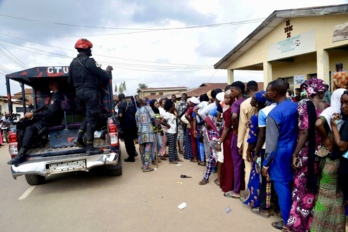
OSOGBO, Osun State — A potentially explosive allegation has emerged from Otan-Ayegbaju in Boluwaduro Local Government Area of Osun State, where residents claim that a police Divisional Police Officer (DPO) led suspected All Progressives Congress (APC) thugs in an attempt to remove election materials from the area during Saturday’s governorship election.
The allegation, which emerged through a video reviewed by SaharaReporters, has placed fresh scrutiny on the neutrality of security personnel deployed to protect voters, electoral officers and sensitive election materials in a contest already marked by unusually high political tension.
Crucially, the allegation remains unverified. The identity of the police officer could not immediately be independently established, the exact materials allegedly targeted were unclear from the available footage, and SaharaReporters reported that there was no immediate response from the Osun State Police Command when it filed its report.
That distinction matters.
An accusation that a serving police officer personally led political actors in an attempt to interfere with election materials, if ultimately established, would move the matter beyond the familiar terrain of partisan street violence. It would raise a much more serious question: whether an officer entrusted with protecting the electoral process became an alleged participant in an effort to disrupt it.
‘The police boss led thugs here’
In the footage reported by SaharaReporters, residents are heard confronting what they believed was an attempt to disperse them while election materials were allegedly being moved.
One resident said:
“The police boss led thugs here and they are now trying to chase us away, we are not leaving.”
SaharaReporters said the residents resisted the reported attempt to remove the materials. However, the available footage does not independently establish who the alleged thugs were, whether they were acting for the APC, what materials were involved, or the identity and precise role of the police officer being accused.
Those unanswered questions are now central to the story.
There is a profound difference between an allegation appearing in a politically charged environment and an independently established fact. In an election where misinformation, intimidation and competing accusations can themselves inflame tensions, the burden is on the authorities to determine exactly what happened.
Why the allegation is particularly serious
Election materials are not ordinary political property.
Once deployed, sensitive materials fall within the chain of responsibility surrounding the conduct and integrity of the election. Any unauthorised movement, seizure, concealment or destruction could potentially interfere with voting or subsequent verification and collation.
That is why the conduct of security personnel matters so much.
Yiaga Africa, in its pre-election assessment, warned that Osun 2026 would be a major test of the neutrality and professionalism of security agencies. The organisation specifically said security personnel must protect the election without becoming participants in the contest and should act impartially rather than create the perception that they are aligned with any political actor.
The warning now looks particularly relevant.
Yiaga Africa had also identified security threats, vote-buying, inflammatory political rhetoric, BVAS-related challenges and logistical pressure as potential risks surrounding the election. INEC said the poll involved 3,763 polling units across Osun’s 30 local government areas, with 4,427 BVAS devices deployed and 2,339,233 registered voters eligible to participate.
The scale means that even isolated incidents can carry consequences beyond the immediate locality.
A police command already under intense scrutiny
The Otan-Ayegbaju allegation did not emerge in an institutional vacuum.
For weeks, the conduct and neutrality of the police in Osun have been the subject of political controversy. In June, Accord lawmakers demanded the redeployment of then Commissioner of Police Ibrahim Gotan, accusing the command of failing to act impartially against alleged political violence. The APC rejected the accusations as politically motivated.
There have also been competing claims from both major political camps over attacks, intimidation and alleged sponsorship of political violence.
The APC has repeatedly denied sponsoring violence. Its governorship candidate, Bola Oyebamiji, publicly warned against voter harassment and said anyone caught intimidating voters should face security agencies. He said:
“I am assuring you that no one can intimidate or harass you to prevent you from participating in the poll. Any thug or hoodlum caught harassing people will be severely dealt with by security operatives.”
He had also declared:
“There is absolutely no reason for us to approach an election with violence.”
Those statements are important in assessing the allegation now emerging from Otan-Ayegbaju. A formal investigation, rather than partisan interpretation, would be required to establish whether anyone connected to the APC was involved and, even more importantly, whether any police officer facilitated such conduct.
The broader security picture: more than one flashpoint
The Otan-Ayegbaju allegation comes against a backdrop of other troubling developments on election day.
Earlier on Saturday, the Imole Campaign Council, the campaign organisation supporting incumbent Governor Ademola Adeleke, alleged that armed security personnel had surrounded the residence of the Speaker of the Osun State House of Assembly, Adewale Egbedun.
According to spokesperson Pelumi Olajengbesi, more than 10 black Hilux vehicles reportedly arrived at the residence and surrounded the premises.
The statement said:
“We have received reports that the residence of the Speaker of the Osun State House of Assembly, Rt. Hon. Adewale Egbedun, has been surrounded by armed security personnel who reportedly arrived in more than 10 black Hilux vehicles.”
It added:
“We have also been informed that the residence has effectively been sealed off, with everyone inside reportedly prevented from leaving the premises.”
But the campaign council itself acknowledged that it had not independently confirmed the purpose of the deployment, including whether the officers were providing security or carrying out official duties. It said attempts to reach senior police officials and the Police Situation Room were unsuccessful.
That caveat is essential.
The Speaker’s residence allegation, like the Otan-Ayegbaju allegation, is not proof of wrongdoing by security personnel. It is an allegation requiring clarification.
Yet when two politically sensitive security claims emerge on the same election day, the cumulative effect is significant: public confidence begins to depend not merely on whether security agencies are acting lawfully, but on whether citizens can see enough transparency to believe that they are.
Police action elsewhere shows the command is responding to election-related threats
There is also evidence that the police are actively intervening in alleged electoral offences elsewhere in Osun.
The state command arrested a serving State House of Assembly member, Abiola Ibrahim Inaolaji, alongside 146 suspected electoral mercenaries allegedly found at his residence in Ikire. More than 200 Permanent Voter Cards were reportedly recovered, while police said the suspects were allegedly brought into the state from neighbouring states. The command said further details would be provided by its public relations officer.
The Nigerian Fact-Checkers’ Coalition subsequently classified the reported arrest of the lawmaker and 146 suspects as correct, citing reports and confirmation from the police command.
This provides an important counterpoint.
It demonstrates that the security agencies are not simply standing aside during the election. They are making arrests and acting against conduct they regard as potentially capable of undermining the poll.
That makes the alleged conduct in Otan-Ayegbaju even more deserving of a transparent inquiry.
If a police officer was merely responding to an incident, that should be established. If the officer was legitimately securing electoral materials, that should be explained. But if an officer crossed the line into facilitating political interference, that too must be established and dealt with.
Another police incident: tear gas officer arrested
The command has also acted swiftly in response to another election-day controversy.
A police officer was arrested after an accidental tear-gas discharge at a Registration Area Centre in Modakeke Ward 10, Ife East Local Government Area. The command stressed that the incident occurred at a RAC rather than a polling unit and described the discharge as negligence by an officer who was attempting to ease himself.
The police said the conduct was “highly condemnable” and “far below the standard expected of an officer” and confirmed that the officer had been apprehended while an investigation continued.
The episode offers a useful benchmark for the Otan-Ayegbaju controversy.
If the command can publicly identify, arrest and investigate an officer over negligent handling of tear gas, stakeholders will reasonably expect the same seriousness where a serving officer is accused of politically interfering with election materials.
The danger of allowing allegations to outpace evidence
There is another lesson emerging from the election-day information environment.
The Nigerian Fact-Checkers’ Coalition has already had to investigate claims concerning alleged seizure of election materials. In one case, an online claim that APC thugs had carted away election materials in Ada, Boripe Local Government Area was found to be incorrect after the coalition contacted the Osun INEC Resident Electoral Commissioner, Oluwatoyin Babalola, and the Commissioner of Police in charge of election security, Samuel Etaifo. Both said they had received no such report.
That does not disprove the separate Otan-Ayegbaju allegation.
It does, however, demonstrate why every claim circulating during an election must be examined carefully.
A viral video may show a confrontation without revealing what happened immediately before it. A political accusation may identify an alleged perpetrator without establishing motive. A crowd may interpret a security operation one way while officers involved may offer another explanation.
The danger is that a false allegation can trigger violence just as easily as a genuine act of electoral interference.
The test now is transparency
By late afternoon, voting had closed at many polling units and counting had begun, with INEC results starting to appear on the IReV results portal.
That transition makes the credibility of the remaining process even more important.
The central question is no longer simply who wins individual polling units. It is whether every lawful vote is protected from intimidation, whether electoral materials remain within the proper chain of custody, whether results are accurately transmitted and whether security agencies perform their duties without political favour.
President Bola Tinubu had earlier charged INEC and security agencies to guarantee a peaceful, transparent and credible election, while Yiaga Africa warned that the Osun poll would be a test of security neutrality and electoral professionalism.
The Inspector-General of Police, Tunji Disu, had also previously warned political actors that the election was not a battlefield. During his engagement with Governor Adeleke and stakeholders in July, he said:
“This is an election, not a war.”
He also said he had directed that political thugs and their sponsors be arrested and prosecuted, while promising fair policing without fear or favour.
That pledge now faces a real-world test in Otan-Ayegbaju.
What should happen next
The allegations should not be settled on social media.
The Osun State Police Command should identify the DPO responsible for policing the area, establish the officer’s movements, identify the personnel and civilians present, determine what election materials were involved, obtain and preserve the original video evidence, interview INEC officials and witnesses, and disclose its findings promptly.
INEC should also clarify whether any materials were authorised to leave the location and whether there was any disruption to the official chain of custody.
If the allegation is false, authorities should say so clearly and provide the evidence.
If it is true, disciplinary and criminal proceedings should follow.
And if the evidence is inconclusive, the public deserves to know that too.
The objective must not be to protect the reputation of a particular political party or security officer. It must be to protect the credibility of the election.
For Osun, this is bigger than Otan-Ayegbaju.
The election is the last major governorship contest before the 2027 general election and is therefore being watched closely as an indicator of whether Nigeria’s institutions can manage a fiercely contested electoral process without security agencies, political parties or their supporters crossing the constitutional and legal boundaries separating competition from coercion. Yiaga Africa described the poll as an important test of the country’s electoral preparedness under the new Electoral Act 2026.
The residents’ accusation from Otan-Ayegbaju may ultimately prove substantiated, mistaken or deliberately misrepresented.
But until the authorities establish which one it is, one fact remains unavoidable: an allegation that a police officer led suspected party thugs towards election materials is too serious to be ignored.
In an election already carrying the weight of national scrutiny, neutrality cannot merely be promised.
It has to be demonstrated.
Follow us on our broadcast channels today!
- WhatsApp: https://whatsapp.com/channel/0029VawZ8TbDDmFT1a1Syg46
- Telegram: https://t.me/atlanticpostchannel
- Facebook: https://www.messenger.com/channel/atlanticpostng