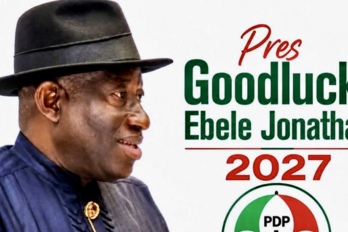
Former President Goodluck Jonathan has been thrust back into Nigeria’s most combustible political conversation, with fresh reports suggesting that some groups may pick up the Peoples Democratic Party presidential nomination form on his behalf on Monday, May 11, 2026.
SaharaReporters said sources close to the matter claimed the move could happen, but an associate in Jonathan’s camp insisted the position remained fluid, stressing that several groups were only pushing him and that no final decision had been confirmed.
The speculation gathered pace after Jonathan’s recent encounter with youth groups in Abuja, where he declined to give a direct yes or no answer and instead signalled that he was still weighing the matter.
He said the presidential race is “not a computer game” and added that he would “consult widely”, while also urging young Nigerians to be patriotic, defend peace and take part in elections by obtaining their voter cards.
He also warned that low voter turnout has become one of the country’s biggest democratic weaknesses.
That public hesitation has not stopped the political temperature from rising. On Thursday, a crowd of youths under the Coalition for Goodluck Jonathan staged a solidarity rally at his Abuja residence, chanting support for a 2027 comeback and presenting him as a unifying figure capable of rescuing the country.
Jonathan told the crowd he had heard them “loud and clear” and would consult widely before deciding, while also lamenting voter apathy as one of Nigeria’s most serious democratic problems.
At the same time, Jonathan is now fighting to keep the legal road open. In Abuja, the Federal High Court is handling suit FHC/ABJ/CS/2102/2025, filed by lawyer Johnmary Jideobi, who wants the court to permanently stop the former president from presenting himself to any political party for the 2027 election and to restrain INEC from accepting or publishing his name as a candidate.
Justice Peter Lifu had ordered hearing notices to be issued, while Jonathan’s camp, through senior advocate Chris Uche, filed a conditional appearance, preliminary objection, counter-affidavit and written address on May 5 and asked the court to throw out the case. The matter was adjourned to May 11.
Jonathan’s lawyers are arguing that the case is unnecessary because the issue of his eligibility has already been considered by superior courts.
Uche told the court the dispute had already been settled up to the Court of Appeal, while the plaintiff’s side said it had only just received Jonathan’s processes and needed time to reply.
The judge then fixed May 11 for hearing of both the preliminary objection and the substantive suit.
The deeper legal fault line is one that has followed Jonathan for years. Before the 2015 presidential election, the Court of Appeal cleared him to contest, holding that he became president through constitutional succession after the death of Umaru Musa Yar’Adua and that his first elected tenure began in 2011.
The controversy resurfaced after the 2018 constitutional amendment, which introduced Section 137(3), and that a separate suit ahead of the 2023 cycle was also resolved in Jonathan’s favour by the Federal High Court in Yenagoa, which held that the amendment could not apply retroactively to him.
That history explains why Jonathan’s possible return has become more than a simple rumour. It is now a live test of political appetite inside the PDP, a legal probe into the reach of Nigeria’s tenure rules, and a broader measure of whether the former president can still command enough public trust to re-enter the national arena.
For now, the evidence points to three simultaneous realities: pressure is building from supporter groups, the courts are preparing to hear a renewed challenge, and Jonathan himself has kept his decision deliberately open.
Follow us on our broadcast channels today!
- WhatsApp: https://whatsapp.com/channel/0029VawZ8TbDDmFT1a1Syg46
- Telegram: https://t.me/atlanticpostchannel
- Facebook: https://www.messenger.com/channel/atlanticpostng