The EFCC questions now surrounding the Moreplex-MultiChoice fight
The reported intervention of the Economic and Financial Crimes Commission (EFCC) in the long-running dispute between Moreplex Television Limited and MultiChoice Nigeria Limited has opened a new and potentially explosive chapter in Nigeria’s already contentious pay-TV and broadcasting industry.
At face value, the underlying disagreement is about access to premium television content — including sports and news channels. But the controversy has now expanded into questions about the boundary between commercial litigation, broadcasting regulation, copyright enforcement and criminal investigation.
The most important question is therefore not whether the EFCC can investigate private companies. It plainly can investigate economic and financial crimes involving private persons and corporate entities. Its statutory functions include investigating financial crimes and examining reported cases of economic and financial crimes involving individuals and corporate bodies.
The harder question is this:
What precise criminal offence was allegedly being investigated in the Moreplex matter, what evidence triggered the intervention, and how directly did that alleged offence relate to the commercial and regulatory dispute already before the courts?
That distinction matters enormously.
And it matters even more because a remarkably similar conflict involving another indigenous broadcaster, Metro Digital Limited, produced a major judicial rebuke of an EFCC operation only months ago.
That parallel cannot be ignored.
Moreplex dispute began as a battle over broadcasting access
The Moreplex controversy is rooted in the amended 6th Edition of the Nigerian Broadcasting Code, particularly its provisions on competition, premium content and sports rights.
The NBC’s own published version of the Code says its amendments were intended, among other things, to restrict monopolistic and anti-competitive conduct within Nigeria’s broadcasting industry. (NBC)
The sports-rights provisions are particularly consequential.
Section 6.2.5 requires rights owners of live foreign sporting events to offer rights to broadcasters across several platforms, including satellite/DTH, cable, terrestrial television, internet, mobile and IPTV. Section 6.2.8 goes further, stating that exclusivity of sporting rights in Nigeria is prohibited and that broadcasters or licensees must not acquire rights in a way that excludes Nigerian broadcasters from sub-licensing them.
The Code states bluntly:
“exclusivity of sporting rights in Nigeria is prohibited.”
It also provides that, where a dispute under the relevant provisions cannot be resolved amicably, the Commission may arbitrate, with its decision stated to be binding.
The Code further says under section 9.1.1.9 that a decision of the NBC is binding on broadcast licensees where the subject matter concerns broadcasting in Nigeria, irrespective of contrary contractual arrangements.
It is against that regulatory backdrop that Moreplex approached MultiChoice for access to requested channels and, according to documents and accounts cited in the dispute, complained after the request was allegedly rejected.
The March 2024 judgment changed the stakes
According to records and reports concerning Suit No. FHC/PH/CS/129/2023, Moreplex commenced proceedings before the Federal High Court in Port Harcourt challenging MultiChoice’s refusal to sublicense requested content.
A report reproducing details of the litigation states that Justice Phoebe M. Ayuba delivered judgment on 8 March 2024, ruling in Moreplex’s favour and finding MultiChoice’s refusal unlawful under the Broadcasting Code. It further reported an award of ₦200 million in general damages, with 10 per cent post-judgment interest.
The litigation also involved the NBC, which Moreplex accused of failing to properly enforce the regulatory framework.
The dispute did not, however, end with the Federal High Court judgment.
MultiChoice appealed.
And that is where one of the legal fault lines in the present controversy becomes important.
An appeal and a stay of execution are not automatically the same thing.
Nigerian appellate authorities have repeatedly held that filing an appeal does not, by itself, operate as a stay of execution. A stay requires a separate judicial order and is governed by established principles, including whether refusal of a stay would render a successful appeal nugatory.
Consequently, the legally relevant question is not simply whether MultiChoice appealed.
It is whether a valid stay of execution or other binding appellate order was granted.
That distinction is central to Moreplex’s position that the underlying judgment remained effective pending determination of the appeal.
The NBC directive is another crucial piece of the puzzle
Moreplex’s lawyers, in the rejoinder cited in the material supplied for this investigation, rely heavily on an NBC directive said to have been issued on 24 November 2024 directing MultiChoice to comply with Moreplex’s request “for channel sub-licensing”.
That assertion could not be independently located in the NBC’s publicly indexed website during this investigation, and Atlantic Post has therefore treated the directive as a documentary claim requiring verification from the original certified copy rather than presenting it as independently authenticated fact.
That caveat is important because the legal consequences are significant.
If the directive exists in the form alleged, it would demonstrate that the dispute was not solely a private contractual contest. It would show that the industry regulator itself had taken a substantive position on the rights-sharing question.
And that raises a further issue: why would a criminal law-enforcement intervention be necessary to resolve conduct already being regulated and litigated through statutory and judicial mechanisms?
The answer depends entirely on what criminal offence the EFCC was investigating.
The EFCC has powers — but those powers are not unlimited
The EFCC Establishment Act gives the Commission broad responsibilities.
Section 6 covers the investigation of financial crimes, while the Act empowers the Commission to investigate whether persons, corporate bodies or organisations have committed offences under the Act or other laws relating to economic and financial crimes.
That means the argument that a dispute involving a company can never attract EFCC attention would be legally unsustainable.
A private commercial transaction can generate criminal liability where the facts disclose fraud, money laundering, financial misconduct or another offence within the EFCC’s statutory remit.
But there is an equally important limitation in Nigeria’s criminal-procedure regime.
Section 8(2) of the Administration of Criminal Justice Act 2015 provides that:
“A suspect shall not be arrested merely on a civil wrong or breach of contract.”
That provision does not immunise a commercial actor from criminal investigation merely because litigation exists.
Rather, it demands a distinction between a civil dispute and a separate, evidence-based criminal offence.
That distinction is the heart of the Moreplex controversy.
Copyright complicates the “purely civil dispute” argument
There is, however, another side to the story that cannot responsibly be ignored.
Nigeria’s Copyright Act 2022 expressly protects copyright in broadcasts. Section 13 gives the rights holder exclusive control over acts including rebroadcasting and communication of the broadcast to the public.
The Nigerian Copyright Commission also has statutory responsibility for copyright administration, regulation and enforcement. Under section 78 of the Copyright Act, the Commission can investigate copyright infringements, settle qualifying disputes and prosecute proceedings arising under the Act.
The Commission publicly describes itself as the primary authority for copyright administration and enforcement in Nigeria and says its officers can investigate alleged infringements, conduct raids, make seizures and prosecute criminal infringements.
This is significant.
It means that an allegation that Moreplex was illegally intercepting, rebroadcasting or exploiting protected MultiChoice material could potentially raise criminal copyright questions, depending on the evidence and legal classification of the conduct.
Therefore, it would be wrong for any report to conclude merely from the existence of a civil judgment that no criminal investigation could lawfully take place.
The real issue is much narrower:
Was the alleged conduct genuinely evidence of a criminal offence, or was criminal enforcement being used to resolve the substance of a commercial and regulatory disagreement?
Only the petition, investigative file, seizure documentation, statements of the arrested persons and any eventual charge sheet can answer that conclusively.
Why the alleged Ilorin-to-Lagos operation raises questions
The most controversial allegation concerns the reported involvement of EFCC personnel said to have come from the Commission’s Ilorin office for an operation at Moreplex’s Lagos premises.
There is an important legal nuance here.
The EFCC Act does not establish a state-by-state criminal jurisdiction comparable to a state police command. The Commission is a federal institution with a nationwide mandate. Its operational commands therefore cannot automatically be treated as having authority only over offences occurring inside the state where the office is located.
So, the fact that officers allegedly came from Ilorin does not, by itself, prove lack of jurisdiction.
That would be an overstatement.
But the location issue remains a legitimate investigative question because operational allocation should ordinarily be traceable to an identifiable petition, investigative file, command structure or internal directive.
The crucial documents would include:
the original petition;
the alleged offence;
the date the petition was received;
the evidence attached to it;
the officer or command assigned to investigate;
the warrant or other legal authority for entry and arrest;
the identity of the persons named as suspects;
the grounds for taking each person into custody; and
the written authorisation, if any, for transferring a detainee from Lagos to Ilorin.
Atlantic Post found no publicly available EFCC statement or charge sheet specifically confirming the alleged Moreplex operation during this review.
That does not prove the operation did not occur.
It means the allegations remain allegations until the Commission, the courts or documentary evidence independently establish them.
The reported arrests raise even more serious questions
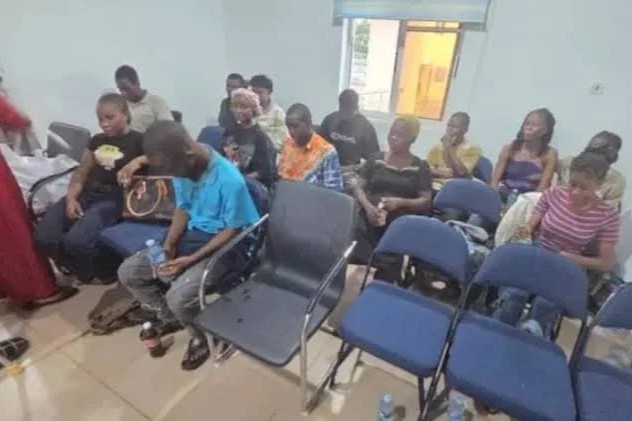
According to Moreplex’s account supplied to this publication, two people were allegedly arrested during the reported operation at the company’s Lagos premises.
One was said to be a woman who, Moreplex maintains, was neither an employee, director nor shareholder of the company.
The second was reportedly a contractor who happened to be present.
Those claims demand scrutiny because an arrest is legally about the individual suspect and the suspected offence, not merely association with a company or physical presence at a business premises.
The Administration of Criminal Justice Act provides safeguards surrounding arrest, including informing a suspect of the reason for arrest and rights to legal representation. It also requires the arrest and subsequent handling of suspects to be recorded.
The Constitution likewise protects personal liberty and requires an arrested or detained person to be informed in writing, within 24 hours, of the facts and grounds for the arrest or detention.
That is why the question posed in the material supplied for this investigation — “Why was a person allegedly unconnected to Moreplex arrested?” — cannot simply be dismissed.
If the woman had no corporate or employment relationship with Moreplex, investigators would need to explain what evidence linked her personally to the suspected offence.
The same applies to the contractor.
Presence is not guilt.
Association is not guilt.
And employment status alone cannot establish criminal liability.
The alleged transfer from Lagos to Ilorin needs a paper trail
The allegation that the woman was taken from Lagos to an EFCC facility in Ikoyi and subsequently transferred to Ilorin introduces another layer of legal scrutiny.
The key questions are procedural.
Who authorised the transfer?
What offence was recorded?
Was the transfer entered in the arrest records?
Was the detainee informed of the grounds?
Was access to counsel facilitated?
Was next-of-kin notification made?
Was the detainee brought before a court within the period required by law, or otherwise lawfully released?
The ACJA expressly provides safeguards governing arrested suspects, including notification of the reason for arrest, access to legal advice and recording of arrest details.
These are not technicalities.
They are precisely the protections designed to prevent investigative authority from becoming arbitrary power.
The Metro Digital case changes the context
Here lies perhaps the most important development discovered during this investigation.
The Moreplex controversy is not occurring in isolation.
In May 2026, the Rivers State High Court delivered a judgment in Suit No. PHC/3943/FHR/2025 involving Metro Digital Limited, EFCC and MultiChoice.
According to BusinessDay’s account of the ruling, Justice Chinelo Odili declared an October 2025 EFCC operation at Metro Digital unlawful and unjustified, finding that it arose from a civil copyright dispute. The court reportedly found that staff were arrested, company equipment was seized and broadcasting operations disrupted.
The court awarded ₦10 million in damages against the EFCC and MultiChoice and granted a perpetual injunction restraining the EFCC, MultiChoice and other security agencies from further harassment, arrest or interference with Metro Digital’s business over the dispute.
The case is particularly striking because the underlying conflict also concerned broadcast sub-licensing rights.
BusinessDay reported that the underlying copyright dispute was linked to proceedings before the Court of Appeal and an appeal pending at the Supreme Court. It also reported that Justice A.T. Mohammed of the Federal High Court had earlier set aside preservation orders and ordered the EFCC to return items seized during the raid.
That is not a minor coincidence.
It provides a fresh judicial record showing that, in at least one related broadcasting dispute, a court found that the use of EFCC powers had crossed the line into unlawful interference.
Yet an important distinction must be maintained.
The Metro Digital judgment does not automatically determine the legality of any Moreplex operation.
Each case turns on its own facts, evidence and legal authority.
But it unquestionably makes the Moreplex allegations more worthy of scrutiny.
And there is another twist: the EFCC still prosecuted Metro Digital
The complexity becomes even greater.
On 5 May 2026, just days after the Rivers State High Court judgment, the EFCC arraigned Metro Digital before the Federal High Court in Port Harcourt on an amended four-count charge involving alleged cybercrime and unlawful interception and rebroadcast of MultiChoice content.
The judge ordered the company to take its plea after rejecting an attempt by the defence to halt the arraignment.
This creates a crucial legal lesson for the Moreplex debate.
An allegation may simultaneously generate:
a civil dispute;
a regulatory proceeding;
a copyright claim;
and, if supported by evidence of a criminal offence, a criminal prosecution.
The existence of one does not mechanically extinguish the others.
The real issue is whether the criminal process is being used because there is a genuine criminal case to answer.
MultiChoice’s position cannot simply be erased
Any serious investigation must also resist the temptation to portray MultiChoice as automatically being in the wrong simply because its commercial rival won a judgment.
MultiChoice has legal rights to defend its intellectual-property, contractual and commercial interests.
Copyright in broadcasts is expressly recognised by Nigerian law.
And in the Metro Digital proceedings, the EFCC was simultaneously pursuing criminal allegations involving alleged interception and rebroadcasting of MultiChoice material.
Therefore, the assertion that every enforcement action requested by a rights holder is necessarily an abuse of process would be legally indefensible.
The appropriate test is evidence.
What exactly was MultiChoice alleging?
What offence was contained in the petition?
Was the complaint about unauthorised broadcasting, signal interception, copyright infringement, tax fraud, money laundering, or something else?
Were separate complaints consolidated?
Did investigators independently test the allegations?
Were warrants obtained?
What materials were seized?
Who authorised the arrests?
And what ultimately happened to the people allegedly detained?
Those are the questions that distinguish journalism from corporate propaganda.
Tax allegations also require evidence
Moreplex reportedly disputes allegations that it illegally broadcasts MultiChoice/DStv material and has failed to meet its tax obligations.
Again, there are two different issues.
Tax liabilities are ordinarily matters for the relevant tax authorities under Nigeria’s tax laws. A disagreement over tax assessments does not automatically transform into an EFCC case.
But where investigators uncover evidence of fraud, criminal concealment, money laundering or another economic crime arising from financial conduct, an EFCC investigation could potentially be justified.
That is why the alleged tax component of the Moreplex petition must be examined independently rather than casually folded into the broadcasting dispute.
The public deserves to know whether tax allegations are a substantive criminal complaint or simply another layer of pressure inside the wider commercial confrontation.
What the regulators should explain
The first institution facing questions is the EFCC.
The Commission should be able to state, without disclosing sensitive investigative details:
Was there a Moreplex-related operation in Lagos?
Which command conducted it?
Under whose authority?
What offence was being investigated?
Was there a warrant or other lawful authority for the arrests and search?
How many people were detained?
What was the recorded basis for detaining each individual?
Was anyone transferred to Ilorin and why?
Were the relevant constitutional and ACJA safeguards followed?
There is nothing inherently unreasonable about demanding those answers from a powerful federal law-enforcement agency.
Indeed, transparency is essential precisely because EFCC investigations can carry enormous consequences for individuals and businesses even before a case reaches trial.
The NBC also has questions to answer
The National Broadcasting Commission cannot escape scrutiny either.
The regulator’s own Code expressly seeks to promote competition and restrict anti-competitive practices.
Its rules also contemplate content-sharing and sub-licensing disputes.
Yet the Commission has faced litigation over the legality and scope of the amended 6th Edition.
In January 2026, TheCable reported that the NBC was preparing a broader review of the 6th Edition after years of controversy, litigation and judicial scrutiny, noting that Chapter Six on sports rights had become particularly contentious.
That means the regulator must now explain not only what its Code says, but how it expects competing government institutions and courts to interpret it.
If a broadcaster believes another operator is violating the Code, what is the proper regulatory route?
If the same conduct is alleged to constitute copyright piracy, when should the Nigerian Copyright Commission become involved?
When should the Police become involved?
When should the EFCC become involved?
And who resolves a dispute where contractual rights collide with broadcasting regulation?
Nigeria needs clearer answers.
The bigger danger: criminalising commercial competition
The most troubling possibility in disputes of this kind is not that one company wins and another loses.
It is that commercial competition becomes intertwined with coercive state power.
That is dangerous for everybody.
A smaller broadcaster must be able to challenge a dominant operator in court without fearing that litigation itself could trigger a law-enforcement operation.
A dominant broadcaster, on the other hand, must be able to report genuine piracy or financial crime without being told that every criminal complaint is merely an attempt to suppress competition.
The rule of law sits between those two extremes.
And the courts remain the arena where disputed legal rights should ultimately be determined.
Canal+ ownership adds a new dimension
There is also a broader corporate context that cannot be ignored.
Canal+ obtained effective control of MultiChoice Group in September 2025 after its takeover offer became unconditional.
That means the strategic significance of Nigeria’s pay-TV market has grown rather than diminished.
MultiChoice’s Nigerian interests now sit within a much larger international media structure, while indigenous competitors such as Moreplex continue to operate in a market where sports, premium news, broadcast technology, intellectual property and regulation overlap.
For regulators, this makes consistency even more important.
Nigeria cannot credibly court investment while allowing uncertainty about where commercial disputes end and criminal enforcement begins.
What happens next?
The Moreplex controversy now presents a series of test cases for institutional accountability.
The Federal High Court judgment in favour of Moreplex is one part of the legal story.
The appeal is another.
The alleged NBC directive is another.
The alleged EFCC arrests are another.
And the May 2026 Metro Digital judgment creates an important judicial backdrop.
But none of these should be artificially collapsed into a single conclusion.
Moreplex still has to establish the precise scope and continuing legal effect of its judgment and any subsequent orders.
MultiChoice retains the right to defend its intellectual-property and contractual interests.
The EFCC has the lawful authority to investigate genuine economic and financial crimes.
And copyright infringement can, in appropriate circumstances, carry criminal consequences under Nigerian law.
What the EFCC cannot do is use the mere existence of a commercial disagreement as a substitute for establishing a criminal offence.
That is precisely why section 8(2) of the ACJA matters.
And that is why the Metro Digital judgment matters.
The questions that should now be on the EFCC chairman’s desk
The unanswered questions surrounding the Moreplex operation are too consequential to be left to anonymous sources and competing corporate narratives.
The EFCC should identify the legal foundation of its reported intervention.
Moreplex should make available the relevant court orders and NBC directive on which it says its conduct rests.
MultiChoice should clarify precisely what criminal conduct it complained of, rather than allowing the public debate to remain framed only as a fight over broadcasting rights.
And the NBC should publish, where legally permissible, the regulatory directive that reportedly ordered MultiChoice to comply with Moreplex’s sub-licensing request.
Until those documents are independently tested, neither side should be allowed to convert allegations into established fact.
That is the point at which the Moreplex controversy becomes bigger than Moreplex.
It becomes a test of whether Nigerian institutions can draw a clean line between regulation, litigation, copyright enforcement and criminal investigation.
The lesson from the Metro Digital judgment is already stark: when state coercive powers are deployed in a commercial dispute, the question is not merely whether the agency had good intentions.
The question is whether it had lawful authority, reasonable grounds and evidence sufficient to justify what it did.
For the EFCC, the burden is particularly high.
Its reputation depends not only on the number of arrests it makes, but on the quality of the cases it builds, the fairness with which it treats suspects and the confidence Nigerians can have that criminal justice is not being converted into a weapon in commercial warfare.
That is the real issue now confronting the Commission in the Moreplex-MultiChoice controversy.
And until the documentary questions are answered, the scrutiny is justified.
Follow us on our broadcast channels today!
- WhatsApp: https://whatsapp.com/channel/0029VawZ8TbDDmFT1a1Syg46
- Telegram: https://t.me/atlanticpostchannel
- Facebook: https://www.messenger.com/channel/atlanticpostng