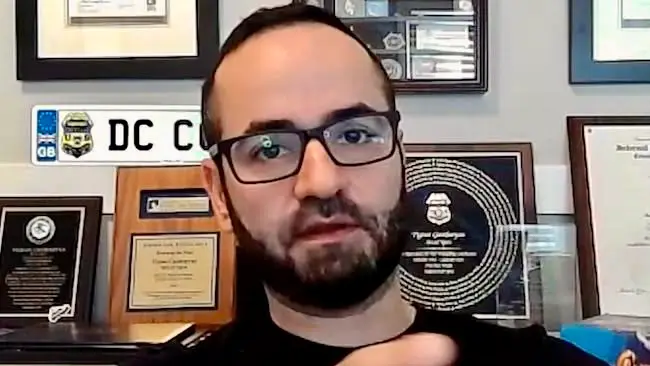
ABUJA, Nigeria — In a blistering salvo that has sent shockwaves through Nigeria’s political and financial circles, Tigran Gambaryan—the former Binance official embroiled in recent financial misconduct trials—has launched a vehement rebuttal against the Federal Government’s denouncement of his actions.
His response, dripping with sarcasm and fury, challenges the official narrative, accusing Nigerian authorities of fabricating allegations and orchestrating a campaign of misinformation.
A Fiery Rebuttal
Gambaryan’s response was unequivocal: “Maybe you should take the time to get your facts straight before posting.” In a series of incendiary remarks posted on social media, he levelled scathing criticism at the government for what he describes as a deliberate misrepresentation of his visits to Nigeria.
According to Gambaryan, he was invited by the Nigerian Financial Intelligence Unit (FIU) to a meeting in January—a meeting also attended by members of the legislative branch.
“Last time I checked, they are part of the Nigerian government,” he retorted, suggesting that his involvement was not a rogue initiative but rather an official engagement.
Challenging the Official Account
The former Binance official did not hold back when addressing claims that his second visit to Nigeria was part of a probe into the criminal manipulation of the nation’s currency through peer-to-peer platforms.
“You said the second part was part of a probe? Lol. So when you invited us to a friendly meeting, you even lied about that?” he exclaimed, ridiculing the government’s narrative.
This sarcastic dismissal not only questions the veracity of the official statement but also paints a picture of a government more interested in political theatre than factual reporting.
Gambaryan further alleges that during his time in Nigeria, he was confined to a safe house for a month—merely watching television while he claims Nigerian authorities used him as leverage against his will.
“I was in a safe house for a month, watching TV, while you were trying to use me as leverage,” he asserted, implying that his detention was less about due process and more about political expediency.
Allegations of Deceit and Mismanagement
One of the most provocative aspects of Gambaryan’s statement is his rebuke of the so-called humanitarian grounds cited by the Nigerian government for his release.
“So I was released on humanitarian grounds? At least you’re finally admitting the need to release me,” he observed, juxtaposing this admission against previous assurances that his health was perfectly fine. This contradiction, he argues, exposes a disturbing inconsistency in the government’s narrative.
Gambaryan also lambasted the investigative process, accusing authorities of neglecting his firsthand account. “You investigated? Yet you didn’t take a statement from me? A person with direct knowledge.
What a joke,” he fumed. His claims suggest that, despite his direct involvement and knowledge, the investigative process was one-sided and dismissive—a sentiment that casts a long shadow over the integrity of the ongoing inquiry.
A Narrative of Personal and Familial Trauma
In one of the most damning parts of his response, Gambaryan alleges that his name was dragged through the mud for over a year, resulting in severe personal repercussions.
“You dragged my name through the mud for the past year with zero evidence against me, nearly killed me, and caused trauma to my family,” he declared.
Such statements resonate deeply in a nation where public trust in governmental institutions is paramount, and they amplify the contentious nature of the dispute.
By invoking personal and familial trauma, Gambaryan not only defends his credibility but also shifts the spotlight onto what he perceives as a systemic abuse of power.
The Courtroom as the Ultimate Arbiter
Perhaps most telling is Gambaryan’s challenge to settle these disputes in a court of law—a setting he implies would expose the deficiencies of the governmental case against him.
“I’ll put my credibility on the line anytime. In court? You mean like last time, when your attorneys didn’t even show up to the human rights suit in Abuja?” he scornfully queried.
His remark alludes to a previous legal debacle that, in his view, further undermines the credibility of the Nigerian authorities. By invoking past legal missteps, Gambaryan is not only defiant but also signalling that the judicial system should be the arena where the truth is ultimately determined.
Public Reaction and the Wider Implications
Gambaryan’s explosive response has ignited a firestorm of debate on social media and in political circles. His supporters see him as a victim of governmental overreach—a man unjustly caught in the crosshairs of political machinations—while critics dismiss his claims as a desperate ploy to evade accountability. The conflicting narratives underscore the volatile intersection of politics, finance, and media in Nigeria today.
Analysts warn that such high-octane exchanges, if left unchecked, could further erode public trust in both the government and the judicial system. The stakes are enormous: the integrity of Nigeria’s financial oversight mechanisms and the credibility of its political institutions hang in the balance.
As both sides prepare for what promises to be an intense courtroom battle, the public is urged to remain discerning amid the barrage of accusations and counter-accusations.
A Battle of Narratives
At its core, the clash between Gambaryan and the Nigerian authorities is a battle over narrative control. On one side, the government insists that its actions were driven by a commitment to justice and transparency, vital for maintaining national stability.
On the other, Gambaryan contends that his treatment was nothing short of a politically motivated charade, designed to tarnish his reputation and silence his dissent.
This discord not only reflects the current state of Nigeria’s political discourse but also highlights the challenges inherent in regulating and verifying information in the digital age. With social media serving as both a battleground and a megaphone, the struggle to control public perception is as fierce as ever.
The Road Ahead
As the saga unfolds, both Nigerian authorities and Gambaryan are set to test their claims in court—a venue where evidence, not rhetoric, will prevail. Until then, the public is left to sift through a maze of conflicting accounts and emotive rhetoric.
What remains clear is that this high-profile confrontation is far from over, and its outcome will have profound implications for Nigeria’s political and financial future.
Atlantic Post will continue to monitor this developing story with the rigour and impartiality that has defined our reporting over the years. In a nation where every word carries weight, the pursuit of truth remains our paramount objective, regardless of the turbulence that accompanies it.
Stay tuned for further updates as we delve deeper into the heart of this escalating conflict, examining every twist and turn in the quest for justice and accountability.
Atlantic Post – Delivering incisive, in-depth, and fearless journalism in Nigerian politics for years.