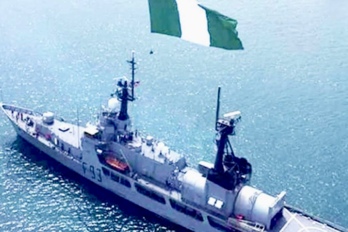
Nigeria’s latest maritime crackdown is a reminder that the Gulf of Guinea remains a contested security lane, not a calm stretch of water. Published reports show the Nigerian Navy flagged off its national component of Exercise Obangame Express 2026 in Onne, Rivers State, while the wider multinational exercise opened in Cameroon under U.S. sponsorship, with operations running from 13 April to 1 May and involving 30 nations.
That split launch is significant. It shows that Obangame Express is no longer a single ceremonial event but a regional security architecture spread across multiple coastal states.
At the centre of the Nigerian deployment are 10 ships, two helicopters, maritime domain awareness assets and Special Boat Service personnel. The mission is broad and blunt.
The Navy says the assets will be used against piracy, sea robbery, illegal arms and drug trafficking, crude oil theft and illegal, unreported and unregulated fishing.
They will also be pressed into visit, board, search and seizure drills, search and rescue tasks and simulated hot pursuit operations at sea.
In other words, this is not a parade of steel for public relations. It is a law-enforcement exercise built around fast-moving maritime crime.
The scale also matters because it is not new. The Nigerian Navy has used a similar Obangame template before, including deployments of 10 ships, two helicopters and Special Boat Service elements during earlier editions of the exercise.
In 2025, however, the Navy scaled that back to six ships and two helicopters, so the 2026 build-up suggests a stronger push to project presence and signal deterrence.
The question is why the heavier posture is back. The answer is likely simple enough. The threat has not disappeared, even if it has become less visible in headlines.
The latest global piracy figures support that reading. The ICC International Maritime Bureau reported 137 incidents against ships in 2025, up from 116 in 2024, while the Gulf of Guinea still recorded 21 incidents and 23 kidnapped crew in four separate cases.
The IMB also warned that naval presence remains essential to keeping piracy contained and to protecting trade routes. That is the uncomfortable truth behind the flag-off ceremony.
Nigeria may have improved its own waters, but the wider corridor remains vulnerable to opportunistic attacks, hostage-taking and criminal spillover.
UNODC’s long-running assessments reinforce the same point from a broader angle. The organisation has described the Gulf of Guinea as a major hub for maritime criminality, and in a major 2021 briefing it said 27 of the world’s 28 recorded kidnapping-at-sea incidents in 2020 occurred in the Gulf of Guinea.
UNODC has also argued that piracy and armed robbery at sea damage investment, weaken state control of offshore areas, slow blue-economy growth and feed illicit trading networks.
That makes the Nigerian Navy’s latest operation more than an anti-piracy drill. It is also an economic defence measure.
For the multinational dimension, Obangame Express remains one of the U.S. Africa Command and U.S. Sixth Fleet’s core maritime exercises.
AFRICOM says the drill is the largest multinational maritime exercise in Western and Central Africa and is designed to improve regional cooperation, information-sharing and tactical interdiction expertise.
The U.S. Navy adds that the 2026 edition is reinforcing the Yaoundé Architecture for Maritime Security, the regional framework meant to coordinate surveillance, legal response and shared action against maritime crime.
That is why the exercise matters beyond Nigeria. The Gulf of Guinea is a shared corridor, and criminal networks exploit any gap between national jurisdictions.
Vice Admiral Idi Abbas, through Rear Admiral P. E. Effah, framed the exercise as a test of readiness, logistics and teamwork.
His message is consistent with the long-running language of the drill: “unity of effort”, better interoperability and stronger intelligence sharing.
The political signal was equally clear in his commendation of President Bola Tinubu’s support for the Armed Forces.
But the political credit will only hold if it translates into measurable security outcomes at sea, not just another round of speeches and photographs on the jetty.
That is the real story here. Nigeria is still fighting a layered maritime threat economy in which piracy, oil theft, trafficking and illegal fishing overlap and feed one another.
The navy’s 10-ship, two-helicopter posture sends a message of intent, but the deeper test will be what happens after the exercise ends.
If intelligence sharing improves, prosecutions follow arrests, and patrols remain persistent, then Obangame Express will have done more than stage a show of force. It will have strengthened the sea wall around one of Africa’s most strategic economic corridors.
If not, the Gulf of Guinea will remain what it has too often been: a rich waterway patrolled hard for a few days, then abandoned to the criminals.
Follow us on our broadcast channels today!
- WhatsApp: https://whatsapp.com/channel/0029VawZ8TbDDmFT1a1Syg46
- Telegram: https://t.me/atlanticpostchannel
- Facebook: https://www.messenger.com/channel/atlanticpostng



