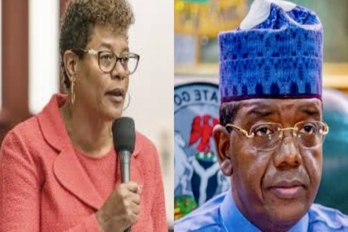
Florida lawmaker Kimberly Daniels says Nigeria’s defence minister tried to buy silence over a Christian killings report, turning a disputed security debate into a transatlantic scandal.
A political and diplomatic firestorm is building around Nigeria’s Minister of State for Defence, Bello Matawalle, after Florida lawmaker Kimberly Daniels accused him of attempting to bribe a United States official to derail a report describing killings in Nigeria as a Christian genocide.
The allegation, which Daniels made publicly during a live broadcast and repeated in follow-up remarks, has sent shockwaves through both Nigerian and American political circles.
Daniels claims a U.S. elected official was offered money by Matawalle in exchange for helping to discredit the findings of a report tied to the United World Congress of Diplomats.
She says the communication was real, the materials were circulated, and the pressure was deliberate.
No public evidence has been released to back the allegation, and the claim remains unproven.
But the political damage may already be done.
The matter has landed at a dangerous intersection of faith, insecurity, diplomacy and power.
For months, international criticism of Nigeria’s security crisis has been hardening around claims that Christians are being specifically targeted in parts of the country.
The Nigerian government has repeatedly rejected that framing.
Officials insist the crisis is more complex, driven by insurgency, banditry, communal violence, land disputes and criminal networks rather than a single religious campaign.
That dispute has now become even more combustible.
Daniels says her organisation’s report was based on ground-level investigations across Nigeria and other countries, and that it captured attacks on churches and worshippers during Palm Sunday and Easter.
She alleges the findings were strong enough to trigger an effort to silence or weaken them.
Her claim is that Matawalle did not merely disagree with the report.
She says he tried to buy a counter-narrative.
That is an explosive charge in any setting.
In Nigeria’s case, it lands in the middle of a long-running debate over how the nation’s insecurity should be understood.
On one side are those who say religious communities, especially Christian communities in the North-Central and North-West, have suffered repeated and targeted assaults.
On the other are officials and analysts who argue that the violence is often driven by multiple overlapping forces, including banditry, terrorism, reprisal attacks and local land conflict.
Both sides agree on one thing.
The death toll is unacceptable.
The disagreement is over motive, pattern and responsibility.
That is why Daniels’ latest claim has generated such heat.
It is not just an accusation against a Nigerian minister.
It is part of a wider attempt to shape how the world sees Nigeria’s crisis.
If the claim is true, it would raise serious questions about political conduct, lobbying ethics and the handling of a highly sensitive international controversy.
If it is false, it still exposes the scale of the credibility war now surrounding Nigeria’s security narrative.
The Nigerian government has not officially responded to the bribery allegation at the time of filing this report.
That silence is itself feeding suspicion, debate and political pressure.
Matawalle has built his public defence around national security reform, inter-agency coordination and efforts to confront insurgency and banditry.
His supporters argue that he is being dragged into a foreign information war over a crisis he did not create.
Critics, however, say the controversy shows just how badly Nigeria’s security messaging has broken down.
The report Daniels linked to the allegations had already stirred outrage before the bribery claim emerged.
It accused elements within Nigeria’s security architecture of enabling attacks on Christian communities in parts of the North-Central and North-West.
It also argued that the Easter-season killings were not random.
According to Daniels, worshippers were deliberately attacked during sacred services.
Her language was deliberately sharp.
She described the violence as a brutal surge that specifically targeted religious congregations at their most vulnerable moments.
She also said the gap between official statements from Abuja and the lived reality in affected communities was deeply troubling.
That accusation, whether one agrees with it or not, has political force.
Nigeria’s insecurity has for years been measured not only by the number of dead but by the number of unanswered questions.
Who is behind the killings.
Why are communities repeatedly exposed.
Why does the state appear unable to prevent the bloodshed.
And why does every new incident produce a fresh battle over narrative rather than clarity.
Daniels says she has already escalated the matter in Washington.
She confirmed that the report was forwarded to U.S. officials, including Senator Marco Rubio, and called for deeper scrutiny.
She also insisted that she was not trying to wage war against Nigeria.
Instead, she said she wanted the allegations investigated and the killings stopped.
That distinction matters.
It places her statement in the language of accountability rather than open hostility.
But the accusation itself is still severe enough to demand hard questions.
Did anyone attempt to influence a U.S. lawmaker over the report.
Was there an inducement offer.
Was the material authentic.
And what exactly was sent, by whom, and for what purpose.
Those questions now sit at the centre of a growing international controversy.
For Nigeria, the timing could hardly be worse.
The country is already under pressure over mass abductions, village raids, church attacks and the broader collapse of security in several regions.
Any suggestion that a minister tried to purchase silence abroad will intensify scrutiny of the government’s credibility at home and abroad.
For the United States, the matter is equally sensitive.
Daniels is a sitting lawmaker, and her allegations involve a foreign minister accused of trying to manipulate an American political process.
That alone gives the story serious diplomatic weight.
At its core, this is no longer just a disagreement over a report.
It is a fight over legitimacy.
Who gets to define Nigeria’s crisis.
Who gets to speak for victims.
Who controls the narrative when blood is already on the ground.
And who, if anyone, tried to pay to change the answer.
Until the evidence is made public, the allegation remains exactly that.
An allegation.
But in the brutal politics of insecurity, perception can move faster than proof.
And this latest claim has already shoved Nigeria into a sharper and more dangerous spotlight.
Social Post
Florida lawmaker Kimberly Daniels has dropped a bombshell, alleging Nigeria’s Bello Matawalle tried to buy silence over a Christian killings report. If true, it is a scandal. If false, the narrative war just got uglier. Abuja must answer. #Nigeria #Matawalle #ChristianGenocide