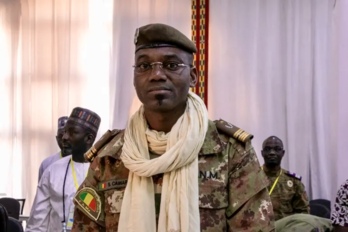
Mali has been thrown into fresh turmoil after authorities imposed a night curfew in Bamako in the wake of coordinated jihadist and rebel attacks that reportedly killed Defence Minister Sadio Camara, deepened fears over the junta’s grip on power, and forced the United States Embassy to tell American citizens to shelter in place.
The latest crisis has exposed just how fragile security has become in a country already battered by years of insurgency, coups, and widening distrust of the military leadership.
The US Embassy in Mali said on Sunday, April 26, 2026, that there was “a curfew in effect from 21:00 to 06:00 in the District of Bamako through the morning of April 28.”
It also instructed citizens to “continue to shelter in place, remain alert, follow local news for updates, and avoid areas where security operations may be underway.”
The advisory is a blunt reminder that the capital is no longer insulated from the violence spreading across the state.
What makes the crisis especially alarming is the reported killing of Sadio Camara, one of the junta’s most influential figures and a central architect of Mali’s post-coup military order.
Reuters reported that Camara was killed in an attack by the al Qaeda affiliate Jama’at Nusrat al-Islam wal-Muslimin, or JNIM, on his residence near the main army base in Kati, outside Bamako.
AP similarly said he died during the coordinated offensive, describing the violence as one of the most serious recent blows to Mali’s security establishment.
The reported attack on Kati matters because the town is regarded as one of the most heavily guarded military areas in Mali.
Reuters said the assault was part of a broader offensive that also spread to Bamako, Mopti, Sévaré, Gao and possibly Kidal.
AP reported that the attacks involved separatists and jihadists operating in tandem, which would mark a dangerous shift in the conflict and suggest that Mali’s enemies are now capable of more coordinated action than at any point in recent years.
That coordination is politically explosive. For years, Mali’s military rulers have presented themselves as the force capable of restoring order after two coups in 2020 and 2021.
Camara, according to Reuters, was a key figure in that military project and symbolised the junta’s hard line and its break with Western security partners in favour of a new alignment.
His reported death is therefore more than a battlefield loss. It is a direct strike at the heart of the ruling system’s credibility and a signal that the insurgency is still capable of reaching into the state’s inner circle.
The scale of the violence also appears to have stretched the security forces. Reuters reported sustained gunfire near Kati on April 26, a day after the initial attacks, suggesting that the confrontation had not fully ended even after the army claimed to have regained control.
That detail is important because it points to either incomplete containment or a wider intelligence failure, both of which raise serious questions about the junta’s preparedness and battlefield awareness.
International reaction has been swift. The Organisation of Islamic Cooperation said the military operations “seriously endanger the lives of civilians and threaten peace, security, and stability.”
Reuters also reported that the United Nations condemned the violence and called for an international response to the worsening insecurity in the Sahel. Such statements are not merely diplomatic routine.
They reflect growing alarm that Mali’s crisis is no longer a domestic insurgency alone, but part of a broader regional security breakdown with implications for neighbouring states already battling spillover violence.
The timing is also significant. The attacks came as Mali’s capital and several regional centres were already under pressure from insurgent activity, and as foreign observers watched for signs that the country’s military leadership might be losing its hold on strategic terrain.
The fact that Bamako, Kati, Gao, Kidal and Sévaré were all affected in a single wave of attacks suggests a level of planning that goes far beyond random hit-and-run violence.
It also shows that militant groups are still probing the state’s weakest points, even inside territory that the government considers secure.
For citizens inside Mali, the immediate consequence is simple: movement has become dangerous, uncertainty has deepened, and the state is responding with curfews rather than confidence.
For the junta, the wider problem is far bigger. If a defence minister can be reported killed in a major assault on the outskirts of the capital, then the old promise of restored stability looks increasingly hollow.
Unless the authorities regain credible control, improve intelligence and answer the rising sophistication of the insurgency, Bamako risks becoming a symbol of a state under siege rather than a capital in command.
Follow us on our broadcast channels today!
- WhatsApp: https://whatsapp.com/channel/0029VawZ8TbDDmFT1a1Syg46
- Telegram: https://t.me/atlanticpostchannel
- Facebook: https://www.messenger.com/channel/atlanticpostng