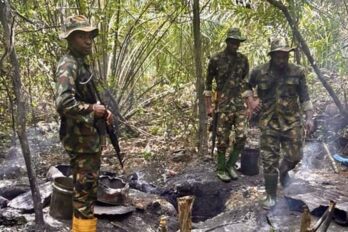
Troops of the 6 Division of the Nigerian Army have delivered another hard blow to the Niger Delta’s illicit oil economy, confiscating more than 130,000 litres of stolen crude oil and over 26,000 litres of Automotive Gas Oil, arresting nine suspected oil thieves and dismantling 10 illegal refining sites in operations that stretched from 1 to 26 April 2026.
The Army said the recovered products were worth more than ₦250 million, underscoring just how deeply organised oil theft remains embedded in the region’s creeks, forests and hinterlands.
According to the statement issued by the Acting Deputy Director, 6 Division Army Public Relations, Lieutenant Colonel Danjuma Jonah Danjuma, the troops maintained what the Army described as operational dominance across Rivers, Delta, Akwa Ibom and Bayelsa states, acting on intelligence-led targeting of bunkering hubs and refinery camps.
In Rivers State alone, soldiers intercepted an abandoned truck with registration number KMC 310 ZV Kano at Ukpeye Community along the East-West Road in Ahoada East, where it was found loaded with 45,000 litres of stolen products.
They later uncovered a reservoir in the Orashi National Forest in Ahoada West containing more than 35,000 litres of stolen crude and another holding over 26,000 litres of illegally refined AGO.
The scale of the recovery is important for one reason above all: Nigeria is still bleeding from oil theft on an industrial scale.
Reuters reported in late 2024 that oil remains the country’s economic lifeline, accounting for around two-thirds of state revenue and more than 90 per cent of foreign currency earnings, while the government was still wrestling with production that hovered around 1.8 million barrels per day.
NEITI has also said its audits over a 12-year period showed Nigeria losing, on average, more than 140,000 barrels of crude oil daily. Against that backdrop, every bunker busted is more than a policing victory. It is a small strike against a national revenue leak that has persisted for years.
What makes the latest haul striking is not only the volume but the spread of the seizures.
In Ebocha, Omoku, troops confiscated 266 sacks containing 17,760 litres of stolen products.
At Abessa Forest in Ahoada West, they found four drum ovens and 50 sacks containing more than 3,000 litres of crude oil, while two waste pits were destroyed.
At Okolomade in Abua/Odual, soldiers discovered 30 sacks holding over 1,500 litres of stolen crude.
In Delta State, an active tapping point linked to a storage pit was uncovered in Obazogbe Community, while in Akwa Ibom troops recovered 45 bags containing about 1,350 litres of illegally refined AGO.
That pattern suggests a dispersed and adaptive criminal chain, not isolated opportunism.
This is also why the Army’s own language matters. The force said it was determined to sustain pressure on the syndicates, while General Officer Commanding 6 Division, Major General Emmanuel Eric Emekah, commended the troops and urged them to maintain the tempo against “economic saboteurs”.
Earlier Reuters reporting showed that the military and other security agencies have been steadily escalating their anti-theft campaign, including the use of drones, attack helicopters and intensified intelligence under the broader Delta Sanity push.
The message from the security establishment is plain enough: the state does not view these sites as petty backyard operations, but as part of a wider assault on national assets.
Yet the bigger question is whether the raids are cutting deep enough into the business model of oil theft. Experience suggests the answer remains uncertain.
Reuters reported in 2024 that the military recovered nearly 700,000 litres of stolen crude in a single week-long operation, while another 2024 report showed 27 illicit refineries destroyed and about 100,000 litres seized in a separate Army sweep.
The repetition of these numbers points to resilience in the criminal supply chain. In plain terms, the same kind of sites keep reappearing because the underlying network of local facilitators, transport links, buyers and refinery operators has not been broken decisively.
That is an inference from the pattern of repeated seizures and raids, but it is an unavoidable one.
The environmental dimension is just as severe as the financial one. Reuters has repeatedly documented how spills, sabotage and illegal refining continue to blight the Niger Delta, damaging livelihoods, polluting creeks and undermining farming and fishing communities.
That means the cost of oil theft is not only measured in lost barrels and stolen litres. It is also measured in poisoned soil, damaged waterways and communities left to bear the consequences of a shadow economy that thrives around pipelines and reservoirs.
The Army’s latest operation may therefore be read as both a security intervention and an environmental containment effort, even if the larger cleanup of the region remains far beyond the reach of one sweep.
For Abuja, the political stakes are obvious. The government has repeatedly linked stronger anti-theft operations to the prospect of higher output, improved export receipts and reduced pressure on public finances.
Reuters reported that Nigeria has been pushing hard to raise production and strengthen pipeline security, with officials portraying the crackdown as central to revenue recovery. But the latest Army figures also show how much work remains.
If 130,000 litres can still be recovered in less than a month across just one theatre, then the theft economy is not merely surviving. It is still operating at scale, still feeding off gaps in surveillance, and still testing the state’s resolve.
The conclusion, therefore, is not simply that soldiers seized stolen crude. It is that Nigeria’s anti-oil theft war has moved into a more intense phase, with the Army trying to deny criminal networks room to breathe across the Niger Delta.
The latest operation will be welcomed in government circles, but the true test lies ahead: whether the pressure can be sustained long enough to translate tactical wins into lasting economic relief, cleaner communities and a meaningful reduction in the value being sucked out of the nation’s oil belt.
Follow us on our broadcast channels today!
- WhatsApp: https://whatsapp.com/channel/0029VawZ8TbDDmFT1a1Syg46
- Telegram: https://t.me/atlanticpostchannel
- Facebook: https://www.messenger.com/channel/atlanticpostng