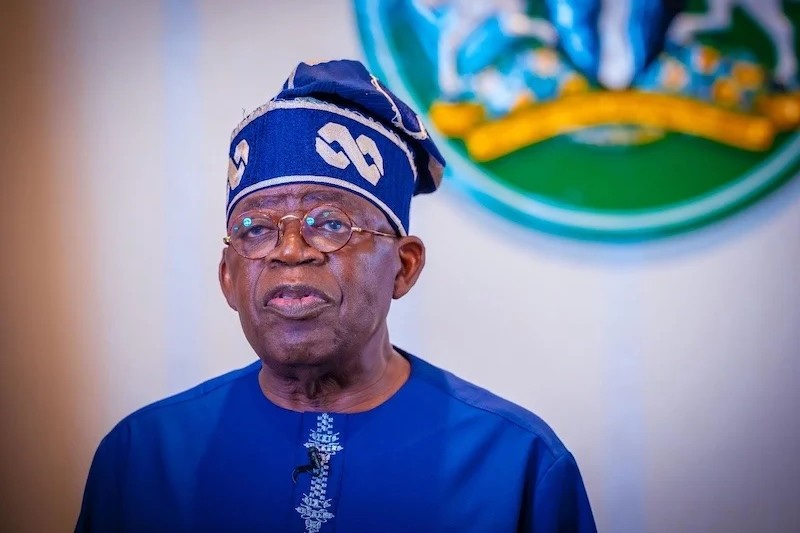
APC campaign chief Abdulaziz Yari believes Tinubu’s performance and campaign machinery will secure another presidential victory. But inflation, insecurity and the gap between economic recovery and household welfare could prove harder to overcome than political mobilisation.
ABUJA, Nigeria — President Bola Tinubu’s re-election campaign is increasingly turning towards a familiar combination of political mobilisation, religious conviction and claims of economic progress. But as Nigeria approaches its January 2027 presidential election, the ruling All Progressives Congress (APC) faces a question that no campaign slogan can answer: are ordinary Nigerians experiencing the improvements the government says it has delivered?
Senator Abdulaziz Yari, the former Zamfara State governor and Director-General of the APC Presidential Campaign Council (APC-PCC), believes the answer will ultimately favour Tinubu.
Speaking to journalists in Mecca, Saudi Arabia, where he joined the President and other prominent Nigerians for the Muslim lesser pilgrimage, Umrah, Yari expressed confidence that Tinubu’s performance record, faith in Allah and the campaign organisation’s ability to convince voters would secure another four-year mandate.
His remarks offered a revealing insight into the political strategy taking shape within the ruling party.
“That’s what makes a leader. When you ask President Tinubu, he first prays for the country and every Nigerian,” Yari said.
He explained that the President believes leadership ultimately rests with Allah, who determines who occupies political office.
Yari added that he was relying on divine intervention, as he believed had happened during the 2023 election.
“So, in total, I depend on Allah to do it for him as He did it for him in 2023,” he said.
But the APC campaign director-general also acknowledged that victory would require more than prayer.
He said the campaign council would have to work, engage Nigerians, convince them and demonstrate what the administration had achieved.
That admission may be the most politically significant part of his remarks.
The question is no longer simply whether the APC can mobilise its political structure. It is whether the party can produce a convincing account of its government’s performance that resonates beyond its traditional supporters.
The campaign begins with a promise to prove performance
Yari’s appointment places him at the centre of one of the most consequential political operations ahead of the 2027 election.
The State House announced on 22 August 2026 that Tinubu would chair the APC Presidential Campaign Council, with Vice-President Kashim Shettima serving as vice-chairman. APC National Chairman Nentawe Yilwatda was also named vice-chairman, while Yari was appointed director-general.
Imo State Governor Hope Uzodimma was appointed secretary.
The council also brought together influential figures from the National Assembly, state governments and the party’s national leadership.
This is a substantial political mobilisation structure, with access to the ruling party’s national networks and government leadership.
But political organisation and electoral popularity are not interchangeable.
A campaign can command governors, legislators, party officials and extensive grassroots structures without necessarily commanding the confidence of undecided voters.
The distinction will become increasingly important as the election approaches.
According to the Independent National Electoral Commission (INEC), the presidential and National Assembly elections will take place on 16 January 2027. Presidential campaigns formally commenced on 19 August 2026.
The APC therefore has a relatively short period to turn its claims of performance into a persuasive electoral argument.
Yari’s challenge is to explain not merely what the government has announced, but what has changed.
Economic recovery offers Tinubu a campaign advantage
There are measurable improvements the APC can legitimately place before voters.
Nigeria’s economy has experienced stronger growth following the difficult adjustment period associated with Tinubu’s removal of the petrol subsidy and foreign exchange reforms.
The World Bank’s October 2026 Nigeria Development Update reported that real GDP expanded by 4.2 per cent during the first half of 2026, compared with 3.9 per cent during the corresponding period in 2025.
Growth was supported largely by services and a stronger contribution from agriculture.
The World Bank also reported improvements in Nigeria’s external position, with the current account surplus increasing to $12 billion in the first half of 2026, compared with $8.6 billion during the same period a year earlier.
Higher international oil prices contributed to stronger export earnings and government revenues.
These figures provide the Tinubu administration with evidence of improved macroeconomic conditions.
They also demonstrate why international financial institutions have acknowledged the progress made through the government’s economic reforms.
But the political problem is that macroeconomic recovery does not automatically translate into improved living standards.
For millions of households, the most important economic indicators remain the cost of food, transport, housing, electricity and healthcare.
And these are precisely the areas where the government’s performance will face its toughest examination.
Falling inflation does not mean cheaper living
Nigeria’s inflation rate has declined considerably from the levels recorded during the height of the cost-of-living crisis.
National Bureau of Statistics figures showed headline inflation easing to 14.63 per cent in September 2026, compared with 15.39 per cent in August.
But food inflation remained high at 19.59 per cent.
This is an important distinction.
A falling inflation rate means prices are increasing more slowly. It does not mean food, transport and other essential goods have returned to their previous prices.
For households already struggling with reduced purchasing power, the difference between slowing inflation and actual affordability is significant.
In an October 15 Reuters report, a Lagos resident, Michael Udoariri, captured the frustration facing ordinary consumers.
“The common man is suffering. Everything has sky-rocketed,” he said.
Such concerns are politically important because voters experience economic policy through their daily expenditure rather than government economic presentations.
The International Monetary Fund’s June 2026 assessment estimated that poverty had reached 63 per cent under Nigeria’s national poverty line. It also estimated that 27 million Nigerians faced food insecurity in the autumn of 2025.
The World Bank subsequently reported that poverty had stabilised for the first time since 2019.
That is encouraging, but stabilising poverty is not the same as eliminating it.
For Tinubu’s campaign, the challenge is to demonstrate that the economic recovery is reaching households, workers, small businesses and vulnerable communities.
The unanswered question of subsidy savings
The administration’s decision to eliminate petrol subsidies and reform the foreign exchange market remains one of its defining economic interventions.
Both measures were intended to address structural distortions, improve government finances and restore confidence in the economy.
But the resulting increase in living costs has created a political burden that the government must still overcome.
In July 2026, Finance Minister Taiwo Oyedele acknowledged that savings from subsidy removal and foreign exchange reforms had largely been absorbed by higher debt-servicing costs and increased government expenditure.
That admission raises an important question for the APC campaign.
If the government is asking Nigerians to recognise the benefits of difficult economic reforms, it must also explain how the resulting savings have improved public services, infrastructure, employment opportunities and social protection.
The IMF’s June 2026 assessment projected that federal government interest payments would consume approximately 53.7 per cent of federal revenue in 2026.
This remains a significant fiscal constraint.
Yari’s promise to show Nigerians what the government has achieved therefore creates an opportunity for a more detailed public accounting of the reforms.
The APC cannot rely solely on explaining why the reforms were necessary. It must demonstrate what Nigerians have received in return.
Insecurity remains a major threat to the re-election narrative
Economic performance is only one part of the President’s electoral record.
Security may prove even more politically sensitive.
Nigeria continues to face an extensive security crisis involving banditry, mass kidnappings, insurgency and attacks on rural communities.
On 27 October 2026, the Associated Press reported that at least 62 people had been killed in an attack on Binnari community in Taraba State.
The attack reportedly wounded 52 people and displaced thousands. Authorities warned that the death toll could rise as recovery operations continued.
The incident is another reminder of the devastating consequences of Nigeria’s inability to guarantee security in vulnerable communities.
There are also worrying trends in the country’s kidnapping economy.
The Armed Conflict Location and Event Data organisation (ACLED) reported in September that Zamfara accounted for 12.3 per cent of recorded abduction incidents nationwide during 2026, the highest share among Nigerian states.
Niger State ranked fifth, accounting for 6.4 per cent.
ACLED also found that mass kidnappings had declined from the previous year’s peak but remained above pre-2025 levels.
These findings present a difficult backdrop for a government seeking another mandate.
The APC will need to show measurable improvements in protecting communities, securing highways, rescuing kidnapped victims and dismantling armed criminal networks.
For families living under the threat of abduction or displacement, political promises cannot substitute for physical security.
The 2023 victory is not a guarantee of another mandate
Yari’s reference to Tinubu’s 2023 victory is understandable from a political standpoint.
But treating that victory as a formula for another electoral success could be a strategic mistake.
Tinubu won the 2023 presidential election with 8,794,726 votes, representing 36.61 per cent of valid votes cast, according to the officially declared results.
International IDEA records voter turnout at just 26.71 per cent.
Turnout had fallen from 34.75 per cent in 2019 and 43.65 per cent in 2015.
The figures reveal an important weakness in Nigeria’s electoral politics: winning an election does not necessarily mean convincing a large proportion of the population to participate in the democratic process.
The next election presents an opportunity for the APC to strengthen its mandate by attracting voters who stayed away in 2023.
But doing so will require confidence in the electoral process, credible competition and a convincing explanation of why another four years of Tinubu would improve their circumstances.
It will also require the President’s campaign organisation to confront dissatisfaction rather than assume that party loyalty and political structures will overcome it.
Yari’s greatest challenge is turning claims into evidence
There is nothing unusual about a political campaign expressing confidence in its candidate’s prospects.
Nor is there anything inherently contradictory about a leader relying on religious faith while encouraging political supporters to work towards an electoral objective.
Yari himself acknowledged that campaigners must engage Nigerians and demonstrate what the administration has accomplished.
That is the standard against which his confidence should be measured.
The Tinubu administration can point to improved economic growth, stronger external balances and declining headline inflation.
But its critics can point to persistent food affordability problems, elevated poverty, debt-service pressures and the continued insecurity confronting communities across the country.
Both sides of that record deserve examination.
Ultimately, the 2027 election will not be decided by how many prominent Nigerians accompany the President to Mecca, how influential the campaign council becomes or how confidently party leaders predict victory.
It will be decided by voters exercising their constitutional rights.
Yari may believe Allah will repeat what happened in 2023.
But the APC must still persuade Nigerians that the country they are living in today offers stronger reasons to renew Tinubu’s mandate than the country they experienced when he first assumed office.
For a campaign built around performance, the most compelling argument will not be another declaration of confidence.
It will be evidence that the lives of Nigerians are genuinely getting better.
Follow us on our broadcast channels today!
- WhatsApp: https://whatsapp.com/channel/0029VawZ8TbDDmFT1a1Syg46
- Telegram: https://t.me/atlanticpostchannel
- Facebook: https://www.messenger.com/channel/atlanticpostng
Join the debate; let’s know your opinion.