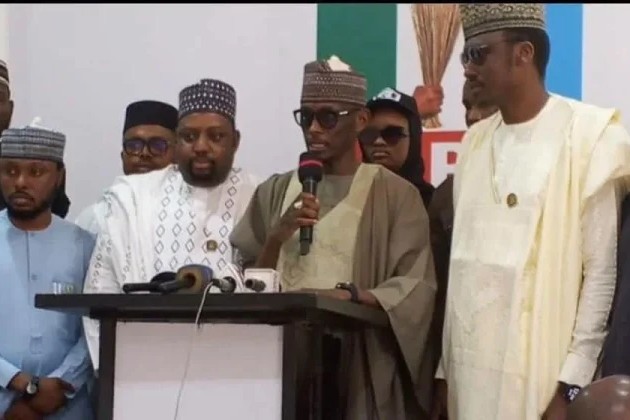
Abuja, Nigeria — The political divide between President Bola Tinubu and former Vice-President Atiku Abubakar has acquired an unusual family dimension, with Atiku’s son, Abba Atiku Abubakar, pledging 10 buses to support the President’s re-election campaign in 2027.
The pledge, announced during a visit to the All Progressives Congress (APC) National Secretariat in Abuja on Friday, 30 October 2026, places Abba more visibly on the side of the governing party as his father prepares to contest the presidency on the opposition platform of the African Democratic Congress (ADC).
Abba was received by Bukar Dalori, the APC Deputy National Chairman (North). According to a statement issued by Yusi Buba, the party’s Senior Special Assistant on Youth Mobilisation to the deputy national chairman, Abba expressed confidence in the APC leadership and supported continuity in Tinubu’s administration.
“In a demonstration of his commitment to the political engagement ahead of the 2027 general elections, Hon. Abba Atiku Abubakar announced the donation of ten buses to support activities aimed at mobilising support for the re-election of President Bola Ahmed Tinubu and Vice President Kashim Shettima in 2027,” the statement said.
The announcement is politically striking. But its significance extends beyond the optics of a prominent political family divided by competing electoral ambitions.
It raises a more consequential question: how much influence can political connections, family associations and mobilisation networks exert over an electorate increasingly concerned with economic hardship, public security and the performance of government?
A family political divide that has become a campaign asset
Abba’s decision to support Tinubu is not new. He defected from the Peoples Democratic Party (PDP) to the APC on 15 January 2026, declaring his intention to work towards the President’s re-election.
At the time, he was received by Deputy Senate President Barau Jibrin and other APC leaders in Abuja.
He also directed members and coordinators of his political organisation to align with the APC and support Tinubu’s Renewed Hope Agenda.
His father responded by drawing a clear distinction between personal family relationships and political convictions.
In a statement published on 15 January 2026, Atiku described his son’s defection as a personal decision.
“The decision of my son, Abba Abubakar, to join the APC is entirely personal. In a democracy, such choices are neither unusual nor alarming, even when family and politics intersect,” he said.
He added:
“As a democrat, I do not coerce my own children in matters of conscience, and I certainly will not coerce Nigerians.”
Atiku nevertheless maintained his criticism of the governing party, saying:
“What truly concerns me is the poor governance of the APC and the severe economic and social hardships it has imposed on our people.”
The former vice-president also reaffirmed his determination to work with political allies to offer Nigerians an alternative.
That response matters. It demonstrates that Atiku had publicly separated his son’s political decision from his own political ambitions long before the latest mobilisation announcement.
The APC may find considerable political value in the symbolism of Abba’s position. But his father’s response makes it difficult to present the development as evidence that Atiku himself has softened his opposition to Tinubu.
Indeed, the distinction is essential in a political environment where the actions of relatives are frequently presented as endorsements, political defections or indications of wider shifts in party allegiance.
The two-million-person march: mobilisation or political theatre?
The bus pledge was part of a wider political announcement. Abba unveiled the Haske Bola Tinubu Organisation (HBTO), presenting it as a nationwide platform intended to coordinate grassroots support for Tinubu and take government policies beyond political gatherings into communities.
His ambition is substantial.
He announced plans for a two-million-man mobilisation march across Nigeria’s six geopolitical zones, beginning in Abuja. The organisation also intends to establish political structures across the country, engage community leaders, youth and women’s organisations, and work with other political groups.
Abba described the organisation’s purpose as follows:
“Our objective is to build a structured, inclusive and nationally coordinated movement capable of mobilising support, engaging communities and communicating government policies.”
He also insisted that the initiative was about more than organising large political gatherings.
“This is not simply about numbers or political appearances. It is about building a disciplined, coordinated and effective grassroots mobilisation network,” he said.
The organisation has identified two immediate political targets: the Federal Capital Territory and Rivers State.
Abba indicated that HBTO would work with FCT Minister Nyesom Wike, whom he described as an important political figure in its mobilisation structure, to secure support for Tinubu in the capital and Rivers ahead of the election.
He also announced plans for a major mobilisation exercise in Rivers State in the first week of November 2026.
The Rivers component deserves attention. It suggests that HBTO is not simply trading on the publicity surrounding Abba’s family background. It is attempting to position itself within an existing network of political interests, influential figures and electoral calculations.
But the proposed two-million-person march should be treated as an aspiration, not an established measure of political strength.
There is an important difference between announcing a mobilisation target and demonstrating that a movement has the organisational capacity to deliver it. The announcement, as reported, does not establish how many people are already registered, how the six-zone exercise will be financed, or how participation will be independently verified.
Nigeria’s political history contains numerous examples of impressive crowd projections that have not necessarily translated into electoral victories.
A two-million-person gathering could generate enormous publicity. It would not, by itself, establish two million committed voters, much less guarantee their votes for Tinubu.
The 10 buses: a pledge that needs clearer answers
The most tangible element of Abba’s announcement is the proposed fleet of 10 luxury buses.
Yet the descriptions of the initiative in the available accounts leave an important distinction requiring clarification.
The statement from the APC official described the buses as a donation intended to support activities mobilising voters for Tinubu and Vice-President Kashim Shettima.
Abba’s separate press conference announcement, as reported by The Guardian and Voice of Nigeria, described a transportation support initiative intended to ease commuting difficulties, beginning in Abuja before expanding to other parts of the country.
These descriptions are not necessarily mutually exclusive. A transport initiative could provide a public service while also generating political goodwill for its sponsors.
But the distinction is important.
Are the buses being donated directly to the APC for campaign logistics? Will HBTO own and operate them as a commuter-support scheme? Will members of the public pay fares? Who will determine the routes, operating arrangements and maintenance costs?
The announcement, as reported, does not provide those operational details.
Nor does a pledge establish that the vehicles have been purchased, delivered or deployed.
These are not minor administrative questions. They go to the heart of whether the project is principally an electoral mobilisation resource, a public-facing social intervention or a combination of both.
If the buses are intended to help ordinary commuters, their eventual value should be measured by accessibility, affordability, reliability and the number of people served.
If they are intended for campaign mobilisation, their political purpose should be clearly acknowledged.
Either way, Nigerians deserve more than an announcement and a photograph of a political visit.
A complication: who owns the Haske political machinery?
There is another detail in Abba’s political journey that deserves scrutiny.
When he defected to the APC in January 2026, he announced that his political organisation, previously known as the Atiku Haske Organisation, would become the Haske Bola Tinubu Organisation.
That announcement did not go unchallenged.
On 18 January 2026, TheCable reported that Musa Bakari, who identified himself as the original initiator and convener of the Atiku Haske Organisation, disputed Abba’s authority to redirect the group towards Tinubu.
Bakari alleged that Abba was neither the organisation’s founder nor its originator, and said the group had not authorised the move to the APC.
He stated:
“We founded the Atiku Haske Organisation and we merely invited Abba to join the group.”
Bakari also alleged that Abba did not possess the organisation’s registration certificate and announced his expulsion from the group.
The organisation, according to Bakari’s statement, had resolved to move towards the ADC and support Atiku’s presidential ambition.
“The Atiku Haske Organisation is solidly behind Atiku,” the statement declared.
Those were the claims of the organisation’s convener, not an independently established legal determination of ownership.
Nevertheless, the dispute raises a legitimate question about the organisational foundations of the new pro-Tinubu platform.
Is HBTO a newly constituted organisation, a rebranded political structure controlled by Abba, or a continuation of an earlier movement whose ownership and political direction were contested?
The distinction matters because a political organisation’s claimed national reach depends not simply on its name, but on its recognised leadership, membership, institutional structure and capacity to mobilise supporters.
The latest unveiling establishes that Abba is presenting HBTO as his vehicle for supporting Tinubu. It does not, on its own, resolve the earlier dispute over the Atiku Haske Organisation.
What the 2027 election will actually test
The timing of Abba’s announcement is significant.
INEC’s revised electoral calendar places the presidential and National Assembly elections on 16 January 2027, with the governorship and state assembly elections scheduled for 6 February. The presidential campaign period began on 19 August 2026.
The ADC has publicly announced that it submitted Atiku Abubakar as its presidential candidate and former Rivers State governor Rotimi Amaechi as his running mate to INEC’s nomination portal on 2 July.
The contest therefore places father and son on opposing political sides in an election with potentially significant implications for Nigeria’s political future.
For the APC, Abba’s position offers an attractive political narrative: a member of the family of one of Tinubu’s most prominent opponents has chosen to campaign for the incumbent.
It is a potentially useful demonstration of political reach and an opportunity to promote the argument that support for Tinubu extends beyond traditional APC constituencies.
But political symbolism should not be confused with electoral evidence.
There is no demonstrated basis for concluding that Abba’s decision will automatically transfer Atiku’s supporters, political network or traditional electoral base to Tinubu.
Nor should his decision be presented as a reversal of his father’s position.
Atiku had already made his position clear in January. He would not dictate his children’s political choices, but he remained opposed to the governing party’s record.
The former vice-president’s criticism also leaves a fundamental challenge for the Tinubu campaign: the administration must persuade voters on its performance, not merely on the growing number of politicians and political associates declaring support for its continuity.
Abba says he supports the President because of policies including NELFUND, infrastructure investment and increased allocations to states. He has also acknowledged that the administration’s reforms have imposed difficult adjustments on Nigerians while arguing that their longer-term benefits deserve recognition.
That is a political argument. Its credibility will ultimately depend on what Nigerians experience in their daily lives, including the cost of food, transport, housing, healthcare and education, as well as employment opportunities and personal security.
A bus fleet and a large mobilisation march might help a campaign communicate its message. They cannot substitute for measurable improvements in living conditions.
The bigger question behind the family divide
Nigeria’s 2027 election is already becoming a contest over coalitions, political identities and the ability to organise support beyond established party structures.
Abba’s move illustrates how political alliances can cross family boundaries without necessarily changing the political convictions of the people involved.
It also demonstrates the growing importance of support organisations that operate around major political figures, offering campaign structures, community engagement, public interventions and mobilisation machinery.
The unanswered questions surrounding HBTO’s organisational history and the 10-bus initiative deserve attention as the group expands its ambitions.
Will the buses arrive? Who will operate them? Can the organisation substantiate its proposed nationwide reach? And will the promised two-million-person march translate into sustained political participation?
These are more consequential questions than the political spectacle of a son campaigning against his father’s preferred candidate.
For Tinubu, the announcement offers a useful political endorsement. For Abba, it provides an opportunity to build an independent political identity. For Atiku, it is another demonstration that his presidential ambitions cannot be assumed to command the allegiance of every member of his family.
But for Nigerian voters, the central question remains unchanged.
They are not voting for a political family. They are voting on the record, promises and credibility of those seeking to govern them.
And in January 2027, it will be the electorate, not the number of buses or the size of a proposed march, that determines who wins the presidency.
Follow us on our broadcast channels today!
- WhatsApp: https://whatsapp.com/channel/0029VawZ8TbDDmFT1a1Syg46
- Telegram: https://t.me/atlanticpostchannel
- Facebook: https://www.messenger.com/channel/atlanticpostng


Join the debate; let’s know your opinion.