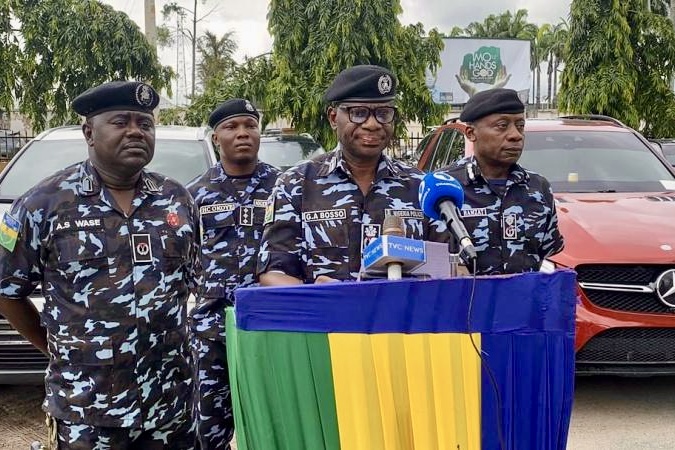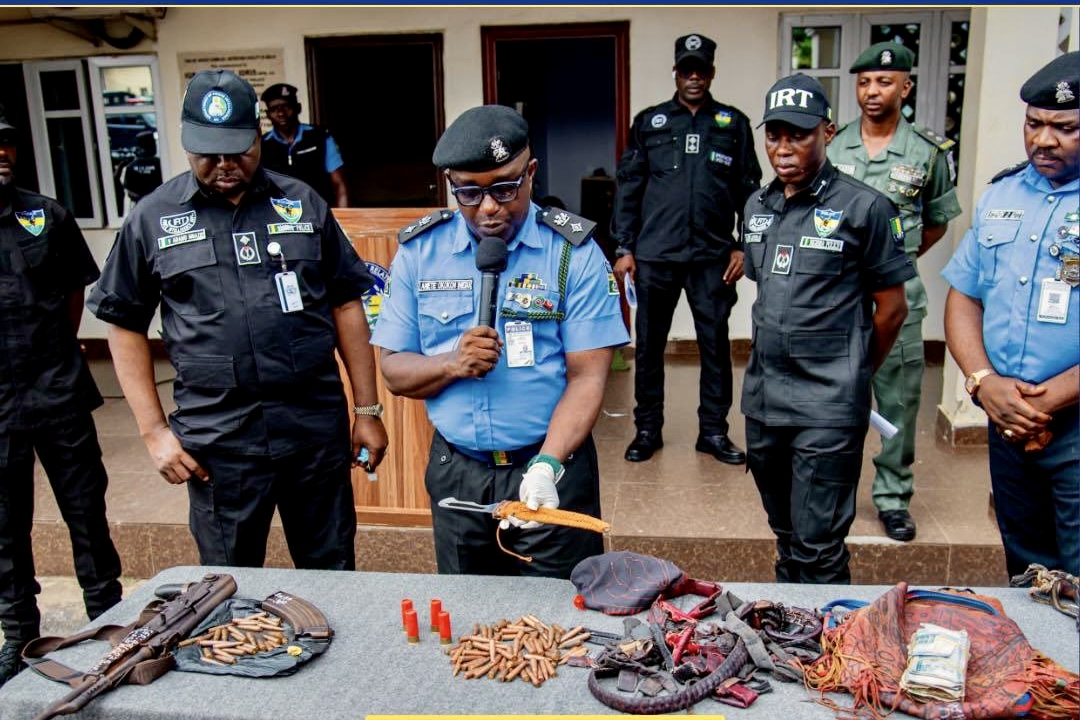
ABUJA, Nigeria — The Nigeria Police Force has arrested 10 suspects and recovered two AK-47 rifles, a Type 06 rifle, two magazines and 58 rounds of live ammunition in separate intelligence-led operations targeting suspected firearms traffickers and criminal networks.
The arrests, announced by Force Public Relations Officer, CSP Anietie Okokon Edem Iniedu, on Thursday, 27 August 2026, involved operations spanning Imo, Rivers and the North-Central region. The Force said the investigations were directed at networks allegedly involved in kidnapping, illegal firearms procurement, transportation and distribution.
At first glance, the seizure may appear modest when compared with larger arms interceptions recorded by Nigerian security agencies this year. But the significance lies less in the number of rifles recovered than in what the police say the investigations reveal: a potentially interconnected market in which firearms move between regions and are allegedly supplied to criminal groups involved in kidnapping and violent crime.
The police account also comes at a moment when Nigeria’s security agencies are under mounting pressure to choke off the weapons supply feeding kidnapping, banditry and other forms of organised violence.
Eight suspects linked to alleged kidnapping and arms network
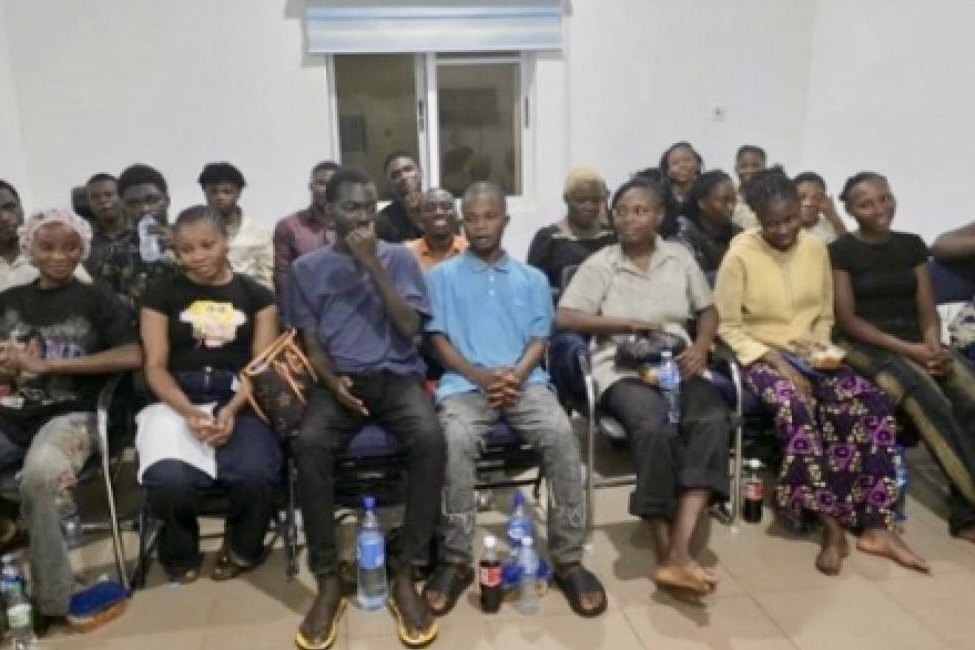
The police said eight of the 10 suspects were arrested during an operation across Imo and Rivers States, following intelligence concerning a suspected criminal syndicate allegedly involved in kidnapping and illegal firearms procurement.
At the centre of the operation was Mohammadu Sani, whom investigators identified as the principal suspect.
According to the Force:
“The operation led to the arrest of Mohammadu Sani, identified as the principal suspect, who was apprehended on the outskirts of Owerri, Imo State, with an AK-47 rifle and 30 rounds of 7.62mm ammunition.”
Police said preliminary findings showed that Sani had previously operated in Kogi State before moving to Port Harcourt, Rivers State, where he allegedly began rebuilding his criminal network.
That detail is potentially significant from an intelligence perspective.
Rather than describing a criminal group confined to one community, the police account points to a network allegedly capable of relocating between states and rebuilding its operational structure in a new environment.
The Force further alleged that members of the syndicate were linked to kidnapping operations in parts of Rivers and Imo States, while investigators traced the recovered firearm to an intermediary allegedly involved in firearms trafficking.
The remaining suspects in the eight-person group were identified as Moses Daniel, Usman Mohammad, Aliyu Manu, Ibrahim Mohammed, Samaila Ibrahim, Ahmed Abubakar and Umaru Abdullahi, according to reports on the police investigation.
The suspects had reportedly been handed over to the Force Intelligence Department–Intelligence Response Team following earlier arrests by the Office of the National Security Adviser, with the IRT continuing the investigation into their alleged activities.
The police allegations have not, however, been tested in court, and arrest does not amount to a finding of guilt.
Second operation exposes alleged North-Central firearms pipeline
The second operation focused on a suspected firearms-trafficking network operating in the North-Central region.
The police said operatives arrested Yakubu Danladi Pam and Abdulsalam Mohammed Hussain, recovering a locally fabricated AK-47 rifle, a Type 06 rifle, two magazines and 28 rounds of live ammunition.
Iniedu stated:
“Preliminary investigation indicates that the suspects were involved in the supply, transportation and distribution of firearms across parts of the North-Central and North-Eastern regions.”
That assertion is particularly important because it changes the character of the case from simple unlawful possession to an alleged distribution network.
The question for investigators is therefore no longer only who possessed the weapons, but who manufactured or sourced them, who financed the purchases, who transported them, who received them and whether the supply chain extends into established kidnapping, banditry or terrorist structures.
There is already evidence that investigators have been pursuing similar links.
In an earlier Plateau State investigation, police arrested Pam following intelligence linking him to alleged illegal possession of firearms. Police said he told investigators that he had obtained a locally fabricated firearm for personal protection and named a 19-year-old, Abdulsalam Mohammed Hassan, as the alleged supplier.
Channels Television reported that investigators subsequently arrested Hassan, who allegedly described himself as a middleman receiving firearms from unknown sources and supplying interested buyers for money. A Type 06 rifle, two magazines and 29 rounds of ammunition were reportedly recovered during that operation.
There is a naming discrepancy in reporting: the earlier Plateau investigation identifies the alleged supplier as Abdulsalam Mohammed Hassan, while the Force’s 27 August update identifies Abdulsalam Mohammed Hussain. The distinction should be resolved against the police case file before either name is treated as definitive.
The bigger security question: where are the guns coming from?
The arrest of 10 suspects matters because Nigeria’s firearms problem is increasingly less about isolated armed individuals and more about the networks that enable weapons to reach them.
The National Centre for the Control of Small Arms and Light Weapons has described illicit small arms and light weapons as a major national-security problem and a driver of terrorism, banditry and violent crime.
In March 2026, the Centre said it destroyed 2,800 illicit, obsolete, unserviceable and decommissioned weapons in Abuja and disclosed that it had destroyed more than 16,000 weapons since its establishment.
By July, the Centre said the Nigeria Police Force alone had supplied 11,907 illicit, obsolete, decommissioned and unserviceable weapons for destruction, comprising 8,438 automatic firearms and 3,489 locally fabricated guns.
The scale of those figures puts the latest police seizure into context.
The 58 rounds of ammunition recovered in the new operations are not, by themselves, evidence of a nationwide arms network. But when combined with the recovery of military-style rifles, intelligence linking suspects across different states and allegations of supply and transportation, they provide another indication of how illegal weapons can move through Nigeria’s criminal economy.
Customs seizure shows the supply problem extends beyond local manufacture
The firearms recovered by the police also form part of a broader national picture.
Earlier in August, the Nigeria Customs Service announced the seizure of 399 fully assembled JOJEF firearms and a large quantity of associated rifle components at the Tin Can Island Port in Lagos.
The weapons were discovered after Customs intercepted a container carrying concealed firearm components and conducted a detailed examination and coupling exercise.
The case demonstrated a different part of the firearms pipeline: weapons entering Nigeria through commercial logistics infrastructure.
Customs subsequently handed the seized rifles to the National Centre for the Control of Small Arms and Light Weapons. Two suspects were arrested in connection with the consignment, according to reporting on the case.
Taken together, the Customs seizure and the police arrests illustrate why firearms control cannot depend solely on road checkpoints and raids.
The threat exists at multiple points — international entry, local fabrication, intermediary networks, transport routes, criminal procurement and end-user distribution.
Why the arms trade is an economic problem
This is where the latest police operation moves beyond conventional crime reporting.
Illegal firearms are not merely a policing issue. They impose a substantial economic cost by making legitimate economic activity more expensive and risky.
Businesses operating in areas affected by kidnapping and armed violence face higher expenditure on security, transport protection, insurance, staff welfare and emergency response. Haulage operators may alter routes. Farmers may abandon productive areas. Construction projects may be delayed. Investors can demand higher risk premiums. Employees may refuse postings to insecure locations.
The World Bank continues to identify insecurity, including banditry and kidnapping, as one of the challenges constraining Nigeria, alongside infrastructure and logistics weaknesses. It has also stressed the importance of private-sector-led growth, productive investment and better connectivity for Nigeria’s economic expansion.
A functioning economy depends on people being able to travel, trade, farm, build, transport goods and invest without calculating the probability of being robbed or abducted.
Every illegal rifle that strengthens a kidnapping operation therefore has the potential to generate costs far beyond the price of the weapon itself.
Kidnapping is becoming a measurable criminal economy
The economic implications are becoming harder to dismiss.
A fresh SBM Intelligence report published on 27 August found that 7,825 people were abducted in 1,713 kidnapping and related incidents between July 2025 and June 2026, while at least 1,142 people were killed.
The report estimated that ₦7.78 billion was actually paid in ransom during the period, more than three times the ₦2.56 billion recorded in the preceding cycle.
Reuters reported the same study as showing that ransom demand and payment patterns had changed dramatically, with kidnappers collecting nearly $5.8 million over the period.
The significance for firearms investigators is straightforward.
A criminal market that generates billions of naira in ransom payments creates a financial incentive for gangs to acquire more weapons, recruit more personnel, secure transport and expand into new territories.
That is why arresting armed suspects is only one part of the equation.
The more difficult task is to identify the money, communications, suppliers, transporters, intermediaries and financiers behind the weapons.
Intelligence-led policing is becoming more important
The latest arrests also highlight the growing importance of intelligence-led investigations rather than relying exclusively on reactive policing.
In the Imo-Rivers case, the police say investigators were able to trace an alleged network across geographical boundaries.
In the North-Central case, investigators allegedly followed information concerning firearm supply and distribution.
That approach aligns with the broader direction of the police leadership.
The Inspector-General of Police, Olatunji Rilwan Disu, has in recent months ordered greater operational coordination, including deployment of senior officers across geopolitical zones and stronger inter-state policing arrangements.
The rationale is obvious: criminal organisations do not respect state boundaries.
An arms dealer can operate in one state, buy or fabricate weapons in another, transport them through several jurisdictions and ultimately supply a criminal group somewhere else.
A policing structure that remains territorially fragmented risks chasing the symptoms rather than dismantling the network.
But seizures alone will not solve Nigeria’s firearms crisis
There is a temptation in security reporting to measure success by the number of arrests or rifles recovered.
Those numbers matter, but they can also be misleading.
The real test is whether investigators can turn seizures into prosecutions, convictions and intelligence about the wider supply chain.
Nigeria has previously recorded significant weapons recoveries, including large seizures by police, customs and other security agencies. The National Centre’s destruction programme shows that the government is removing thousands of illicit weapons from circulation.
But destruction addresses the stock already recovered.
It does not automatically prevent new weapons from entering the country, being manufactured locally or being purchased by criminal organisations.
That requires sustained investigation into arms financing, stronger border controls, forensic tracing of firearms, intelligence sharing and effective prosecution.
The prosecution test now begins
For the 10 suspects announced this week, the next stage may ultimately be more important than the arrests themselves.
Police say investigations are continuing to identify other members of the alleged syndicates and establish the full extent of their activities.
Iniedu said:
“The Nigeria Police Force has intensified efforts to identify and apprehend other members of the syndicates and further disrupt the illegal movement of firearms used to facilitate violent crimes.”
The Force added that the recovered weapons and ammunition would form part of the evidence in the ongoing investigations.
The critical questions are now whether the recovered rifles can be forensically linked to specific crimes; whether investigators can identify the alleged intermediary or wider suppliers; whether financial records can establish payment channels; and whether the suspects can be successfully prosecuted on the evidence gathered.
Those answers will determine whether the latest operation is merely another arrest bulletin or a genuine intelligence breakthrough.
What is at stake for Nigeria’s economy?
The stakes extend well beyond the police stations where the suspects are being interrogated.
Nigeria is trying to attract investment, expand domestic production, strengthen logistics, create jobs and build a more competitive private sector. The World Bank says recent reforms have improved macroeconomic stability, but it continues to identify insecurity, infrastructure gaps and weak state capacity in parts of the country as major challenges.
Security failures can undermine those gains.
An investor does not assess a factory location on electricity and tax policy alone. Security, insurance, road access, staff safety, supply-chain reliability and the probability of disruption all enter the calculation.
For households, the cost can be even more immediate: ransom payments, medical expenses, lost income, relocation and the destruction of livelihoods.
For government, every prolonged security crisis also means more public resources diverted towards emergency deployments, patrols, intelligence, rescue operations and reconstruction.
The battle against firearms trafficking is therefore also a battle over Nigeria’s economic future.
Bottom line
The Nigeria Police Force’s arrest of 10 suspects and recovery of two AK-47 rifles, a Type 06 rifle and 58 rounds of ammunition should not be viewed simply as another crime statistic.
The more revealing issue is the alleged supply architecture behind the guns.
Police investigations point to suspects allegedly operating across states, an alleged intermediary system, local firearm fabrication and networks supposedly connected to kidnapping.
That makes the operation strategically important.
Nigeria has shown that it can seize and destroy weapons. The harder question is whether its security and justice institutions can consistently follow the weapons back to their sources, trace the money behind them and dismantle the networks that profit from violence.
Until that happens, the country risks fighting criminals at the point of attack while leaving the firearms economy that equips them largely intact.
And in a country where kidnapping generated an estimated ₦7.78 billion in ransom payments in one year, that is not merely a security failure.
It is an economic risk with a gun attached to it.
Follow us on our broadcast channels today!
- WhatsApp: https://whatsapp.com/channel/0029VawZ8TbDDmFT1a1Syg46
- Telegram: https://t.me/atlanticpostchannel
- Facebook: https://www.messenger.com/channel/atlanticpostng