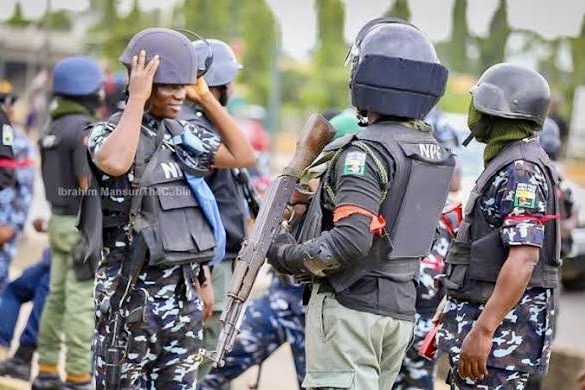
Ten police officers and two civilians were killed in a fierce gun battle between security personnel and suspected bandits in Sakaba Local Government Area of Kebbi State, in an encounter that has once again exposed the lethal security pressures confronting communities along Nigeria’s north-western frontier.
The Nigeria Police Force confirmed on Tuesday, August 11, 2026, that 10 of its personnel died after officers intercepted a heavily armed group suspected to be bandits along the Rafin Makuku axis on Monday morning.
According to the Force, at least 17 suspected bandits were neutralised during the engagement and four motorcycles used by the attackers were destroyed. Two additional police personnel were injured and were receiving medical treatment, while two civilians also died in the violence.
The figures present a grim picture of the encounter: 29 people were reported killed or neutralised across both sides and among civilians, with the police suffering one of their heaviest single-incident losses in the state in recent times.
But the immediate casualty count is only one part of the story.
The location, the movement of the attackers between Kebbi and Zamfara, the deployment of a 44 Police Mobile Force contingent on special duty, and the fact that the confrontation occurred after an interception raise broader questions about intelligence, operational readiness, border surveillance and the capacity of security agencies to prevent heavily armed groups from moving through vulnerable rural corridors.
How the Kebbi battle unfolded
The police said the confrontation happened at approximately 9:25 a.m. on Monday, August 10, when operatives intercepted suspected bandits moving between Zamfara and Kebbi states.
The encounter occurred along the Rafin Makuku axis in Sakaba LGA, an area that sits within a wider belt of rural communities and forest corridors where armed criminal groups have repeatedly operated across state boundaries.
The Force said the suspects were heavily armed and were travelling on motorcycles. Police engaged them in what became a prolonged and deadly exchange of fire.
By the end of the confrontation, 17 suspected bandits had been neutralised, according to the police, while four motorcycles belonging to the attackers were destroyed.
The security forces, however, paid a severe price.
Ten police personnel were killed and two others injured. Two civilians also lost their lives.
The remains of the slain officers were subsequently moved to Birnin Kebbi, while the police said additional personnel had been deployed to reinforce the area and pursue members of the criminal group who escaped.
The Force did not publicly provide, in the statement cited by major outlets, a detailed breakdown of the weapons recovered from the bandits, the number of attackers who escaped, or the precise composition of the police tactical detachment beyond the broader account of the operation.
Those details matter because they could help establish how the battle developed and whether the attackers were caught by surprise, whether the police force was outnumbered, and what tactical advantages enabled the suspected bandits to inflict such significant casualties.
Police confirm what an earlier SITREP had revealed
The official confirmation came after an earlier report by Sahara Reporters, which said it had obtained a police situation report, or SITREP, detailing the deaths.
According to the publication, the document dated August 10 stated that information available to police at about 7:40 p.m. showed that 10 personnel and two civilians had been killed following a gun duel at Makuku village in Sakaba LGA.
The reported document also said a team led by the Divisional Police Officer of Sakaba Division, DSP Umaru Bagudu, visited the scene and found the bodies of the slain officers.
That account provides an important timeline.
The confrontation reportedly occurred in the morning. However, information about the scale of the casualties was still being consolidated several hours later, suggesting that the difficult terrain and operational circumstances may have complicated immediate recovery and confirmation efforts.
Sahara Reporters further identified the 10 dead personnel as ASP Bala Buba, Inspector Saminu Sulaiman, Inspector Solomon Jatau, Inspector Ayuba Hassain, Inspector Umar Yahuza, Inspector Auwal Sani, Sergeant Jimoh Momo, Corporal Ukpong Otrukmj, Inspector Adamu Abdullahi and Inspector Abdullahi Magaji.
It reported that all 10 were attached to the 44 Police Mobile Force, Abuja, and were serving on special duty in the area.
The two civilians named in the reported SITREP were Mohammadu Magwawara and Muhammadu Tiritiri.
Atlantic Post has not independently verified the individual names in the reported SITREP against a separate official casualty list. They should therefore be treated as names contained in the document reported by Sahara Reporters rather than as a separately verified police casualty register.
Disproportionate cost for the police
The most sobering aspect of the incident is the number of police personnel killed in a single engagement.
Ten officers were lost while attempting to stop the movement of the armed group.
The police have not disclosed the exact number of officers involved in the operation, making it impossible to determine from the available public record whether the force was significantly outnumbered, whether reinforcements were delayed, or whether the attackers possessed superior firepower.
That missing information is central to understanding the tactical implications of the battle.
Mobile Police Force formations are among the Nigeria Police Force’s principal specialised formations for dealing with high-risk situations, including armed attacks and violent crime. A contingent of the 44 PMF being deployed on special duty in a rural and security-sensitive area indicates that authorities already regarded the environment as requiring reinforced policing.
Yet the outcome demonstrates the continuing difficulty of securing wide, sparsely populated terrain where criminal groups can exploit forests, motorcycles, informal tracks and state borders.
The police have not suggested that the officers were abandoned or poorly equipped, and no verified public evidence presently establishes that equipment failure or inadequate reinforcement caused the deaths.
What can be established is that a police contingent tasked with operating in an insecure corridor encountered a heavily armed group and suffered catastrophic losses.
That is itself a major operational warning.
The border corridor is the bigger security story
The battle did not take place in isolation.
Kebbi has experienced renewed pressure from armed groups in 2026, with state authorities warning that bandit activity had resurged in parts of the state.
In June, Governor Nasir Idris ordered an immediate review of existing security strategies after an emergency meeting involving senior military, police, intelligence and paramilitary officials. The discussions followed fresh attacks and concerns about the activities of armed groups, including the Lakurawa faction, in parts of the state.
The security problem is compounded by geography.
The Sakaba area contains numerous rural communities and settlements spread across a landscape where movement can be difficult to monitor. Official state records list Makuku among communities within Sakaba Local Government Area.
The wider Kebbi security environment has also featured cattle rustling, armed motorcycle snatching, bandit attacks and concerns over criminal networks using border corridors.
In May, the Kebbi police command said it had arrested dozens of suspects in connection with violent crimes and recovered assault rifles and other weapons. The command specifically cited armed banditry, cattle rustling, armed motorcycle snatching and the threat posed by Lakurawa elements operating along border corridors.
The pattern suggests that the problem is not simply a question of isolated bandit raids.
It is increasingly about control of space.
Armed groups that can move between jurisdictions create an enforcement problem for security agencies. Criminals do not have to respect administrative boundaries, but the security agencies confronting them operate through separate commands, formations and jurisdictions.
That makes intelligence-sharing, coordinated patrols, rapid reinforcement and pursuit operations particularly important.
Zamfara connection adds another layer
The police said the suspected attackers were moving between Zamfara and Kebbi when they were intercepted.
That detail is significant.
Zamfara has for years been one of Nigeria’s principal theatres of organised banditry, with heavily armed gangs using vast rural and forested areas to carry out raids, kidnappings, cattle theft and attacks on communities.
The Guardian reported in June that armed bandits in Zamfara abducted villagers who had gathered for a meeting supposedly intended to discuss peace negotiations, underlining the continuing capacity of criminal gangs to exploit local engagement and weak security environments.
The Kebbi-Zamfara connection therefore represents a broader operational challenge. A group that can move from one state to another can potentially evade pressure in one jurisdiction and emerge in another.
That is why the Rafin Makuku clash should not be interpreted merely as a local police-versus-bandit shootout.
It is also an example of the trans-state nature of insecurity in Nigeria’s north-west.
Kebbi has already seen attacks on security personnel
The latest incident follows a pattern in which criminals have increasingly demonstrated a willingness to confront security personnel rather than simply evade them.
Earlier in 2026, police operations in Kebbi led to arrests of suspected bandits and the recovery of rifles, ammunition and other equipment. In another incident in February, police said operatives repelled a suspected Lakurawa attack along a border road after engaging the attackers in a gun battle. No security personnel were killed in that particular encounter.
In June, the Kebbi police command also announced arrests linked to violent criminal activity in the Soda Forest axis and surrounding border communities, amid investigations into the killing of three Federal Road Safety Corps personnel.
The accumulation of such incidents is important.
When attacks repeatedly target roads, rural settlements and government personnel, they can gradually turn a security problem into a territorial problem.
The danger is that communities begin to adapt to the presence of armed criminal groups while legitimate state authority becomes increasingly episodic.
What the police are saying
Inspector-General of Police Olatunji Rilwan Disu expressed grief over the deaths and offered condolences to the families of the fallen officers.
He described the deaths as “a painful loss to the Force and the nation” and said the officers had “paid the ultimate price while defending the people they swore to protect”. He also assured the families that the sacrifice of the officers “will never be forgotten”.
The Force said the affected area had been brought under control and that reinforcements had been deployed.
It also said efforts were continuing to pursue members of the armed group who fled the encounter.
That creates the next test for the security agencies.
Neutralising 17 suspected bandits is a substantial operational claim, but it does not by itself guarantee that the network responsible for moving men and weapons through the corridor has been dismantled.
The real measure will be whether the security forces can identify the surviving commanders, trace their supply chains, disrupt their mobility and prevent another group from taking advantage of the same terrain.
The missing intelligence question
One of the biggest unanswered questions surrounding the Makuku clash is how the suspected bandits were detected.
The police said officers intercepted them while they were moving between Zamfara and Kebbi states.
That indicates some degree of intelligence or observation.
But the public statement does not explain whether the movement was detected through human intelligence, patrol surveillance, informants, checkpoints, aerial assets or another intelligence source.
Nor does it explain how many armed men were involved before the engagement began.
Those details are operationally sensitive, so authorities may not release them publicly.
Nevertheless, the difference between detecting an armed group and successfully stopping it is enormous.
The fact that the encounter ended with 10 police fatalities means the operation evolved into a high-intensity firefight.
For investigators, the critical questions are therefore likely to include whether the police had timely intelligence on the group, whether the team had sufficient reinforcement, whether commanders had an accurate assessment of the attackers’ strength and firepower, and whether other security agencies were positioned to block escape routes.
None of those questions should be answered through speculation.
They require evidence from the operational report, commanders involved in the engagement, ballistic assessments, casualty records, communications logs and subsequent intelligence operations.
Civilian deaths deepen the crisis
The deaths of two civilians are another reminder that armed clashes in rural communities rarely remain confined to combatants.
The two civilians named in the reported SITREP were Mohammadu Magwawara and Muhammadu Tiritiri.
Their deaths underline the vulnerability of residents living along routes that armed groups use for movement.
For people in remote communities, there may be little distinction between a counter-bandit operation and the wider insecurity surrounding them. Gun battles can disrupt farming, movement, trade and access to basic services long after the shooting has stopped.
That is particularly dangerous in communities already suffering from repeated attacks and displacement.
Why this battle matters beyond the 10 dead officers
The loss of 10 police officers is not simply another casualty figure in Nigeria’s long-running insecurity crisis.
It represents the loss of trained personnel, leadership and operational experience.
Every officer killed represents years of recruitment, training and field experience lost in a single engagement.
The larger issue is the possibility that armed groups are becoming sufficiently confident to move in organised formations through state border corridors despite intensified security operations.
The police said the attackers were heavily armed and travelling on motorcycles.
Motorcycles are particularly useful for rural armed groups because they allow rapid movement over difficult terrain and can disperse quickly after attacks.
Destroying four motorcycles may therefore have tactical value, but it does not automatically neutralise the wider mobility network of the attackers.
The state’s challenge is to make the entire corridor hostile to organised criminal movement, rather than merely reacting after armed groups are detected.
A warning for the security architecture
In June, Governor Idris brought together military, police, intelligence, civil defence and vigilante representatives for an emergency security assessment.
That response recognised a critical reality: no single security institution can effectively dominate the vast terrain involved.
The latest bloodshed reinforces that argument.
The police can conduct ground operations. The military can provide heavier firepower and wider-area operations. Intelligence agencies can identify networks and movement patterns. Community structures can provide local information. Technology can improve surveillance.
But unless those layers operate as an integrated system, armed groups can continue exploiting the gaps between them.
The federal government’s broader security burden is already enormous. Reuters reported last week that President Bola Tinubu had approved significant salary increases for the armed forces, citing persistent security challenges including north-western banditry, kidnappings and insurgency.
The pressure, therefore, is not limited to one police command or one state.
It is national.
What happens next
The Police Force has promised reinforcement and a pursuit operation.
The credibility of that promise will be measured not by the language of mourning but by what happens in the days ahead.
Will the attackers who escaped be tracked down?
Will the leadership structure behind the group be identified?
Will firearms and ammunition channels be traced?
Will intelligence indicate that the suspected bandits were part of an established criminal network or simply one armed group moving through the area?
And perhaps most importantly, will communities around Makuku and the wider Sakaba corridor see a sustained reduction in armed movement?
Those are the questions that will determine whether Monday’s battle becomes a temporary tactical victory or another chapter in a cycle of violence.
For now, the police have declared the immediate area under control.
But control after a gun battle is not the same as security before one.
That distinction may ultimately be the most important lesson from the deaths of the 10 officers.
Nigeria’s security agencies can continue to win individual firefights and still lose the larger contest if armed groups retain the ability to move, recruit, arm themselves and return.
The fallen officers paid the ultimate price in that contest.
The responsibility now extends beyond honouring their memory.
It is to ensure that the corridor they died defending does not become the scene of another funeral tomorrow.
Follow us on our broadcast channels today!
- WhatsApp: https://whatsapp.com/channel/0029VawZ8TbDDmFT1a1Syg46
- Telegram: https://t.me/atlanticpostchannel
- Facebook: https://www.messenger.com/channel/atlanticpostng