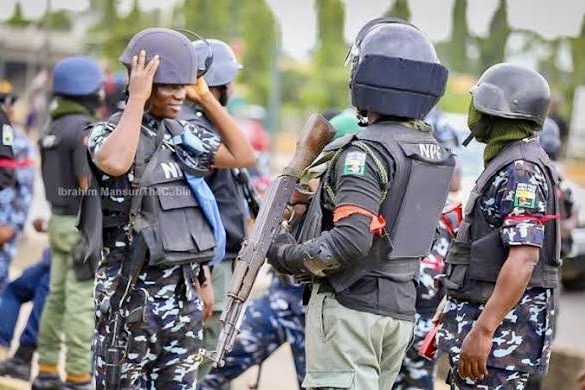
ABUJA, Nigeria — Ten police officers serving with the 44 Police Mobile Force (PMF), Abuja, and two civilians have been killed in a fierce gun battle with heavily armed bandits in Makuku, Sakaba Local Government Area of Kebbi State, in a fresh assault that has again exposed the vulnerability of security formations operating along Nigeria’s increasingly volatile north-western corridor.
The deadly confrontation, which occurred on Monday, August 10, has subsequently been independently corroborated by the Associated Press, which reported on Tuesday that 10 police officers and two civilians were killed while 17 of the attackers were also killed. Two other police officers were wounded and are receiving medical treatment, according to Kebbi Police spokesman SP Bashir Usman.
The development is particularly disturbing because Makuku and the wider Sakaba axis are not new frontiers in Nigeria’s prolonged battle against banditry. Security concerns in the area have been sufficiently severe that, in June, the National Youth Service Corps suspended postings to Sakaba and two other Kebbi local government areas because of insecurity.
How the Makuku attack unfolded
A police situation report dated August 10, obtained by SaharaReporters and reviewed in connection with the latest reporting, indicated that information available to the command at about 7:40 p.m. showed that Mobile Police personnel had engaged armed bandits in Makuku.
The officers had reportedly been deployed to the area on special duty as part of efforts to confront armed groups operating around the community.
The encounter escalated into a prolonged exchange of gunfire before the attackers gained the upper hand.
Following the battle, a police team led by the Divisional Police Officer of Sakaba Division, DSP Umaru Bagudu, reportedly moved to the scene and found the bodies of the fallen personnel.
The deceased officers were identified as ASP Bala Buba, 43; Inspector Saminu Sulaiman, 40; Inspector Solomon Jatau, 39; Inspector Ayuba Hassain, 38; Inspector Umar Yahuza, 37; Inspector Auwal Sani, 38; Sergeant Jimoh Momo, 35; Corporal Ukpong Otrukmj, 34; Inspector Adamu Abdullahi, 35; and Inspector Abdullahi Magaji, 43.
All 10 were attached to the 44 Police Mobile Force, Abuja, and had been deployed to Kebbi on special duty.
Two civilians, identified as Mohammadu Magwawara, 50, and Muhammadu Tiritiri, 45, were also killed during the confrontation.
Another civilian, Shehu Abubakar, 41, was reported in the initial police account to have sustained serious gunshot wounds. He was referred from General Hospital, Dirin Daji, to the Federal Teaching Hospital, Birnin Kebbi, for further treatment.
The later police account reported by AP gives a somewhat different casualty detail, saying that two police officers sustained injuries and were receiving medical attention. The two accounts are not necessarily contradictory, but they underline the need for a final consolidated casualty statement from the police command.
Police confirm heavy losses, and 17 attackers killed
Kebbi Police spokesman SP Bashir Usman subsequently confirmed the deaths of the 10 officers, two civilians and 17 attackers.
Describing the losses, Usman said: “Tragically, we lost 10 gallant police personnel in the engagement, while two others sustained injuries and are receiving medical attention.”
According to the police account cited by AP, the attackers were heavily armed and travelling on motorcycles when security forces intercepted them near the border with Zamfara State.
That detail is significant.
The Sakaba area sits within a wider security environment in which criminal gangs and militant networks have exploited difficult terrain, forests and state boundaries to move personnel, weapons, livestock and kidnapped victims.
The latest clash therefore appears to have involved more than a random village raid. Available accounts point to a deliberate armed movement that came into direct contact with security personnel.
The weapons question: a dangerous loss for Nigeria
Perhaps the most worrying element of the initial SITREP is not only the number of officers killed but the alleged quantity of police weapons seized by the attackers.
The report obtained by SaharaReporters said the bandits escaped with one RPG, two riot guns and 10 AK-47 rifles, in addition to other weapons and ammunition.
Atlantic Post has not independently verified the complete inventory of weapons allegedly taken from the scene, and the later police account cited by AP did not publicly repeat those specific figures.
That distinction matters.
An attack that kills 10 trained police personnel is already a major tactical setback. An attack that simultaneously supplies a criminal network with military-grade rifles and an RPG capability could have consequences well beyond Makuku.
Every rifle lost to a sophisticated criminal network can potentially be used against another patrol, a police station, a military convoy or a civilian community.
That is why the alleged weapons seizure requires urgent forensic and command-level investigation.
Police authorities must establish exactly how many weapons were deployed, how many were recovered, how many were lost, who was carrying them and whether any ammunition or tactical equipment also fell into the hands of the attackers.
The question is not merely what happened during the gun battle.
The larger question is whether the attackers deliberately targeted the security team partly because they knew substantial quantities of weapons could be captured.
Makuku has been attacked before
The latest bloodshed is especially troubling because Makuku has previously featured prominently in the security crisis in Kebbi.
In June 2025, armed bandits attacked a temporary Mobile Police post in the Makuku area and reportedly escaped with several rifles after overpowering the officers.
Kebbi government officials confirmed that the facility was a temporary mobile police post rather than a conventional police station. Officials said the attackers were reportedly present in large numbers, burned a Toyota Hilux patrol vehicle and escaped with rifles.
Other contemporary reports put the number of attackers at more than 300 and said eight AK-47 rifles were taken from the police camp.
The recurrence is impossible to ignore.
A location that had already witnessed a successful armed assault on a police facility has now become the scene of another confrontation in which 10 police personnel have reportedly been killed.
That raises uncomfortable questions about whether lessons from the earlier attack were fully implemented.
Were permanent or better-defended security positions established?
Was intelligence about bandit movements adequately processed?
Were the officers provided with adequate firepower, armoured protection and communications?
Was aerial surveillance available?
And most importantly, had the attackers identified the operational pattern of police deployments in the area?
These are not abstract questions. They go directly to the ability of the Nigerian state to protect its personnel in a theatre where armed groups have repeatedly demonstrated that they can mass fighters, exploit mobility and withdraw into difficult terrain.
Why Sakaba remains a strategic security problem
The deteriorating security situation in Sakaba has been acknowledged beyond the immediate police structure.
In June 2026, NYSC authorities said corps members would no longer be posted to Sakaba, Augie and Arewa local government areas because of security concerns. The scheme also sought relocation of its orientation camp from Dakingari to a safer location.
The NYSC coordinator in Kebbi said the worsening insecurity had already reduced the number of corps members available to serve across the state.
That decision should not be dismissed as an administrative adjustment.
It represents a practical indicator of how insecurity can gradually force the state to withdraw legitimate civilian services from vulnerable communities.
When teachers, doctors, development workers and other public servants cannot safely reach communities, criminal organisations gain space to operate.
The ultimate danger is not simply that bandits kill people.
It is that they progressively replace the state.
A security crisis stretching beyond Kebbi
Kebbi’s latest tragedy also sits within a broader escalation of armed violence across north-western Nigeria.
In March 2026, nine soldiers, a police officer and a civilian were killed when armed militants ambushed security personnel in Giron Masa, Shanga Local Government Area of Kebbi State. AP reported that several soldiers were wounded in that attack and that suspicion fell on Lakurawa-linked militants, although no group immediately claimed responsibility.
By June, Governor Nasir Idris had ordered an immediate review of security strategies following a resurgence of armed bandit attacks in parts of the state. The security meeting involved the police, military, DSS, NSCDC and other agencies.
The significance of the latest Makuku battle is therefore greater than the casualty figures alone.
The state has been conducting security reviews.
Security agencies have been deploying personnel.
Communities have been receiving warnings.
Yet heavily armed groups are still able to move through the region, confront security forces and, according to the initial SITREP, potentially seize their weapons.
The borderland factor
Makuku’s location is another important part of the puzzle.
The latest police account says the attackers were intercepted close to the Zamfara border.
North-western Nigeria’s security problem cannot easily be confined within state boundaries.
Armed groups can exploit the boundaries separating Kebbi, Zamfara, Sokoto and neighbouring areas, while the broader frontier with Niger provides another layer of operational complexity.
This creates a familiar problem for Nigerian security commanders: an armed group can attack in one jurisdiction, scatter across another and use forests and difficult terrain as temporary sanctuaries.
The response therefore demands intelligence fusion rather than isolated state-by-state policing.
A security architecture that simply reacts after an armed convoy appears near a village will remain vulnerable.
The grim cost paid by the police
Behind the operational terminology are 10 individual officers whose careers ended in a remote battlefield.
The men named in the SITREP ranged from 34 to 43 years old.
They were not statistics when they reported for duty. They were police officers deployed to a dangerous assignment, and their deaths now raise fresh questions about the protection provided to Mobile Police personnel operating in high-risk environments.
The Nigeria Police Force has repeatedly been called upon to confront threats that increasingly resemble military operations.
Yet police formations in remote areas can face hundreds of heavily armed attackers with motorcycles, automatic rifles and other sophisticated weapons.
That imbalance is at the heart of the security problem.
A police deployment can only be as effective as the intelligence, mobility, communications, reinforcement and firepower supporting it.
Where those elements fail simultaneously, bravery alone cannot compensate.
What must happen next
The immediate priority is to stabilise Makuku and surrounding communities, recover any weapons taken from the fallen officers and prevent the attackers from consolidating their gains.
But a serious investigation must go further.
The authorities need to reconstruct the engagement minute by minute: when the officers received intelligence, what strength they deployed, what weapons they carried, whether reinforcements were requested, how long it took for backup to arrive and how the attackers succeeded in disengaging.
If 17 attackers were killed, as reported by the police, the authorities should also establish how many escaped, where they fled and whether intelligence operations are already tracking wounded survivors.
The alleged loss of 10 AK-47 rifles and an RPG, meanwhile, demands an immediate weapons audit.
There should also be a full assessment of whether the special-duty deployment was adequately supported.
This is where the latest tragedy becomes an investigative story rather than another casualty report.
Nigeria has seen too many attacks in which security personnel are killed, weapons disappear and the public is promised an investigation that gradually disappears from national attention.
Makuku should not become another entry in that cycle.
A warning that cannot be ignored
The killing of 10 police officers and two civilians in one engagement is a severe security failure, regardless of how many attackers were also killed.
The reported death of 17 assailants demonstrates that the security forces were capable of inflicting substantial losses.
But a firefight in which 10 police personnel die remains a costly tactical encounter.
And if the attackers truly escaped with 10 AK-47 rifles and an RPG, the danger has not ended at Makuku.
It may have multiplied.
The immediate challenge for Nigeria’s security establishment is therefore twofold: recover control of the affected territory and ensure that the weapons, intelligence and operational lessons generated by the attack do not become assets for the next assault.
For the families of the 10 fallen officers, however, there is a more painful reality.
They will remember the names.
The nation must remember the warning.
The Makuku bloodshed shows that in parts of north-western Nigeria, the contest is no longer simply about stopping bandits from attacking civilians. It is increasingly about whether the state can protect the men and women it sends to confront them.
Follow us on our broadcast channels today!
- WhatsApp: https://whatsapp.com/channel/0029VawZ8TbDDmFT1a1Syg46
- Telegram: https://t.me/atlanticpostchannel
- Facebook: https://www.messenger.com/channel/atlanticpostng