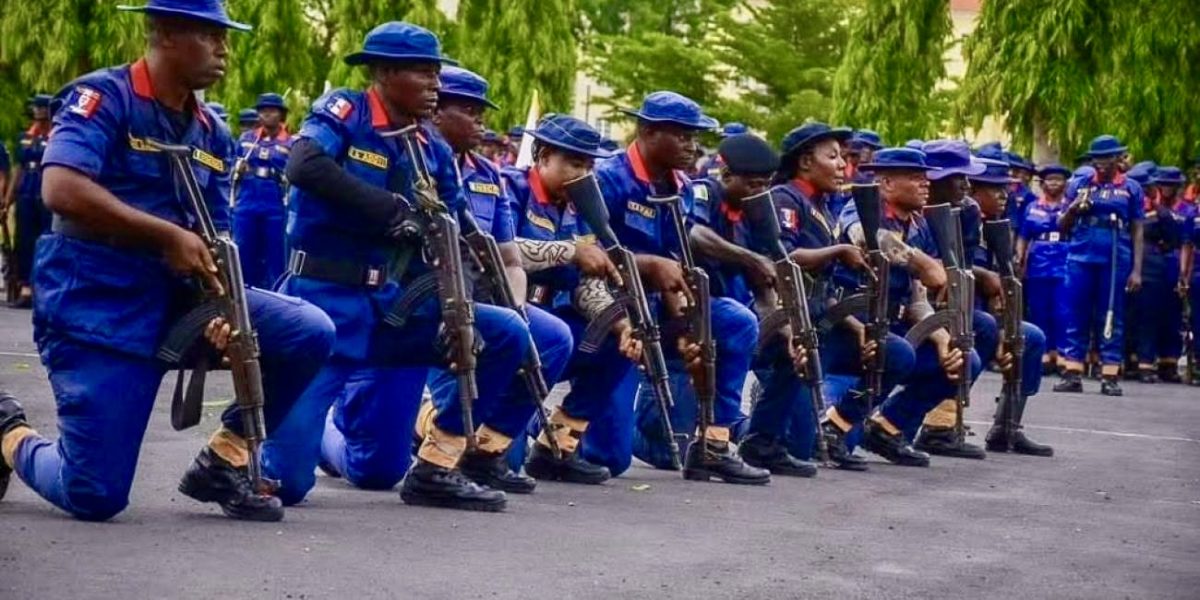
Some personnel have been implicated in arms dealing, according to Commandant-General Ahmed Audi. But the announcement raises bigger questions about weapons control, internal accountability and the potential risks of security personnel becoming part of the illicit arms trade.
Nigeria’s fight against insecurity faces an uncomfortable contradiction: the institutions entrusted with protecting citizens must also protect themselves against the possibility of criminal misconduct within their own ranks.
The Nigeria Security and Civil Defence Corps (NSCDC) has sanctioned 66 personnel nationwide for various offences, including involvement in arms dealing. The announcement, made by Commandant-General Ahmed Audi in Abuja on Friday, 6 November 2026, raises an important question beyond the disciplinary action itself: how effectively can Nigeria control illegal weapons when allegations of arms-related misconduct reach inside its own security institutions?
Audi disclosed that the affected personnel received different punishments, ranging from dismissal and compulsory retirement to demotion and official warnings.
He explained that the disciplinary measures followed investigations into allegations of misconduct and received approval from the Civil Defence, Correctional, Fire and Immigration Services Board (CDCFIB).
The Commandant-General said the sanctions reflected the seriousness of individual offences, adding that some personnel would face criminal prosecution while others had already been dismissed after facing prosecution.
His announcement was reported by the News Agency of Nigeria (NAN) and subsequently published by TheCable, Punch and other Nigerian news organisations.
But the number 66 tells only part of the story. The circumstances surrounding the arms-related offences, the number of personnel implicated in them and the extent of the alleged activities remain unclear.
For an agency involved in protecting critical national infrastructure and supporting Nigeria’s internal security architecture, those unanswered questions deserve attention.
The More Dangerous Question Behind the 66 Sanctions
The most troubling aspect of Audi’s announcement is not simply that personnel have been punished for misconduct.
It is that some of the offences reportedly involved arms dealing.
The NSCDC is not an ordinary civil administration. It is a paramilitary organisation with responsibilities that include protecting lives, preventing crime, safeguarding critical national infrastructure and assisting other security agencies.
The Nigeria Security and Civil Defence Corps Act, 2003, as amended in 2007, gives the organisation extensive operational responsibilities.
These include maintaining surveillance over public infrastructure, investigating criminal activities and assisting in maintaining peace and public order.
Significantly, Section 3(3) of the Act authorises the corps to maintain an armed squad entitled to bear firearms and deployed by the office of the Commandant-General.
That provision makes accountability particularly important.
Personnel serving in an organisation with access to weapons, security intelligence and sensitive operational environments must operate under strict systems of supervision.
When members of such an institution are accused of involvement in arms dealing, the investigation should extend beyond identifying individual offenders.
It should establish whether the alleged activities involved privately sourced weapons, firearms diverted from official inventories, ammunition supplied through unauthorised channels or networks connecting serving personnel with external criminal groups.
There is currently no publicly disclosed evidence establishing that the 66 personnel diverted weapons from NSCDC armouries. Nor has the corps identified the specific weapons, individuals or transactions involved.
That is an important distinction.
An allegation of arms dealing does not automatically establish the diversion of government-owned weapons. But where public security institutions are concerned, investigators must establish the origin and movement of any weapons connected with such cases.
Nigeria’s Official Weapons Leak Problem
The NSCDC announcement comes against the backdrop of growing official concern about the movement of weapons from government custody into illicit markets.
On 13 April 2026, the Director-General of the National Centre for the Control of Small Arms and Light Weapons (NCCSALW), retired Deputy Inspector-General of Police Johnson Kokumo, warned that weaknesses in weapons management were undermining national security.
Speaking at a capacity-development programme on arms physical security and stockpile management, Kokumo highlighted the potential contribution of official weapons inventories to illegal arms circulation.
He warned:
“A significant portion of illegal arms in circulation today passed through official channels at some point.”
He identified weak oversight, inadequate storage arrangements and poor record-keeping as vulnerabilities requiring urgent attention.
The warning is particularly significant because it identifies a potential source of weapons proliferation that cannot be addressed through border security operations alone.
Nigeria can intercept illegal weapons at its borders, arrest arms traffickers and prosecute criminal networks. But those operations will remain incomplete if weapons can also enter the illicit market through weaknesses within institutions responsible for securing them.
On 8 May 2026, Kokumo again highlighted the problem, identifying leakage from government security agencies’ armouries as a major concern in the proliferation of small arms and light weapons across Nigeria and West Africa.
He described the most concerning source of weapons proliferation as “haemorrhages from illicit stockpiles of arms-bearing agencies of government”.
These warnings do not establish any connection between the NCCSALW’s concerns and the NSCDC personnel recently sanctioned.
They do, however, provide an important national security context for investigating allegations of arms-related misconduct within an armed security institution.
What the NSCDC Investigation Should Establish
Audi said the affected personnel underwent established disciplinary procedures, including orderly room trials and investigations by relevant staff disciplinary committees, before the CDCFIB approved the sanctions.
The affected personnel were reportedly drawn from state commands, zonal commands, area commands, the national headquarters and other formations nationwide.
The Commandant-General was unequivocal about the importance of discipline.
“The culture of any military or paramilitary organisation stands or is built on discipline,” he said.
He added that the corps would not tolerate indiscipline or conduct capable of undermining its professional standards.
These commitments are important, but the effectiveness of an investigation should ultimately be judged by the evidence it establishes and the corrective action that follows.
Several questions remain unanswered.
First, how many of the 66 personnel were implicated specifically in arms dealing?
Second, were the alleged activities connected to weapons issued to NSCDC personnel or to an external arms trafficking network?
Third, were any official firearms, ammunition or other government-controlled security equipment recovered during investigations?
Fourth, how many of the affected personnel have been charged before a court, and how many cases have resulted in convictions?
Finally, what additional safeguards has the corps introduced to prevent similar incidents?
These questions are not an attempt to prejudge the individuals involved.
They are necessary questions about institutional accountability, particularly where the alleged misconduct concerns weapons capable of causing serious harm to civilians and security personnel.
The distinction between administrative discipline and criminal prosecution is also important.
Dismissal, compulsory retirement, demotion and warnings are internal or employment-related sanctions. They do not automatically establish criminal guilt.
Audi said some personnel would face prosecution, while others had already been dismissed after facing prosecution. However, the announcement did not provide specific court cases, charges or judicial outcomes.
Under Nigeria’s Firearms Act, Section 9 prohibits dealing in firearms or ammunition by way of trade or business except by a registered firearms dealer. Whether individual cases involving the NSCDC personnel fall under this provision or other criminal offences cannot be determined without details of the allegations and charges.
The corps should therefore make clear which cases require criminal prosecution and ensure that the appropriate authorities pursue them through the courts.
Arms Control Is Becoming a Regional Security Priority
The need for stronger weapons accountability is not limited to Nigeria.
The Economic Community of West African States (ECOWAS) has been working with national authorities and international partners to improve the physical security and management of government-held weapons.
Between 7 and 11 September 2026, ECOWAS, the Bonn International Centre for Conflict Studies and Nigeria’s National Centre for the Control of Small Arms and Light Weapons organised a five-day training programme in Port Harcourt, Rivers State.
Personnel drawn from 12 national security agencies participated in the programme, which focused on preventing weapons diversion, theft, loss and illicit proliferation.
The training included practical exercises and a visit to the Nigerian Army’s 29 Battalion armoury to observe weapons security and stockpile management procedures.
ECOWAS
The initiative reinforces an important point: weapons management is not merely an administrative responsibility.
It is a critical component of national security.
For Nigeria, effective controls should include accurate weapons inventories, secure storage facilities, regular inspections, reliable ammunition accounting and mechanisms for tracing firearms recovered from criminal networks.
Where weapons are suspected of having been diverted, investigators should be able to establish their original source and determine how they left authorised custody.
The NSCDC should be able to demonstrate that comparable accountability measures operate across its commands and formations.
17,000 Promotions and the Challenge of Institutional Discipline
Audi also announced that approximately 17,000 NSCDC personnel had recently been promoted following an examination involving about 22,000 officers and men.
This represents roughly 77 per cent of those who participated in the exercise.
According to the Commandant-General, the promotions reflected individual performance and vacancies approved by the Federal Government.
He said the results were ready and would be displayed on the corps’ notice boards to allow personnel to verify their outcomes.
Audi commended President Bola Tinubu for supporting the exercise and other institutional reforms within the organisation.
The announcement presents two important dimensions of institutional management.
On one side is the recognition and promotion of personnel considered deserving of career advancement. On the other is the punishment of those found responsible for misconduct.
Both are necessary for an effective paramilitary organisation.
But the credibility of a promotion exercise cannot substitute for transparency in disciplinary proceedings. Equally, the announcement of sanctions cannot establish that the underlying institutional weaknesses have been resolved.
The CDCFIB, which oversees appointments, promotions and discipline across the NSCDC, Nigerian Correctional Service, Federal Fire Service and Nigeria Immigration Service, has an important responsibility in maintaining consistent professional standards across these institutions.
The Test Is Whether the System Can Police Itself
Audi’s announcement sends a clear message that misconduct within the NSCDC can attract serious consequences.
But the public should expect more than assurances of discipline.
The real test will be whether the cases produce credible criminal prosecutions where necessary, whether any weapons connected to the offences are traced and recovered, and whether weaknesses exposed by the investigations lead to stronger internal controls.
The corps should also consider publishing an appropriately detailed account of the disciplinary exercise, including the categories of offences, sanctions imposed and prosecution outcomes, while protecting confidential operational information and the rights of individuals facing unresolved charges.
For an institution whose responsibilities include protecting Nigerians and their critical national assets, public confidence depends on the belief that its personnel are subject to the same law they are expected to enforce.
The 66 sanctions may represent a significant disciplinary exercise. But their lasting value will depend on what happens next.
Nigeria does not merely need security agencies capable of punishing erring personnel. It needs security institutions capable of preventing weapons, authority and public trust from being compromised from within.
Follow us on our broadcast channels today!
- WhatsApp: https://whatsapp.com/channel/0029VawZ8TbDDmFT1a1Syg46
- Telegram: https://t.me/atlanticpostchannel
- Facebook: https://www.messenger.com/channel/atlanticpostng



Join the debate; let’s know your opinion.