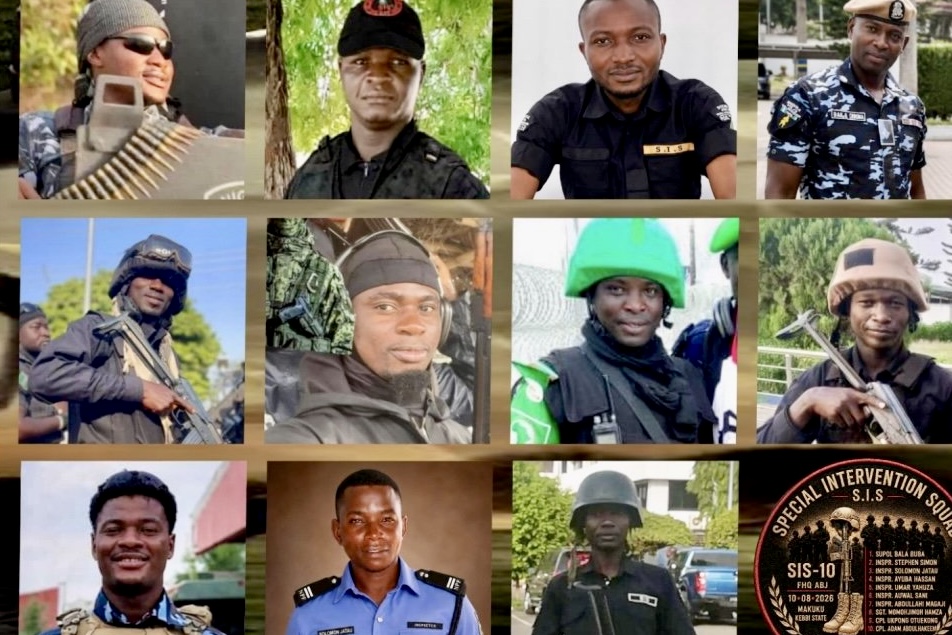
The photographs of the 10 Nigerian police officers killed during the August 10 battle with suspected bandits in Kebbi State have put human faces to one of the Nigeria Police Force’s most painful operational losses in recent months.
Behind the statistics — 10 dead police personnel, two civilians killed and at least 17 suspected bandits reportedly neutralised — are men whose families, colleagues and communities must now live with the consequences of a battle that has also raised uncomfortable questions about intelligence, ammunition, reinforcement and the operational vulnerability of security personnel deployed to remote communities.
The officers, all deployed from the 44 Police Mobile Force (PMF), Abuja, were killed along the Rafin Makuku axis of Sakaba Local Government Area while confronting a heavily armed group moving between Kebbi and neighbouring Zamfara State.
The Nigeria Police Force officially confirmed the deaths on August 11, saying the encounter began at about 9:25 a.m. and that four motorcycles belonging to the attackers were destroyed. The Force also said two other police officers were injured.
But as the photographs of the fallen personnel circulate, the incident is evolving from a report of a deadly bandit clash into a broader test of how Nigeria protects the men and women it sends into the most dangerous corners of the country.
The 10 officers killed in the Kebbi battle
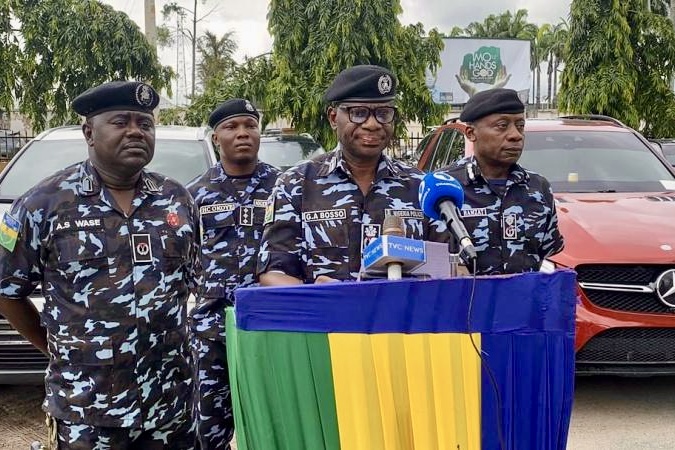
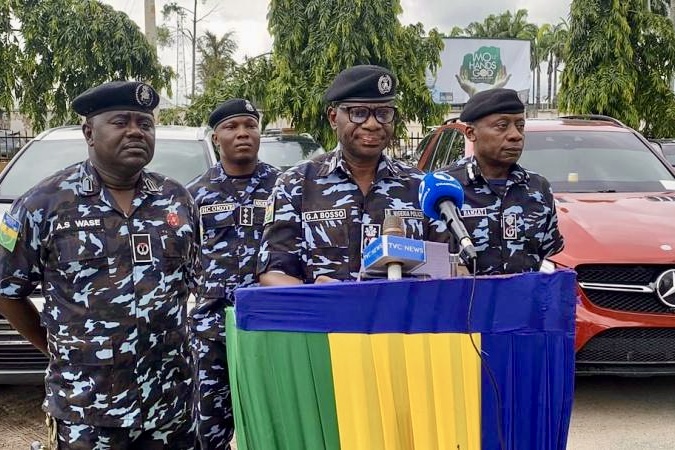
At a memorial service held at Force Headquarters in Abuja on August 24, the Nigeria Police Force formally honoured the fallen Special Intervention Squad (SIS) personnel.
The memorial list identified them as:
ASP Bala Buba — AP/F/No. 306724
Inspector Stephen Simon — AP/F/No. 260162
Inspector Solomon Jatau — AP/F/No. 376893
Inspector Ayuba Hassan — AP/F/No. 376908
Inspector Umar Yahuza — AP/F/No. 370343
Inspector Auwal Sani — AP/F/No. 358380
Inspector Abdullahi Magaji — AP/F/No. 376892
Sergeant Momjimoh Hamza — AP/F/No. 514474
Corporal Ukpong Otuekong — AP/F/No. 524419
Corporal Adam Abdulhakeem — AP/F/No. 538935.

There is an important correction to some earlier accounts circulating online: the latest memorial information identifies Bala Buba as an Assistant Superintendent of Police (ASP), not Superintendent of Police as stated in some versions of the report.
The distinction matters because the story of the fallen officers should be preserved accurately, particularly when official records, family histories and memorial archives are being created.
The battle that left 10 officers dead
According to the Nigeria Police Force, police operatives intercepted suspected bandits travelling between Zamfara and Kebbi States in the Rafin Makuku area.
The Force said the engagement resulted in the deaths of 10 police personnel and two civilians, while at least 17 suspected bandits were neutralised and four motorcycles destroyed.
The scale of the threat was reflected in contemporaneous reports that described a large armed formation moving on motorcycles towards Makuku.
Vanguard, citing security sources, reported on August 10 that more than 100 suspected bandits were involved and that the group had emerged from the Sangeko Gap in Zamfara in three formations. The report said intelligence, surveillance and reconnaissance assets detected the movement.
Other accounts cited by SaharaReporters and subsequently discussed by Premium Times put the possible number of attackers much higher, with reports referring to more than 200 armed men and, in one account, roughly 250 motorcycles carrying several fighters each.
Those figures should be treated cautiously. They are not all independently verified and they differ substantially from the official casualty statement. Premium Times’ later reconstruction of the incident specifically noted that parts of the operational sequence remained unclear, including the relationship between reported movements, the engagement and an air operation.
That uncertainty is one of the most important investigative dimensions of the Makuku tragedy.
Did the police know the attackers were coming?
The answer appears to be yes — at least in broad terms.
Accounts of the operation say intelligence had identified the movement of a heavily armed group towards the area.
That raises a difficult question: how much warning did the tactical team actually have, what assets were available to them, and how rapidly could superior firepower and reinforcement be brought to bear?
The difference between detecting a heavily armed column and preventing it from overwhelming a tactical position can be measured in minutes.
The police said the officers intercepted the attackers. Later reporting, however, raised questions about whether the team had adequate ammunition and whether reinforcement and air support arrived quickly enough.
One source cited by SaharaReporters alleged that the officers eventually exhausted their ammunition and made urgent requests for air support and ground reinforcement.
The source claimed: “They fought back but eventually ran out of ammunition.”
That claim is not the same as the official police account and should therefore be treated as an allegation requiring investigation rather than established fact.
Indeed, the official position presented a different picture. Earlier reporting from the Kebbi Police Command said reinforcement was mobilised after a distress call, with military support reportedly joining the response. The Guardian also reported that the police statement said reinforcements were deployed and supported by Nigerian Army and Air Force units.
Premium Times’ subsequent analysis found that the available accounts did not fully resolve precisely when different stages of the fighting and reported air activity occurred.
That gap in the timeline deserves scrutiny.
The missing weapons question
The aftermath also produced another serious security concern: reports that attackers allegedly seized weapons from the security personnel.
A police situation report cited by SaharaReporters reportedly listed 10 AK-47 rifles, one RPG rifle and two riot guns, alongside additional arms and ammunition, among items allegedly taken after the engagement.
The allegation has circulated widely, but it was not included in the initial public statement by the Kebbi Police Command. One later report explicitly noted that the command had not publicly confirmed the alleged weapons losses.
That distinction is important.
If the reported seizure of weapons is confirmed, the issue goes beyond the loss of personnel. It would represent an operational setback in which an armed criminal group could potentially increase its firepower using weapons taken from the state.
That is why any formal inquiry into Makuku should establish precisely what weapons were issued to the officers, what was expended, what was recovered and what, if anything, was taken by the attackers.
Two civilians also died
The human cost was not limited to the police.
The Nigeria Police Force confirmed that two civilians were killed during the engagement, while another civilian was injured.
Later reports identified the injured civilian as Shehu Abubakar and said he was referred for further treatment in Birnin Kebbi.
The civilian deaths underline the central operational dilemma in attacks of this kind.
Police and other security personnel are not fighting on an empty battlefield. They are often operating inside communities where residents remain exposed even after an armed confrontation begins.
The decision to hold a position can protect civilians. But without adequate support, the same decision can expose police personnel to overwhelming force.
IGP Disu: “We will not abandon you”
Two weeks after the battle, the Nigeria Police Force brought the tragedy to the national spotlight with a memorial service at Force Headquarters, Abuja, on August 24.
Inspector-General of Police Olatunji Rilwan Disu described the officers as gallant personnel who paid the supreme price while serving, protecting and defending lives and property.
He told the bereaved families: “We grieve with you, we stand with you, and we will not abandon you.”
He also stressed the personal cost behind the statistics, saying: “Behind every fallen officer is a family that has lost a husband, father, son, brother or loved one.”
Those words now carry a second meaning.
The families do not merely need condolences. They need to see whether the institution can translate promises into sustained financial support, education, healthcare and long-term security for dependants.
The welfare issue is bigger than Makuku
The timing of the Kebbi deaths is significant because the Federal Government was already reviewing police welfare arrangements before the memorial ceremony.
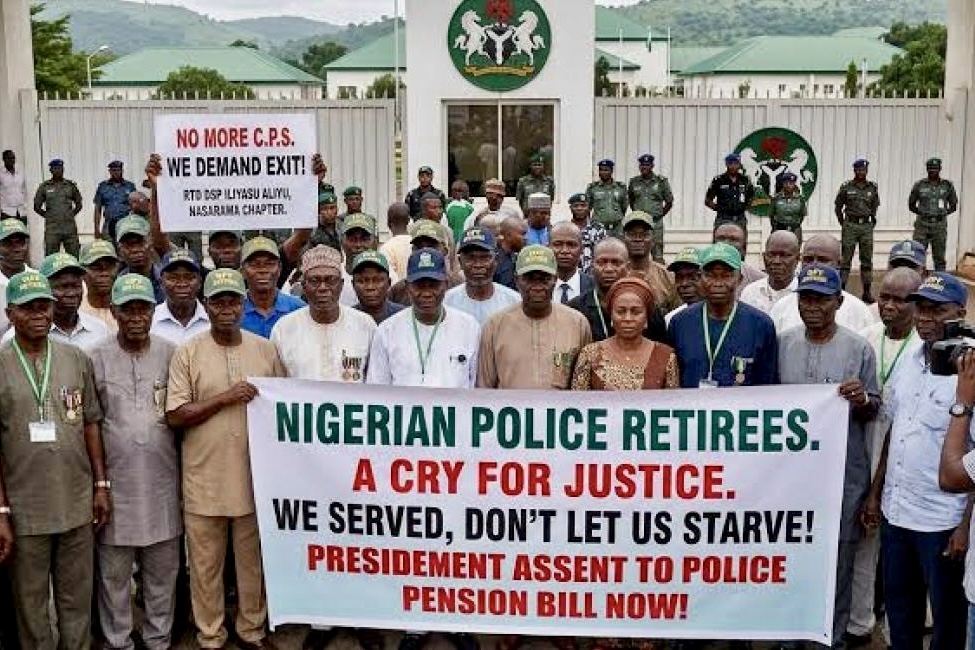
In July, the Ministry of Police Affairs convened a committee to review police allowances and address outstanding pension arrears, death benefits, health benefits and other welfare obligations. The ministry said timely payment was important to sustaining confidence and morale among serving and retired officers and families of deceased personnel.
By August 4, the government said it was advancing a broader review covering police salaries, allowances, insurance, pension-related benefits and other welfare packages.
The welfare challenge is therefore not an abstract policy discussion. It has a direct relationship with operational morale.
The Nigeria Police Force’s pension system reported earlier in 2026 that more than ₦39.5 billion in death benefits had been paid to the next-of-kin of 8,847 officers who died in active service since inception.
At the same time, the Nigeria Police Trust Fund has been positioned by government as a mechanism for sustainable funding of police training, welfare, equipment and infrastructure.
This means the question raised by Makuku is no longer simply whether the 10 officers should be honoured.
It is whether the security institutions have sufficient systems to ensure that a police officer sent into a high-risk environment is properly equipped — and that when he does not return, his family does not enter another battle for survival.
Disu approves recruitment of relatives
There has already been one tangible response.
At the memorial, Disu approved the recruitment of relatives of the fallen officers who applied to join the Nigeria Police Force. He also said the backlog of benefits owed to families of deceased officers had been cleared under directives from President Bola Tinubu.
The Guardian reported the approval as part of a wider pledge that the Force would not abandon the bereaved families.
Such measures can offer immediate relief, but they also raise a broader policy question: should welfare after an officer’s death depend primarily on discretionary interventions, or should families have an automatic, transparent and enforceable benefits system that activates immediately after a fatality?
That distinction could determine whether the Makuku tragedy becomes another memorial story or a catalyst for institutional reform.
A warning from the SIS commander
CP Abayomi Shogunle, Commander of the Special Intervention Squad, said subsequent operational assessments indicated that losses inflicted on the attackers were “significantly higher than the initial assessment.”
He urged personnel not to allow the deaths to destroy their morale.
“The morale of the SIS must not be allowed to waver,” he said.
That message is understandable.
But morale cannot be built on sacrifice alone.
A tactical officer may accept that policing is dangerous. What can damage morale is the belief that courage is being substituted for capability — that officers may be expected to confront superior numbers, mobility and firepower without a matching guarantee of ammunition, reinforcement, medical evacuation, intelligence and air support.
The lesson of Makuku should therefore not be that Nigerian police officers are willing to die.
The country already knows that.
The harder question is whether Nigeria is willing to do what is necessary to keep them alive.
Makuku was not an isolated warning
Premium Times’ investigation into the broader security picture found that Makuku had previously experienced an armed assault in June 2025, when attackers overwhelmed a temporary Mobile Police post, burnt a patrol vehicle and seized an undisclosed number of rifles.
That history is crucial.
It means the August 2026 confrontation cannot be viewed entirely as an unforeseeable event.
A location previously attacked by an armed group later became the site of another deadly confrontation involving a larger tactical challenge.
The key accountability questions therefore extend beyond the immediate firefight:
Was the earlier attack fully analysed?
Were the lessons incorporated into the new deployment?
Was the position adequately fortified?
Were the personnel provided sufficient ammunition and communications?
How quickly could backup arrive?
What intelligence existed about the size and direction of the attackers?
And, critically, was the operational plan designed for the possibility of a massed motorcycle assault rather than a conventional patrol-level threat?
Until those questions are answered, the public is left with a powerful image of courage but an incomplete picture of preparation.
The faces behind the numbers
For Nigerians who see the photographs of Bala Buba, Stephen Simon, Solomon Jatau, Ayuba Hassan, Umar Yahuza, Auwal Sani, Abdullahi Magaji, Momjimoh Hamza, Ukpong Otuekong and Adam Abdulhakeem, the names should never become a passing list in the news cycle.
They were police officers assigned to one of the most dangerous security environments in the country.
They were also sons, brothers, husbands, fathers, friends and providers.
At the memorial, Disu told Nigerians that these officers died doing what they had sworn to do.
The challenge now is for the state to demonstrate that their sacrifice has consequences beyond ceremony.
The story of Makuku should be preserved through a formal, credible operational review. The casualty timeline should be reconciled. Claims about ammunition shortages and delayed reinforcement should be established or disproved. Alleged weapons losses should be accounted for. The families should receive every benefit legally and institutionally due to them. And lessons from the operation should feed directly into future deployments.
The police have pledged that the fallen officers will not be forgotten.
For their families, the real measure of that promise will not be another parade.
It will be what happens after the flags are folded, the photographs are archived and the headlines disappear.
Because the most important question raised by Makuku is not how bravely 10 officers died.
It is whether the next 10 will be given a better chance to come home.
Follow us on our broadcast channels today!
- WhatsApp: https://whatsapp.com/channel/0029VawZ8TbDDmFT1a1Syg46
- Telegram: https://t.me/atlanticpostchannel
- Facebook: https://www.messenger.com/channel/atlanticpostng