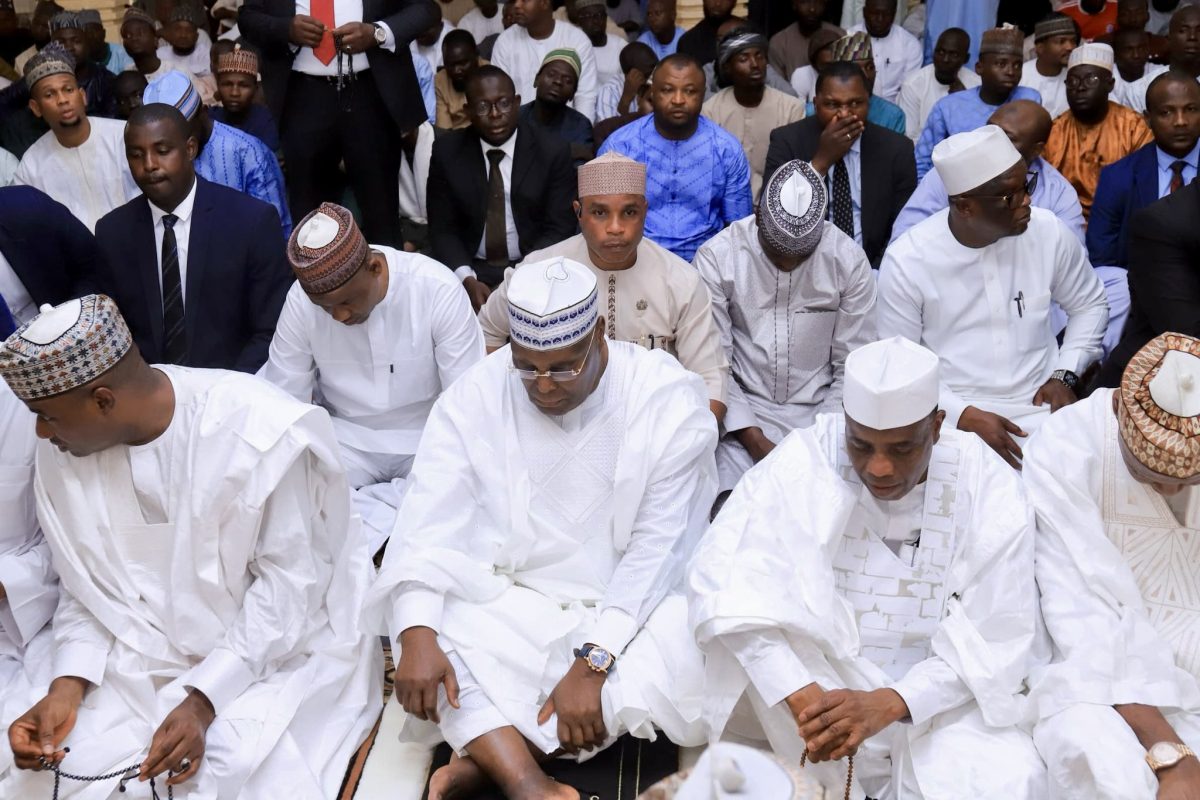
Former Vice-President insists he will contest the January 2027 presidential election, accusing President Bola Tinubu’s government of weakening opposition politics. But a Federal High Court ruling, unresolved party leadership disputes and fresh concerns over INEC’s voters’ register have placed the opposition campaign at a critical crossroads.
Atiku Abubakar has drawn a political battle line ahead of Nigeria’s 2027 presidential election, declaring that neither President Bola Tinubu nor the courts can prevent Nigerians from deciding who governs them.
But behind the former vice-president’s defiant message lies a more consequential question for Africa’s largest democracy: who controls the political and legal processes that determine which candidates Nigerians are ultimately allowed to choose?
Speaking in a statement issued from Sokoto on Friday, 6 November 2026, Atiku rejected the latest Federal High Court judgment affecting his presidential nomination under the African Democratic Congress (ADC).
His message was unmistakable.
“Let no one mistake the latest court ruling for the will of the Nigerian people,” he declared.
He maintained that his campaign would continue, insisting that political pressure, threats and litigation would not force him out of the presidential race.
“ We are on the ballot, and the people must be allowed to decide,” he said.
His most provocative declaration was directed at President Tinubu.
“Bola cannot use the courts to escape the judgment of Nigerians at the ballot box.”
Yet, while Atiku has framed the dispute as a confrontation between the political establishment and popular sovereignty, the legal circumstances surrounding his candidacy are more complicated.
And the implications extend well beyond one presidential aspirant.
The court ruling that threatens the opposition ticket
On Thursday, 5 November, Justice Peter Lifu of the Federal High Court in Abuja delivered a judgment nullifying the Senator David Mark-led national leadership structure of the ADC.
The court also invalidated decisions taken by that leadership, including the party’s presidential primary that produced Atiku as its candidate for the January 2027 election.
The judgment followed a suit instituted by Nafiu Bala Gombe, a former ADC National Deputy Chairman (North-East), who challenged the circumstances surrounding the emergence of Mark, former Osun State Governor Rauf Aregbesola and other members of the party’s leadership.
Gombe argued that the leadership transition failed to comply with the party’s constitution and applicable electoral requirements.
Justice Lifu ruled against the Mark-led leadership structure and nullified the processes that produced the party’s candidates.
The judgment also dismissed 27 preliminary applications filed by the defendants and other party officials seeking to have the case dismissed.
The development has created a serious problem for an opposition party that had spent months positioning itself as a credible alternative to the ruling All Progressives Congress (APC).
The ADC, however, maintains that the judgment contradicts an earlier decision by Justice Musa Liman of the same Federal High Court.
In a judgment delivered on 2 July 2026, in Suit No. FHC/ABJ/CS/1637/2025, Justice Liman had reportedly upheld the positions of Mark and Aregbesola after examining the circumstances surrounding their emergence.
The ADC argues that a court of coordinate jurisdiction cannot simply disregard an existing judicial decision on the same leadership question.
The party says its lawyers are preparing an appeal and seeking appropriate interim relief.
Its legal team also says it is awaiting the certified true copy of the latest judgment to establish its precise orders and consequences.
This disagreement is central to the emerging crisis.
The appellate courts must now determine the legal implications of the competing judgments, the validity of the challenged leadership process and the consequences for candidates already nominated under that structure.
The APC has denied involvement in the dispute.
Its National Chairman, Nentawe Yilwatda, described the crisis as an internal leadership problem that the opposition party must resolve itself.
Nafiu Bala Gombe, meanwhile, welcomed the ruling, arguing that political parties must obey their constitutions.
“Political parties are not above their own constitutions, and the Electoral Act is not a mere suggestion,” he said.
It is an important distinction. The case originated from an internal party dispute, not a presidential directive or a lawsuit instituted by the APC.
There is currently no independently established evidence proving that President Tinubu or the APC orchestrated the judgment.
However, the timing and potential consequences of the decision deserve close scrutiny.
Was Atiku already officially on the ballot?
There is an important documentary detail that complicates the political argument.
On 31 October 2026, INEC published its final list of presidential candidates for the January 2027 election.
The commission’s published document listed Atiku Abubakar as the ADC presidential candidate, with Rotimi Amaechi as his running mate.
That publication preceded the 5 November court judgment.
The distinction is crucial.
Atiku’s name appeared on the official list when it was published. But the subsequent court decision invalidated the party processes that produced his nomination.
Consequently, appearing on the earlier list cannot, by itself, settle his legal eligibility after the judgment.
His declaration that he will be on the ballot is therefore a statement of political determination, not a guarantee that the legal dispute has been resolved.
The January 16, 2027 presidential election is now just 71 days away.
Every week of uncertainty increases the pressure on the ADC, its candidates, INEC and the judiciary.
The judgment also has implications beyond Atiku. Because the court invalidated nominations made under the challenged leadership, the party’s other candidates could face uncertainty.
The opposition therefore faces a potentially nationwide disruption to its electoral preparations.
The growing concentration of political power
Atiku’s warning about Nigeria drifting towards a one-party state cannot be dismissed without examining the country’s changing political landscape.
The APC has considerably strengthened its position through defections from opposition parties.
The ruling party’s own website lists 31 governors among its elected members, although some contemporary reporting on its presidential campaign council has used the figure of 32.
The discrepancy deserves clarification, but either figure illustrates the remarkable concentration of governorship power under the ruling party.
Several politicians who secured their positions on opposition platforms have subsequently crossed over to the APC.
Atiku describes these movements as the product of political pressure, inducements and coercion.
Those are serious allegations. They require individual evidence and should not be treated as established facts simply because defections have occurred.
Nevertheless, the political consequences are significant.
A ruling party controlling the presidency and an overwhelming majority of state governments enjoys substantial political advantages in organisation, mobilisation and access to established political networks.
That does not automatically make Nigeria a one-party state.
A multiparty democracy does not cease to exist because one party wins more elections or attracts more politicians.
The real democratic test is whether competing parties can organise, nominate candidates, campaign freely, access voters, challenge decisions and contest elections without intimidation or arbitrary exclusion.
The opposition’s difficulties also cannot be attributed entirely to the ruling party.
Internal rivalries, leadership disputes, competing presidential ambitions and the failure to establish durable political alliances have weakened opposition coordination.
Atiku’s current predicament exposes that vulnerability.
INEC’s voters’ register: The emerging technological threat
Perhaps the most disturbing allegation in Atiku’s statement concerns the integrity of Nigeria’s voters’ register.
He accused political actors of attempting to manipulate the electoral process through AI-generated photographs, false names and fictitious identities.
This allegation comes against the background of genuine questions raised about INEC’s preliminary register.
In late October, Nigerians began circulating examples of questionable photographs and suspected duplicate entries appearing in the register published online.
Some citizens also reported apparent discrepancies involving personal information and the records of deceased relatives.
The controversy prompted INEC to issue a clarification on 27 October.
The commission acknowledged that questionable registration records had been identified during the physical display of the preliminary register between 9 and 15 October.
It said corrective action and further examination had commenced.
Importantly, INEC admitted that it was investigating the circumstances surrounding suspicious photographs, including possible technical or procedural lapses.
The commission stated:
“The preliminary register is not the final certified register.”
It explained that the online publication represented the original preliminary register and did not reflect all the data-cleaning activities already underway.
INEC also scheduled 15 December 2026 for certification of the final Register of Voters.
This admission makes the controversy too serious to dismiss as ordinary political propaganda.
An inaccurate voters’ register can undermine electoral credibility, create opportunities for identity manipulation and weaken confidence in election results.
But another distinction must be maintained.
There is evidence of suspected irregularities and an ongoing INEC investigation. There is not yet independently verified evidence that the APC deliberately created fictitious voters or directed the production of AI-generated photographs to manipulate the 2027 election.
The commission must establish how the questionable records entered the system, identify responsibility where misconduct occurred and publish the results of its investigation.
Nigerians should not have to rely on political accusations or social media investigations to establish whether their electoral register is credible.
The economic argument behind Atiku’s challenge
Atiku is also attempting to make economic hardship the central issue of the 2027 campaign.
He criticised the Tinubu administration’s decision to remove the fuel subsidy, the depreciation of the naira, the rising cost of food and the difficulties facing businesses.
His assessment reflects real economic pressures, although some of his claims require qualification.
President Tinubu announced the removal of the fuel subsidy during his inauguration on 29 May 2023.
The decision triggered a major adjustment in petrol prices and intensified the immediate cost-of-living pressures facing households.
The assertion that there was no plan whatsoever to protect vulnerable Nigerians is too absolute, however.
The World Bank subsequently documented temporary compensation and targeted cash-transfer measures intended to cushion the consequences of the reform.
The more important question is whether those interventions reached vulnerable households early enough and at sufficient scale to offset the shock.
On inflation, Nigeria’s September 2026 headline rate fell to 14.63 per cent from 15.39 per cent in August.
That represents a significant moderation.
But food inflation remained elevated at 19.59 per cent.
A declining inflation rate does not mean food has become affordable again. It means prices are increasing more slowly, not that the previous price increases have disappeared.
The naira also remains substantially weaker than it was before the foreign-exchange reforms introduced in 2023. The Central Bank of Nigeria reported an official NFEM rate of approximately ₦1,346 to the dollar on 30 October 2026.
For businesses, the operating environment remains difficult.
The Nigerian Economic Summit Group’s October Business Confidence Monitor recorded a Current Business Performance Index of 115.4 points, down from 117.8 points in September.
The index remained above the 100-point threshold for expansion, but the slowdown reflected continuing pressures from high operating costs, unreliable electricity and restricted access to finance.
Manufacturers have also faced significant energy costs.
Consequently, Atiku’s assertion that factories and small businesses have shut their doors should not be presented as a quantified nationwide trend without supporting closure figures.
The available evidence nevertheless confirms that businesses continue to face substantial operational constraints.
His economic argument is politically potent because the difference between improving macroeconomic indicators and improving household welfare remains a major challenge for the administration.
Insecurity adds another dimension to the election
Atiku’s warning about banditry and kidnapping also reflects an unresolved national security problem.
An October 2026 assessment by EONS Intelligence recorded 519 security incidents across Nigeria.
Although the overall figure represented an 11 per cent decline from September, the geographical distribution revealed a worrying trend.
Incidents in the southern part of the country increased by 36 per cent, even as the North recorded a 29 per cent reduction.
The report identified 300 incidents in the North and 219 in the South.
Separately, security agencies reported operations resulting in the rescue of hundreds of kidnapped victims during September and October.
These figures demonstrate the scale of the security challenge, even as security forces report operational successes.
The approaching elections introduce another concern.
Political campaigns must operate in an environment where insecurity, intimidation and attacks on political supporters could undermine participation.
The police have warned that attacks on opposition supporters, destruction of campaign materials and other forms of pre-election violence will attract arrest and prosecution.
Such assurances must translate into visible, impartial protection for every political party.
An election cannot be considered credible if voters are afraid to attend rallies, candidates cannot move safely or political opponents are prevented from communicating with citizens.
What happens next?
Atiku’s declaration has transformed the immediate political narrative, but it has not resolved the legal problem.
The ADC must pursue its appeal and establish the legal basis for retaining the leadership structure that produced its presidential ticket.
The judiciary must resolve the dispute promptly, transparently and without political considerations.
INEC must also clarify the effect of the judgment on its published list of candidates and demonstrate that its decisions are guided by the law rather than pressure from powerful political interests.
The commission’s voters’ register investigation requires similar urgency.
Its December certification deadline provides an important opportunity to demonstrate that questionable records, duplicate identities and suspected manipulated photographs will not survive into the final register.
Above all, the APC administration must recognise that the legitimacy of an election is measured not only by who wins but also by whether political competition was genuinely open.
Atiku is correct on one fundamental democratic principle: the ultimate political authority belongs to Nigerian voters.
But the right to choose also depends on lawful political parties, credible nominations, independent institutions and a transparent electoral process.
The courts cannot replace the people at the ballot box. Equally, political parties cannot disregard the laws governing their nominations simply because their candidates enjoy popular support.
The larger danger for Nigeria is that prolonged legal uncertainty, opposition fragmentation, concentrated political power and unresolved electoral-integrity concerns could weaken public confidence before voting even begins.
Atiku says he is not going anywhere.
Whether he appears on the ballot on 16 January 2027 will ultimately depend on the legal outcome and the actions of the electoral commission.
Whether President Tinubu wins another term is a different question.
That verdict belongs to Nigerians.
And the institutions responsible for protecting their democratic choice must ensure that the ballot remains open, credible and beyond political manipulation.
Follow us on our broadcast channels today!
- WhatsApp: https://whatsapp.com/channel/0029VawZ8TbDDmFT1a1Syg46
- Telegram: https://t.me/atlanticpostchannel
- Facebook: https://www.messenger.com/channel/atlanticpostng



Join the debate; let’s know your opinion.