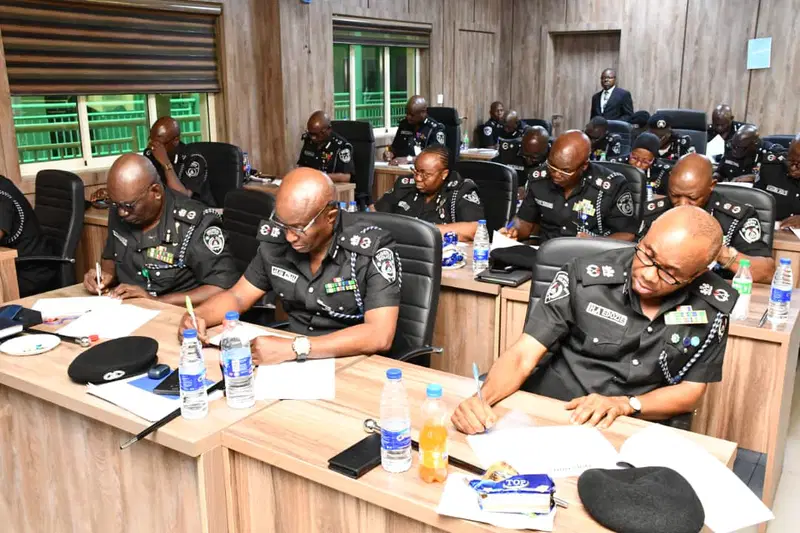
A November 4 internal police directive communicates the approval of ten new AIGs, with promotions carrying an effective date of September 10. But the retrospective dates, formal documentation and operational responsibilities raise important questions about the management of Nigeria’s senior police leadership.
Nigeria’s police leadership is getting ten new Assistant Inspectors-General of Police (AIGs), but the significance of the promotions extends beyond the elevation of ten senior officers.
At a time when Nigeria faces persistent security challenges and growing demands for more effective law enforcement, the question is whether the latest changes in the police hierarchy will translate into stronger operational leadership, greater accountability and improved protection for citizens.
The Police Service Commission (PSC) approved the elevation of ten Commissioners of Police (CPs) to the rank of AIG following a recommendation by the Inspector-General of Police.
The approval was communicated to police formations nationwide through an internal wireless message dated November 4, 2026, issued by the Force Secretary’s office at the Force Headquarters in Abuja.
The communication, with reference number DTO: 041741/11/2026, reportedly followed a PSC approval letter dated November 2.
The message, obtained by SaharaReporters, directed police departments, commands, formations and specialised units to acknowledge the elevation of the affected officers.
It also instructed that the commission’s congratulations be conveyed to the beneficiaries.
But one detail deserves particular attention. The document states that publication in the official gazette and the issuance of a Force Order would follow.
That means the November 4 communication was an internal administrative notification, while the promised formal publications remained a separate step at the time the message was issued.
More importantly, the ten promotions had already been publicly announced following the PSC’s October 29 plenary meeting. The November communication therefore represents the next stage in implementing an earlier decision, rather than a fresh promotion exercise.
The ten officers elevated to AIG
The officers named in the promotion announcement are:
- Omosanyin Olusegun – formerly Commissioner of Police, Administration, Force Criminal Investigation Department (FCID) Annex, Ikoyi, Lagos.
- Ogbodo Ugobueze – formerly Commissioner of Police, Anti-Fraud, FCID Annex, Enugu.
- Ohagwu Felix Ndukwe – formerly Commissioner of Police, Ondo State Command.
- Taylor Lennox Olanrewaju – formerly associated with the Nigeria Police Cooperative.
- Regina Cosmas Udoette – formerly Commissioner of Police, FCID Annex, Enugu.
- Afolabi Wilfred Olutokunbo – formerly Commissioner of Police, Abia State Command.
- Nwogoh Martin – formerly associated with the Police Air Wing.
- Shetima Jauro Mohammed – formerly Commissioner of Police, Nasarawa State.
- Ibrahim D. Gotan – formerly Commissioner of Police, Osun State.
- Danjuma I. Yahaya – formerly associated with the FCID in Kaduna.
The officers’ previous assignments are based on the October 29 promotion announcement and accompanying reports.
There are minor differences in how two names appear in the supplied November 4 wireless transcription and earlier published accounts. The first officer is identified as Olusegun Eyitayo Omosayin in the supplied document, while the October announcement uses Omosanyin Olusegun. Taylor Lennox Olarenwaju in the supplied transcription also appears as Taylor Lennox Olanrewaju in published reports.
The Force Order should provide the definitive official spelling and designation of each officer.
September effective date raises an administrative question
One of the most important details in the wireless message is the effective date attached to the promotions.
All ten entries reportedly carry the notation W.E.F. 10/09/2026, meaning with effect from that date.
Under the Nigerian day/month/year convention, this translates to September 10, 2026.
This is significant because the publicly reported PSC approval followed the commission’s plenary meeting on October 29, while the formal approval letter referenced in the wireless message was dated November 2.
In other words, the promotions appear to have been given an effective date approximately seven weeks before their public announcement and almost eight weeks before the internal notification of November 4.
There is nothing in the supplied communication establishing why the September date was selected.
It is possible that the date reflects an earlier administrative milestone, such as the commencement of the relevant promotion process or an approved seniority arrangement. But that explanation cannot be assumed without confirmation from the commission.
The PSC and police headquarters should clarify whether September 10 represents the date on which the promotions were intended to take effect for seniority, salary, allowances and other employment entitlements.
Retrospective effective dates can have consequences beyond rank insignia. They may affect the seniority of officers, career progression, pension calculations and eligibility for subsequent appointments.
The question is not whether the commission has the authority to promote officers. It is whether the administrative record clearly explains how and when the decision becomes effective.
What the law says about the PSC’s authority
The promotion exercise also highlights the institutional relationship between the Police Service Commission and the Nigeria Police Force.
Section 11(1) of the Nigeria Police Act 2020 provides that the Police Service Commission, acting on the recommendation of the Inspector-General of Police, shall appoint the number of Deputy Inspectors-General and Assistant Inspectors-General required for the efficient performance of the police force’s functions.
Section 11(2) further provides that officers appointed to these positions shall perform the responsibilities and exercise the powers assigned to them by the Inspector-General.
This distinction is important.
The PSC is not simply a ceremonial body endorsing decisions already made within the police hierarchy. The law assigns it a formal role in the appointment process while requiring the Inspector-General’s recommendation.
At the same time, the Inspector-General determines the specific responsibilities assigned to the promoted senior officers.
The new AIGs will therefore need more than their new rank to make an institutional difference. Their actual influence will depend substantially on their assignments, operational mandates and the authority delegated to them.
The law also requires the Inspector-General, guided by efficiency and effectiveness, to devolve appropriate powers to zonal, state and lower police commands to facilitate quicker responses to security needs.
This makes the deployment of senior officers an important part of the broader policing equation.
The October promotion exercise was much wider
The ten AIG promotions formed part of a larger exercise approved at the PSC’s October 29 plenary meeting in Abuja.
The commission announced promotions involving more than 3,800 senior police personnel across several ranks.
The exercise included:
- Two Assistant Inspectors-General elevated to Deputy Inspectors-General.
- Ten Commissioners of Police promoted to Assistant Inspectors-General.
- Seventeen Deputy Commissioners elevated to Commissioners.
- Eighty-five Assistant Commissioners promoted to Deputy Commissioners.
- Forty-nine Chief Superintendents elevated to Assistant Commissioners.
- Two hundred and forty-five Superintendents promoted to Chief Superintendents.
- Four hundred and ninety-eight Deputy Superintendents elevated to Superintendents.
- More than 3,000 Assistant Superintendents promoted to Deputy Superintendents.
The process reportedly followed promotion examinations and oral interviews conducted by the commission.
PSC Chairman, retired Deputy Inspector-General of Police Hashimu Salihu Argungu, presided over the meeting.
Argungu urged the beneficiaries to regard their elevation as a call to greater responsibility, professionalism and commitment to national service.
He also emphasised the need to protect lives and property, enforce the law and improve police service delivery.
His message was significant because the promotion exercise covered officers across different levels of the command structure, not simply a handful of senior appointments.
The real test begins with deployment
For the ten newly promoted AIGs, the most consequential development will be their eventual assignments.
An Assistant Inspector-General occupies a senior position in the police command hierarchy, above a Commissioner of Police and below a Deputy Inspector-General.
AIGs can be assigned significant responsibilities across operational, administrative, investigative and specialised policing structures.
But a higher rank does not automatically establish a new operational command or guarantee greater effectiveness.
The Police Act makes clear that the functions of AIGs are determined by responsibilities assigned by the Inspector-General.
Consequently, the next set of announcements from police headquarters will be important.
Will the newly promoted officers take charge of police zones, strategic departments or specialised operational formations? Will their appointments reflect the security priorities of the country? And what measurable targets will accompany their new responsibilities?
These are questions that matter to citizens who judge the police not by the number of senior officers in uniform, but by their ability to prevent crime, investigate offences, respond to emergencies and protect communities.
The October promotions also came against the background of continuing pressure on Nigeria’s policing institutions to strengthen professionalism, operational coordination and public confidence.
Increasing the number of senior officers does not, by itself, resolve these problems.
The benefits depend on whether senior leadership can improve supervision, intelligence coordination, investigation standards and the discipline of personnel under their authority.
This is particularly important in a country where the public frequently encounters the police at the point of arrest, investigation, traffic enforcement and security emergencies.
The quality of those encounters ultimately shapes public perceptions of the institution.
The accountability questions that should not disappear
The PSC’s responsibility does not end with approving promotions.
The commission’s constitutional and statutory oversight responsibilities make transparency in personnel decisions an important part of institutional accountability.
The October promotion announcement attributed the exercise to examinations and oral interviews. That provides an indication of the selection process, but the published information does not disclose the individual assessment criteria, comparative performance records or detailed reasons for selecting each beneficiary.
It would be unreasonable to conclude from the absence of those details that the promotions were improper.
Nevertheless, public confidence is strengthened when institutions explain how significant personnel decisions are reached.
Three issues deserve particular attention.
First, the effective dates. The PSC should clarify why the ten promotions carry a September 10 effective date when the publicly reported approval came later in October.
Second, formal documentation. The police should confirm when the promotions were published in the official gazette and when the corresponding Force Order was issued.
Third, operational assignments. Nigerians deserve clarity on the responsibilities the new AIGs will assume and how their performance will be evaluated.
These questions are especially relevant because senior police appointments involve public authority, public resources and responsibilities that affect the security of millions of people.
The Police Act 2020 itself identifies transparency, accountability, professionalism and cooperation with communities as important principles underpinning the country’s policing framework.
A higher rank must mean higher responsibility
The elevation of ten Commissioners to Assistant Inspectors-General represents an important development in the management of Nigeria’s police leadership.
For the beneficiaries, it recognises their progression through the ranks and places them in positions of greater institutional responsibility.
For the Nigeria Police Force, the exercise creates an opportunity to strengthen leadership across its operational and administrative structures.
But for the public, promotions will ultimately be judged against a different standard.
A safer community, more credible investigations, faster responses to emergencies, improved discipline and greater respect for citizens’ rights are far more meaningful measures of police performance than the number of officers who receive new ranks.
The message from the PSC chairman that promotion should bring greater responsibility therefore carries a practical test.
The commission must ensure that its promotion decisions are properly documented. The Inspector-General must deploy the newly elevated officers effectively. And the beneficiaries must demonstrate that their increased authority produces measurable improvements in policing.
Nigeria does not simply need more senior police officers.
It needs senior officers who can make the police more effective, more accountable and more trusted.
The next chapter of these ten promotions should be written not only in the official gazette or Force Order, but also in the security outcomes experienced by Nigerians.
Follow us on our broadcast channels today!
- WhatsApp: https://whatsapp.com/channel/0029VawZ8TbDDmFT1a1Syg46
- Telegram: https://t.me/atlanticpostchannel
- Facebook: https://www.messenger.com/channel/atlanticpostng



Join the debate; let’s know your opinion.