Governor Siminalayi Fubara addressed Rivers State amidst Supreme Court rulings overturning local government elections, asserting his commitment to lawful governance. Critics argue his administration has defied constitutional norms. Despite promises for reform, skepticism persists about whether Fubara will genuinely implement changes or merely maintain his regime’s control amid political turmoil.
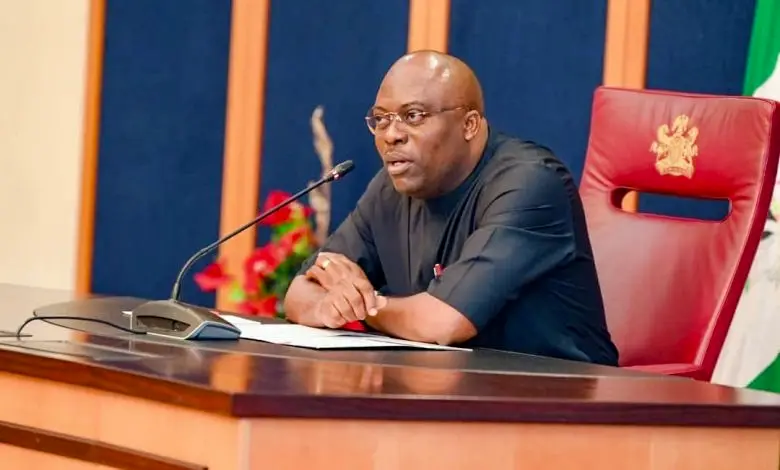
PORT HARCOURT, Rivers — In a dramatic broadcast on Sunday, 2 March 2025, Governor Siminalayi Fubara sought to justify his controversial governance of Rivers State amid the fallout from Friday’s landmark Supreme Court judgements.
Speaking directly to the people of Rivers State, the Governor’s address was a defensive yet calculated effort to reconcile his administration’s actions with the court’s mandates while attempting to restore a semblance of order in an increasingly turbulent political environment.
Fubara opened his broadcast by acknowledging the recent Supreme Court rulings, which have upended the longstanding political impasse in the state.
“We are all aware of the recent Supreme Court judgements and pronouncements regarding aspects of the lingering political disputes in our dear State,” he declared.
Despite his apparent discontent with the decisions, the Governor insisted that his government would abide by the rulings as an act of lawfulness.
“Although we disagree with the judgements, we are bound to obey the orders made therein as a law-abiding government,” he asserted, a statement that would later be scrutinised as emblematic of his broader defiant stance.
Critics, however, have long argued that Fubara’s administration has operated on a precarious edge of legality.
Earlier reports by Atlantic Post detailed how the Supreme Court had not only nullified the disputed local government elections conducted in October 2024 but had also reaffirmed the legitimacy of the 27-member Rivers State House of Assembly led by Speaker Rt. Hon Martin Amaewhule.
In those analyses, the judiciary’s intervention was hailed as a definitive stand for democracy and the rule of law—a stark contrast to the executive excesses witnessed under Fubara’s regime.
During the broadcast, the Governor attempted to distance himself from accusations of wilful constitutional breaches. He claimed that since the inception of his government, all actions were carried out within the framework of the Constitution, due process, and the rule of law.
“While we are not above mistakes because we are humans, we believe that we have not, as a government, done anything deliberately to trample on the rule of law or the hallowed principles of constitutional governance,” he declared.
This defence, however, did little to allay the simmering frustrations among opposition leaders and civil society groups, who argue that the state’s recent history of unlawful appointments and the dismantling of key democratic institutions speaks otherwise.
A significant portion of the broadcast was dedicated to the Governor’s assurances regarding the implementation of the Supreme Court judgements.
Fubara announced that his team of lawyers was set to receive the certified true copy of the judgements by Friday, 7 March 2025.
“Upon receipt, we shall study their ramifications and implement them without reservations to move the State forward,” he promised.
This commitment came on the heels of the court’s directive that halted the release of funds by the Central Bank of Nigeria and the Accountant-General of the Federation until an appropriate Appropriation Bill was presented to the duly constituted Assembly.
In an attempt to stabilise local governance, Fubara issued sweeping directives for a transitional arrangement in the local government system.
He declared that, in light of the outlawing of caretaker arrangements, the Heads of Local Government Administration were to immediately assume control of the 23 local government councils.
Outgoing local government chairmen were ordered to formally hand over power by Monday, 3 March 2025. This move, designed to placate growing discontent over the nullified local government elections, has been met with scepticism.
Critics question whether these emergency measures will usher in true democratic reform or merely serve as a stop-gap to maintain executive control.
Throughout his address, Governor Fubara maintained a tone of cautious optimism, urging citizens to remain calm and continue with their daily lives despite the unsettled political climate.
“Although our dear State seems to be back in trying times, I urge everyone to remain calm and peacefully go about with their legitimate daily activities as we continue to do everything in our power to advance our responsibilities to the citizens,” he implored.
Yet, beneath the surface of this placatory rhetoric lies a contentious legacy of executive overreach.
Political commentators have been quick to point out the irony in Fubara’s assurances of constitutional compliance, given the numerous instances where his government’s actions—such as the demolition of the House of Assembly building and the unapproved appointment of officials—have contravened the very principles he now professes to uphold.
The broadcast, while ostensibly a commitment to rectify past misdeeds, raises important questions about accountability and the future direction of Rivers State.
As the Supreme Court’s judgements continue to reverberate throughout the state’s political landscape, Fubara’s attempt to balance defiant governance with legal conformity appears increasingly fraught with contradictions.
Will his administration truly implement the court’s mandates, or will this be yet another instance of political posturing aimed at preserving a beleaguered regime?
Only time will tell if Governor Fubara’s pledge to study and adhere to the Supreme Court’s rulings will translate into tangible reforms.
For now, the people of Rivers State watch with wary anticipation, hopeful that this critical juncture might finally herald a return to constitutional order and genuine democratic governance.