The Nigerian Army has told the Federal High Court in Abuja that it uncovered what it described as a “credible and elaborate” plot to overthrow President Bola Ahmed Tinubu’s administration, alleging financial trails, coded communications, clandestine meetings and plans for targeted killings.
The case, already among the most politically sensitive in recent years, now sits at the intersection of national security, democratic stability and high-stakes criminal prosecution.
At the centre of Wednesday’s testimony was a masked Nigerian Army Corps of Military Police operative identified only as “AAA”, who appeared as the fourth prosecution witness.
The witness told the court that intelligence first reached the then Chief of Army Staff, Olufemi Oluyede, and was later analysed and found credible enough to trigger a full investigation.
The court had earlier approved protective measures for the witness under Section 232 of the Administration of Criminal Justice Act, with his identity shielded on security grounds.
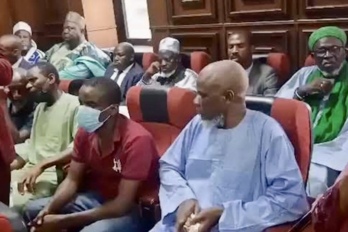
The prosecution says six defendants are standing trial on a 13-count charge in suit number FHC/ABJ/CR/206/2026, including allegations of treason, terrorism and terrorism financing.
Reuters and AP report that those in custody include a retired major general, a retired naval captain, a serving police inspector and three civilians, while former Bayelsa State governor and ex petroleum minister Timipre Sylva is accused of aiding concealment and is said to be at large.
All six defendants pleaded not guilty when they were arraigned on April 22.
According to the Army witness, investigators arrested Colonel Mohammed Maaji after the intelligence review and recovered a Samsung Galaxy phone and a jotter from him.
The witness told the court that the jotter allegedly contained operational notes, names and designations of senior figures in the current administration, as well as officers purportedly marked for assassination in the event of the coup.
The witness also said the recovered phone revealed extensive coordination among the accused, though the defence has yet to test these claims fully under cross examination.
Perhaps the most politically explosive element of the testimony concerns money. The witness said investigators traced funds linking Colonel Maaji, Timipre Sylva and some defendants before the court, and that a company identified as Purple Waves Limited appeared to function as a financial conduit.
The alleged transfers, according to the prosecution’s narrative, ran through September and October 2025 and included debits of N100 million, N50 million, N100 million, N50 million, N100 million, N50 million, N80 million, N70 million, N90 million and N90 million.
The witness said the payments were labelled as legitimate project costs, including debris clearing, but the Army insists those descriptions were diversionary.
The alleged conspiracy was not confined to money trails, the court heard. The witness said secret meetings were held in Abuja, including at Green Land Apartment and BrookVille Hotel, where participants allegedly discussed regime change, assigned roles, and mapped out state targets.
He also said the group discussed key sites such as military installations and strategic road infrastructure.
These claims, if proven, would move the case beyond ordinary political intrigue and into the realm of organised attempts to destabilise the state. For now, however, they remain allegations tested only at the early stage of trial.
The legal architecture of the case is severe. AP reports that the charge sheet alleges the suspects “conspired with one another to levy war against the state to overawe the president of the Federal Republic”, while Reuters says prosecutors filed 13 criminal charges including treason, terrorism and terrorism financing.
The Criminal Code Act also provides that levying war against the state in order to intimidate or overawe the President is treason, and Nigeria’s Terrorism (Prevention and Prohibition) Act 2022 provides the additional framework prosecutors are relying on in this prosecution.
In court, Justice Joyce Abdulmalik has taken a firm line on security and speed. Reuters reported that the judge ordered the defendants remanded in DSS custody after arraignment, while the latest proceedings saw the court grant the Federal Government’s request to conceal the identity of the army witness.
Punch reported that the court allowed the protective measures under Section 232 of the ACJA because of the sensitivity of the case and the prosecution’s concern about “unnecessary attack” on the witness.
The wider political significance is hard to miss. Reuters notes that this is the most serious treason prosecution under Tinubu’s presidency so far, coming at a time of economic strain, security pressure and political tension.
AP adds that Nigeria has not seen a successful coup since 1999, but the alleged plot lands in a region where coup attempts and military takeovers have returned as a troubling pattern.
That backdrop is what makes this trial more than a routine criminal matter. It is now a test of whether Nigeria’s institutions can expose an alleged conspiracy without allowing the case itself to become a source of fresh instability.
For now, the prosecution is building its case around intelligence, phones, hotel records, bank records and witness testimony. The defence is challenging admissibility and will no doubt attack the chain of evidence, the interpretation of the transactions and the credibility of the state’s narrative.
The court has adjourned further hearing to May 4 and 5, when the next phase of a case with grave implications for Nigeria’s democracy will continue.
Follow us on our broadcast channels today!
- WhatsApp: https://whatsapp.com/channel/0029VawZ8TbDDmFT1a1Syg46
- Telegram: https://t.me/atlanticpostchannel
- Facebook: https://www.messenger.com/channel/atlanticpostng