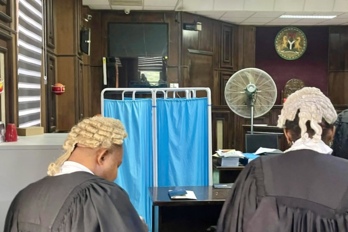
The Federal High Court in Abuja has widened the curtain around Nigeria’s most politically charged security trial in recent years, granting a prosecution request to shield a witness in the alleged coup plot case against a retired major general and five others.
The ruling, delivered by Justice Joyce Abdulmalik on Wednesday, came as the prosecution opened its case in a matter now carrying both treason and terrorism overtones.
The defendants are Mohammed Ibrahim Gana, a retired major-general; Erasmus Ochegobia Victor, a retired navy captain; Ahmed Ibrahim, a police inspector; Zekeri Umoru, an electrician at the Presidential Villa; Bukar Kashim Goni; and Abdulkadir Sani, a Zaria-based Islamic cleric.
All six were arraigned on 22 April and pleaded not guilty when the charges were read in open court. Reuters reported that the government filed 13 criminal charges against them, while the prosecution has framed the matter as an alleged violent bid to overthrow President Bola Tinubu’s government.
What stood out on Wednesday was not just the charge sheet, but the court’s posture. Premium Times reported that four witnesses were ready to testify, and three bank witnesses from Jaiz Bank, SunTrust Bank and Providus Bank were called, tendered EFCC letters and were cross examined by defence counsel.
When the fourth witness was called, prosecution counsel Rotimi Oyedepo, SAN, asked for protective measures, saying the witness should be shielded from “unnecessary attack” and that the officer’s identity must be protected.
The defence did not reject witness protection in principle. Their objection was narrower and more revealing.
They argued that while the public could be kept away from sensitive identifying details, the defence still needed to know who the witness was in order to test credibility and safeguard fair hearing.
In other words, they accepted secrecy as a security tool, but not as a method of insulating a witness from adversarial scrutiny.
That objection goes to the heart of Nigeria’s criminal justice balance sheet, where national security claims often collide with due process demands.
Justice Abdulmalik sided with the prosecution. Premium Times quoted her as saying, “The law permits protective measures, including non-disclosure of names, addresses and contact details where the court is satisfied that security concerns exist.”
She relied on Section 232 of the Administration of Criminal Justice Act, which provides for protective measures such as screening or masking a witness, receipt of video-link evidence, and other steps the court considers appropriate in relevant offences, including terrorism-related matters.
That statutory backdrop matters. Section 232 is not a casual privacy clause. It permits a court, in qualifying cases, to keep the proceedings from sitting fully in open court and to prevent disclosure of a victim’s or witness’s identifying details in records or reports.
The law also allows initials or other non-identifying designations. In effect, the judge has now placed the witness inside a legally approved shield, and directed that the name must not appear in court records or public proceedings.
The politics of the case are equally significant. Premium Times reported that the trial started at about 11 a.m., paused around 2 p.m., and then resumed after a protective screen was installed.
That same newspaper also reported that the wider coup investigation began months earlier, after the arrest of 16 military officers in late September and the later widening of the case to include civilians and former soldiers.
By the end of January, sources said about 40 people had been arrested in connection with the probe, with some suspects still at large.
The case has also exposed a deeper institutional contradiction. On one side, the Federal High Court is trying a criminal case involving civilians and former security officials under public criminal procedure.
On the other, the military has already launched a separate General Court Martial against 36 serving personnel over related allegations of mutiny and an attempt to overthrow the government.
Premium Times and Channels Television reported that journalists were denied access to the military venue in Asokoro, with proceedings held behind closed doors and mobile phones barred, intensifying concerns about transparency in a matter that directly touches the public interest.
That parallel process is politically explosive. It suggests the state is running two tracks at once: a civilian criminal trial at the Federal High Court and a military disciplinary process behind secured doors.
Reuters has already noted that the charges include treason, terrorism and financing terrorism, while AP reported that a seventh suspect, former Bayelsa State governor Timipre Sylva, remains at large and is alleged to have helped conceal the plot.
The government has therefore turned a rumour of instability into an open courtroom test of credibility, evidence and institutional control.
For the Tinubu administration, the symbolism is severe. A coup allegation is never just a legal matter in Nigeria. It is a stress test for the state’s confidence, the armed forces’ cohesion and the judiciary’s willingness to manage cases involving security sensitivity without surrendering fairness.
The court’s decision to protect a witness may help preserve testimony, but it also deepens public curiosity about what the witness knows, who else may be implicated, and how far the alleged conspiracy extends. For now, the court has chosen caution over openness, and the trial has entered a phase where secrecy itself is part of the story.
Follow us on our broadcast channels today!
- WhatsApp: https://whatsapp.com/channel/0029VawZ8TbDDmFT1a1Syg46
- Telegram: https://t.me/atlanticpostchannel
- Facebook: https://www.messenger.com/channel/atlanticpostng