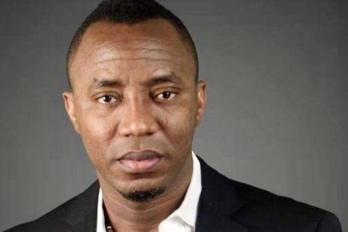
Omoyele Sowore has again forced Nigeria’s political elite to confront an uncomfortable question that has hovered over the republic for more than two decades: can a constitution born under military rule truly command democratic legitimacy?
Speaking in Abuja shortly after court proceedings in his case against the Department of State Services, the former presidential candidate of the African Action Congress said that if elected in 2027, one of his priorities would be to scrap the 1999 Constitution and replace it with a people-driven charter built for the digital age.
His argument is not merely rhetorical. It lands at the intersection of law, power, online speech, state surveillance and the wider battle over who controls Nigeria’s public square.
Sowore’s central claim is that Nigerians were not truly involved in the making of the 1999 Constitution, which he describes as a military-era document that failed to emerge from broad democratic participation.
That argument has documentary support. The promulgation decree itself states that the Federal Military Government decreed that there shall be a Constitution for Nigeria, and that it would come into force on 29 May 1999.
In other words, the extant constitutional order began life as a military instrument handed over at the point of transition, not as a text ratified by popular referendum.
That origin story matters because it is at the heart of the legitimacy dispute. Sowore is essentially saying that Nigeria’s present constitutional settlement is not just outdated; it is structurally compromised by the conditions of its birth.
In his view, the document did not anticipate the realities of remote work, online education, digital activism, platform politics and the new forms of civic mobilisation now shaping democratic life.
He wants a new framework that reflects the way Nigerians actually communicate, organise and resist power in 2026, not the way a military government imagined governance in 1999.
That is a political argument, but it is also a legal one, because it challenges the authority of the current text to regulate a radically different public sphere.
The timing of his remarks is no accident. Sowore delivered them while standing at the centre of a widening courtroom conflict involving the DSS, Meta and X, formerly Twitter.
The dispute began after his August 2025 post on President Bola Tinubu prompted a security push for the removal of the content and the deactivation of his accounts.
Premium Times reported that the DSS wrote to X and Meta asking them to delete the posts and deactivate the accounts, after which Sowore’s lawyers argued that the move amounted to unconstitutional censorship.
The Federal High Court in Abuja dismissed his fundamental rights suit on 2 April 2026, holding that the case lacked merit and awarding N1.5 million in costs.
Today, the case remains alive politically even where one round of litigation has already gone against him.
On 29 April 2026, the Federal High Court overruled a request by Sowore’s counsel for a one-month adjournment and fixed 18 May for hearing.
The Guardian reported that the judge said counsel should ordinarily be pressing for a speedy hearing, not delay it. The same report noted that Sowore’s suit alleges unconstitutional censorship by the DSS and Meta, and that the earlier civil suit had already been found lacking in merit.
That means the battle is now larger than one post, one platform or one politician. It has become a test case for how far a security agency can go in leaning on global tech companies to police political speech in Nigeria.
Sowore’s language on “digital rights” is also rooted in a broader reality that experts have documented for years. Freedom House’s Nigeria country profile rates the country as “partly free” online, gives it a Freedom on the Net score of 59 out of 100, and notes that websites have been blocked and users arrested for online activity.
The same report recalls Nigeria’s 2021 Twitter ban, which was lifted in 2022 after the platform became accessible again.
In plain terms, the digital space is already a contested political theatre in Nigeria, and Sowore’s complaint is that state power has not just entered that theatre but is trying to direct the script through platform moderation and enforcement pressure.
This is where his argument becomes more serious than standard opposition soundbites. Section 39 of the 1999 Constitution guarantees freedom of expression and the press, while Section 40 protects peaceful assembly and association.
Sowore’s case is built around the contention that these rights do not stop at the edge of the street or the newsroom; they extend into the social media feed, the livestream, the group chat and the digital campaign trail.
He is also arguing that if governments can compel platforms to silence critics, then the real censors are no longer only state agents in uniform but also private companies acting under official pressure.
That is a dangerous precedent in any democracy, and it is exactly why his case has attracted interest beyond his own political circle.
The wider context makes his warning harder to dismiss. Freedom House says Nigeria’s vibrant media landscape is hampered by harassment, arrests and legal pressure on journalists who cover politically sensitive issues.
Its 2025 internet freedom findings also warn that governments worldwide are increasingly restricting expression online, blocking websites and tightening surveillance, often in the name of public order.
Sowore’s claim that artificial intelligence and content moderation can become new tools of suppression is therefore not fanciful. It reflects a live global debate about whether digital governance is quietly becoming the modern equivalent of old-fashioned political policing.
Yet the force of Sowore’s message also depends on political memory. He is not just asking Nigerians to imagine a new constitution; he is asking them to confront the fact that the current one was imposed through a military transition, then preserved by a political class that has repeatedly benefited from its ambiguities.
That is why his demand resonates among those who believe Nigeria’s federation remains over-centralised, its security architecture too powerful, and its democratic habits too weak. But it also faces the hard reality that constitutional change in Nigeria has often been easier to demand than to deliver.
The real test is whether this latest push becomes a slogan for 2027, or the start of a serious national conversation about legitimacy, federalism and rights in the digital era.
What Sowore has done, once again, is drag a technical legal dispute into the centre of a bigger national reckoning. The DSS case, the court’s dismissal of his earlier suit, the fresh hearing date of 18 May, the military birth of the 1999 Constitution and the expanding reach of digital censorship all converge into one sharp conclusion: Nigeria is no longer only arguing about who governs, but about what kind of constitutional order is allowed to govern in the first place.
Follow us on our broadcast channels today!
- WhatsApp: https://whatsapp.com/channel/0029VawZ8TbDDmFT1a1Syg46
- Telegram: https://t.me/atlanticpostchannel
- Facebook: https://www.messenger.com/channel/atlanticpostng