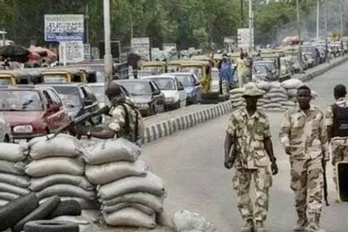
A fresh investigation has once again thrown a harsh spotlight on Nigeria’s South-East, this time on the Onitsha to Enugu corridor, where a traveller and researcher, Dr Amaka Oforbuike, says 32 checkpoints now stand between two major commercial centres on a stretch of just 105 kilometres.
If accurate, that means one stop roughly every 3.7 kilometres, turning a route that should be a routine inter-city journey into a near permanent security gauntlet.
The route map published from her findings lists Army, Police, FRSC and NDLEA points in dense succession, with especially heavy concentration around Ugwuoba and the approach to Enugu.
The significance of this report goes far beyond inconvenience. What it describes is a road economy built around delay, harassment and repeated stoppage.
In practical terms, every extra halt raises transport costs, slows the movement of traders, deepens spoilage of perishables and feeds the cost of living in markets downstream.
That is why the South-East checkpoint problem has become more than a security story. It is now a transport, food supply and governance crisis rolled into one.
Dr Oforbuike’s warning is blunt. She said, “32 checkpoints! This is what a traveller moving just 105 KM from Onitsha to Enugu will endure.”
She also alleged that money is collected at these points and lamented that kidnapping still occurs on the same corridor despite the intense security presence.
Her central accusation is devastating because it captures the contradiction at the heart of the matter.
The region is heavily policed, yet the roads remain unsafe, the journeys remain slow and the public remains exposed to what many residents describe as a predatory roadside system.
This is not the first time the South-East has faced such criticism. A major Guardian investigation in 2024 described the region’s highways as clogged by multiple checkpoints and extortion points, noting that some stops appeared at intervals of about 500 metres and that a count during the festive season found over 120 stops on a major southern travel corridor.
A separate collaborative investigation in 2023 went further, citing a civil society report that estimated 6,000 police roadblocks and 2,500 military roadblocks across the South-East and South-South, with a cumulative N660 billion allegedly extorted over three years.
That earlier report also recalled a 2018 estimate of over N100 billion in roadside bribery and extortion in the region over a three year period.
Seen in that context, the latest Onitsha Enugu finding is not an isolated anomaly. It fits a long pattern of complaints from commuters, traders, civil society groups and market actors who say checkpoints have become a form of unofficial taxation.
In the 2023 collaborative report, even some security personnel and regional stakeholders were quoted acknowledging that officers lobby for postings to the South-East because the roads are considered financially rewarding.
That allegation, whether fully provable in any single case or not, reveals how deeply the public believes the problem has penetrated the system.
The economic burden is immediate and measurable. Reuters reported that Nigeria’s inflation eased only marginally in February 2026 before rising again in March, when headline inflation climbed to 15.38 per cent and food inflation jumped to 14.31 per cent year on year.
In that environment, every extra transport charge matters. When drivers spend more time idling, burn more fuel and face repeated payments at roadblocks, those costs do not stay with the transporter. They are passed on to traders, market women and consumers.
The claim in the new report that perishable goods such as tomatoes and vegetables spoil before reaching their destination is therefore not just plausible. It is exactly how logistics stress turns into market inflation.
There is also the human cost. A commercial driver quoted in a recent Punch report on extortion allegations in Enugu said motorists are forced to “settle” at multiple checkpoints and called the practice “broad-daylight robbery of the poor”.
In the same report, the Enugu Police Command said it would investigate the allegation and asked for better evidence. That reaction is important, because it shows that the issue is not confined to one route or one agency. It is a recurring pattern of complaint, denial, investigation promise and little visible reform.
Security agencies routinely defend checkpoints as necessary responses to kidnapping, armed attacks and separatist violence.
A 2023 investigation noted that the 82 Division of the Nigerian Army said troops had been directed to secure flashpoints and help citizens carry out lawful activities, while some regional figures argued that checkpoint proliferation was meant to stabilise the area.
Yet the same investigation recorded a crucial flaw in that logic. Despite the roadblocks, kidnappings and criminality continued. In other words, the public is being asked to pay the price of a security architecture that does not seem to deliver proportional safety.
Civil society groups are no longer speaking softly about the problem. In May 2025, a coalition of CSOs urged the Federal Government to demilitarise civilian spaces in the South-East and investigate credible allegations of checkpoint extortion and rights abuses.
Their concern was not merely the existence of roadblocks, but the failure of institutions to confront abuses that are repeatedly reported in mainstream and social media.
That complaint now sits at the centre of the Onitsha Enugu story. The issue is not whether security is needed. The issue is why security has so often become indistinguishable from extraction.
The 32 checkpoint count on the Onitsha Enugu road should therefore be treated as a national warning, not a local gripe.
If one of the busiest arteries in the South-East can be cut into a chain of roadblocks every few kilometres, then the region’s commerce, mobility and public confidence will continue to erode.
Nigeria cannot keep expanding security presence while the citizen experiences less safety, more delay and higher prices.
Until the relevant agencies explain the necessity of these concentrations and enforce strict anti extortion discipline, the road will remain what many travellers already believe it to be. A toll corridor in uniform.
Follow us on our broadcast channels today!
- WhatsApp: https://whatsapp.com/channel/0029VawZ8TbDDmFT1a1Syg46
- Telegram: https://t.me/atlanticpostchannel
- Facebook: https://www.messenger.com/channel/atlanticpostng