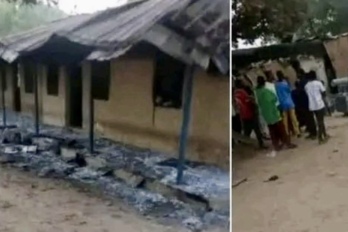
MINNA, Nigeria — Suspected bandits have burnt down the Central Primary School in Dekara in Borgu LGA of Niger State, revealing yet again the deep spread of banditry taxation in the country’s rural areas, especially that locals reportedly paid a sum of N10m to bandits for security but the gunmen reportedly still invaded and burnt down the school, the report said.
The first public alarm came from security analyst Bakatsine, who disclosed the attack in a post on his verified X handle, saying the bandits “have reportedly razed Central Primary School, Dekara community, in Borgu LGA of Niger State” despite the community paying a ₦10 million levy.
He also said the attackers were believed to have emerged from the Kainji Lake National Park, a detail that matters because the park and its surrounding forests have repeatedly featured in accounts of armed groups using the terrain as a shield. Bakatsine’s warning was not simply about one school.
His deeper point was that armed gangs are now operating like parallel authorities, extracting money, issuing threats and still unleashing violence.
According to residents quoted in reporting on the incident, the levy was raised after threats of an imminent attack. One resident said, “The bandits imposed a N10 million levy on our communities. We paid because they threatened to attack us if we failed to comply.”
The same resident said the attackers had assured them that once the money was paid, they would be spared further violence. Instead, the school was set ablaze and the community was thrown into panic.
That sequence is significant because it suggests the gangs are not merely seeking cash. They are testing whether fear alone can make whole communities subordinate to them.
There is also a critical detail in the police version of events. Niger State Police spokesman Wasiu Abiodun confirmed to LEADERSHIP that “suspected bandits invaded Dekara village via Borgu LGA and set the Central Pry School Dekara ablaze”, adding that “one block of classroom was burnt”.
He further said the location was deserted and that there was “no abduction or loss of life” during the incident, while clearance operations were intensified.
That account does not contradict the arson claim, but it does underline a more chilling reality. Communities under repeated threat can become so emptied by fear that attacks destroy not only property, but the last traces of normal life.
The attack fits a growing pattern across Niger State and neighbouring areas where bandit groups impose levies in exchange for temporary restraint, or at least the illusion of it.
Reporting from the same area shows that Borgu Local Government Area has already suffered deadly raids linked to the forested corridor around the Kainji Lake National Park.
In January, at least 30 villagers were killed in Kasuwan-Daji, also in Borgu, while homes and the local market were burnt. The attackers were said to have come from the National Park forest, reinforcing a grim operational pattern in which remote terrain becomes a launch pad for mass violence.
That January massacre is also important because it shows how quickly Borgu has become a recurring theatre of violence. The AP reported that residents said some attackers arrived from the National Park Forest along Kabe district, while The Guardian said President Bola Tinubu ordered a full security response after the killings in Agwara and Borgu.
Tinubu said the perpetrators must be hunted down and those who aid them brought to justice. But the repeated recurrence of these attacks suggests the state is still struggling to convert rhetoric into durable control on the ground.
The burning of a primary school also carries a wider political meaning. Schools are not only physical buildings. In rural Nigeria, they are a statement that the state is present, that children still have a future, and that the community belongs to a civic order larger than the gunmen in the bush.
When attackers burn a school after collecting money, they are they are humiliating the community, erasing confidence and advertising their reach, not just destroying classrooms. Bakatsine captured that wider threat when he said the destruction “raises troubling questions about the growing influence armed groups wield over vulnerable communities”.
What emerges from Dekara is a brutal model of extortion backed by force. Residents are reportedly compelled to pay, bargain or supply goods such as food, fuel, motorcycles and livestock. If they comply, the gangs may still attack.
If they refuse, they may be massacred, abducted or burned out. That is not mere banditry in the casual sense. It is a shadow administration of terror, one that exploits the weakness of forests, the thinness of security deployment and the vulnerability of isolated communities.
Niger State has been one of the worst-hit states in the North-Central, and Borgu’s location near the Kainji Lake National Park appears to be part of why the area keeps drawing gunmen and grief in equal measure.
The most troubling question now is not whether the attackers can burn a school. They already have. The question is why communities are being forced into paying millions to survive while the state still cannot guarantee even basic protection for children’s classrooms.
Until the forest corridors, ransom economies and local extortion networks are broken, rural communities in Niger and beyond will remain trapped between payment and punishment, with education, farming and ordinary life held hostage by those who have turned violence into business.
Follow us on our broadcast channels today!
- WhatsApp: https://whatsapp.com/channel/0029VawZ8TbDDmFT1a1Syg46
- Telegram: https://t.me/atlanticpostchannel
- Facebook: https://www.messenger.com/channel/atlanticpostng