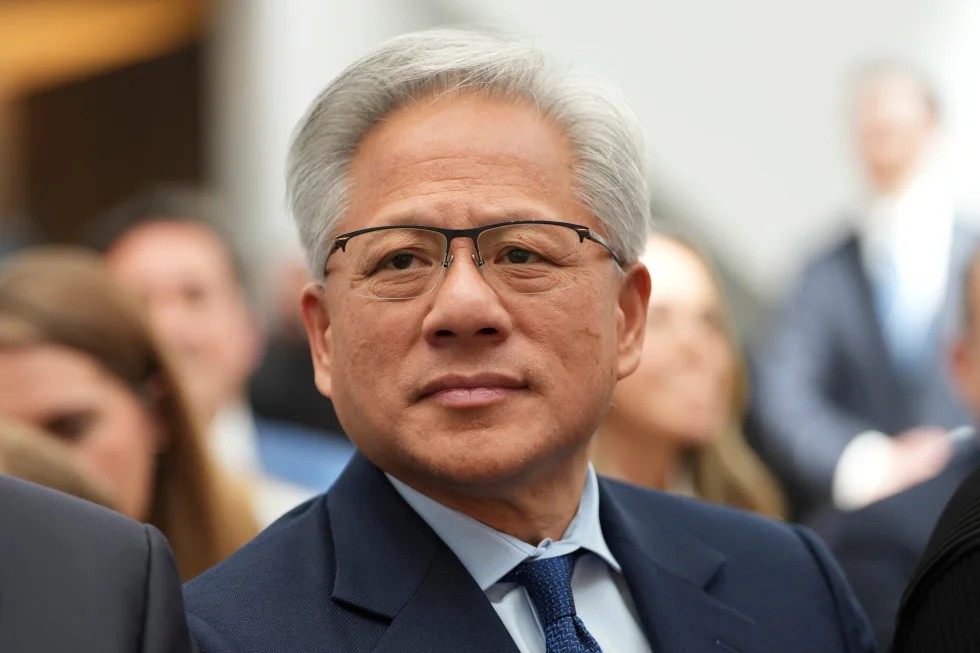
The investigation into Jensen Huang’s reported relationship with a former Megaspeed executive raises questions about corporate security, access to sensitive technology and the vulnerability of America’s AI ambitions. But the central espionage allegation remains unverified publicly.
SAN FRANCISCO — The biggest question facing Nvidia is no longer simply whether its chief executive, Jensen Huang, was unfaithful to his wife. It is whether the company that has become indispensable to the global artificial intelligence industry can protect its most sensitive information when its business relationships intersect with the intelligence interests of rival powers.
Nvidia’s board has launched an independent investigation following reports that Huang was the target of a foreign intelligence operation involving a Chinese business executive with whom he reportedly had a close personal relationship.
The development has placed the leadership of one of the world’s most influential technology companies under unprecedented scrutiny. It also brings together three issues with consequences far beyond Silicon Valley: the US-China technology rivalry, the security of advanced semiconductor supply chains and the concentration of corporate power around a single founder.
But the allegations require careful handling. Nvidia has not confirmed that its secrets were compromised. Reuters reported on Monday that it could not independently verify the intelligence claims or establish Alice Huang’s current employment status. China has rejected the allegations as unfounded.
The investigation is therefore not proof of espionage. It is a test of whether Nvidia’s internal safeguards were strong enough to prevent a potential intelligence vulnerability.
A personal admission, a corporate investigation
Nvidia announced on Sunday, 8 November, that a committee of independent directors, assisted by external legal counsel, would oversee an investigation into reports that its founder and chief executive had been targeted by a foreign intelligence effort.
The board said it had “no reason to believe that either national security or NVIDIA secrets were compromised”, but added that its inquiry would examine all available information.
Huang, 63, will remain chief executive while the investigation proceeds. The board said he supports the review and has committed to cooperating fully.
The announcement followed reports that Huang had developed a close relationship with Alice Huang, a Chinese citizen and former executive of Singapore-based data centre company Megaspeed International. The two are not related.
In a message to employees, Jensen Huang acknowledged being unfaithful to his wife and accepted responsibility for his conduct.
“Leading Nvidia is the privilege of my life,” he wrote. “My responsibility is to serve you and be worthy of your trust. I have fallen short of that responsibility.”
He also apologised to his family and colleagues, saying: “My actions hurt her and our children. There is no excuse for what I did. I am deeply sorry.”
Huang did not name Alice Huang in the message or publicly confirm the details of the relationship described in the intelligence reporting.
He nevertheless addressed the national security concerns directly.
“I love our country and our company,” he said. “I am committed to protecting Nvidia and supporting America’s national security.”
Nvidia spokesperson John Rizzo sought to reassure employees and investors that the controversy would not disrupt the company’s operations.
“Today’s news will not slow Nvidia,” Rizzo said. “Jensen is committed to continuing to lead Nvidia as CEO without interruption.”
The board’s statement and Huang’s apology address two different questions. The first concerns the conduct of a chief executive. The second concerns whether any relationship or business interaction created an opportunity for sensitive information to reach a foreign intelligence service.
Only the investigation can establish whether those questions are connected.
Why Megaspeed matters
The reported connection becomes more consequential because of Megaspeed’s position in the semiconductor supply chain.
The Singapore-based company operates in the data centre and cloud computing market and has been described in reporting as one of Nvidia’s significant customers in Southeast Asia.
According to The New York Times, as subsequently reported by The Associated Press, Megaspeed purchased more than $4.8 billion worth of Nvidia chips over the previous two years.
The reported intelligence concern is that Alice Huang, while associated with Megaspeed, was gathering information for Beijing. US intelligence agencies were said to have concluded that she was passing information directly to China.
Those allegations have not been independently established in the public record. Reuters said on Monday that it could not verify the intelligence claims or determine Alice Huang’s current employment status. Neither she nor Megaspeed had responded to requests for comment at the time of reporting.
There is also a separate history of scrutiny surrounding Megaspeed’s business.
In 2025, US authorities examined allegations that the company had helped Chinese customers obtain Nvidia processors restricted from direct export to China. A report by Reuters said US Senator Tom Cotton had urged the Commerce Department to investigate claims that chips were being routed through Malaysia and Indonesia for Chinese customers.
Nvidia said at the time that it had engaged with US authorities, conducted its own review and found no reason to believe its products had been diverted.
That distinction matters. Suspicion about possible chip diversion, allegations of intelligence gathering and proof that Nvidia’s confidential information was compromised are three different matters. None should be treated as established simply because the others have been reported.
The security question behind the affair
The most important issue is not the personal relationship itself. It is the level of access, if any, that an external business contact may have enjoyed to information about Nvidia’s technology, customers and strategic decisions.
An intelligence operation targeting a senior technology executive would not necessarily need access to a semiconductor production facility or a classified government network to be valuable.
Information about future products, customer deployments, technical capabilities, supply arrangements and the company’s discussions with policymakers could have strategic value. In the wrong hands, such information could help a competitor or foreign government anticipate commercial decisions and understand the direction of a technology industry.
There is no public evidence that such information was obtained or transferred in this case. That is precisely what Nvidia’s board must establish.
The company had previously defended its dealings with Megaspeed. In October, Huang described the relationship and interactions as “completely normal and not unusual”, according to Bloomberg reporting.
Nvidia also argued that its regional cloud customers receive ordinary business information rather than sensitive trade secrets or information relevant to US national security. The company said its chief executive speaks with thousands of customer executives each year.
That explanation may prove accurate. But it also raises an important governance question: how does Nvidia distinguish routine customer engagement from access that could expose the company to commercial or national security risks?
The board will need to examine what information was available to external contacts, what safeguards governed access, whether unusual requests were recorded and whether any company information was transferred outside approved channels.
It must also establish whether Huang knew of any suspected intelligence activity, whether any information was actually compromised and whether existing controls were followed.
A personal relationship does not establish a security breach. Equally, a company cannot rely solely on assurances that business meetings were ordinary when the potential consequences of an information leak extend beyond its shareholders.
Washington’s chip restrictions raise the stakes
The controversy arrives against the background of an increasingly sensitive US-China technology contest.
Nvidia’s graphics processing units are among the most important components used to train and operate advanced AI systems. Its products power data centres, cloud platforms and the infrastructure being built by technology companies around the world.
Washington has restricted exports of advanced AI processors to China since 2022, seeking to prevent Beijing from gaining unrestricted access to computing capabilities that could strengthen its commercial and military technology sectors.
The rules have also evolved. In January 2026, the US Department of Commerce revised its licensing policy to allow certain Nvidia H200 and comparable advanced processors to be considered for export to China on a case-by-case basis, subject to security and other conditions.
Huang has publicly advocated for allowing Nvidia to sell more products into China, arguing that US companies should remain competitive in the global AI market.
This creates an unusually sensitive environment for the company. Nvidia is not simply selling computer components. It is supplying infrastructure that governments increasingly regard as strategically important.
Any credible allegation that a foreign intelligence operation sought information through a commercial relationship involving Nvidia’s leadership is therefore likely to attract attention from regulators and lawmakers, even before evidence of a breach is established.
Congress demands answers as Beijing rejects the allegations
The US Congress has already moved to examine the matter.
On 5 November, the chairmen of the House Foreign Affairs Committee, the House Select Committee on China and the House Permanent Select Committee on Intelligence requested a closed-door briefing from Huang.
The lawmakers asked him to address his interactions with Alice Huang and explain Nvidia’s security protocols against foreign intelligence activity.
They requested the briefing for 18 November and asked Huang to accept the date or propose an alternative by 11 November.
In their letter, the chairmen warned that the reports raised “significant national security concerns regarding the PRC’s access to sensitive U.S. technology and information”.
They added: “It is vital that Congress determines the extent to which U.S. national security has been placed at risk.”
China, meanwhile, has rejected the allegations.
On Monday, Foreign Ministry spokesperson Guo Jiakun dismissed the claim that Beijing had used a business executive to gather information from Huang.
“The so-called Chinese spy allegation is unsubstantiated. It is nothing but smears against China,” he said.
The denial does not resolve the questions raised by US intelligence reporting. But neither does the reporting itself establish that China directed an operation against Huang or obtained confidential Nvidia information.
The public evidence remains incomplete.
President Donald Trump also voiced support for the Nvidia chief, saying he had not spoken to Huang about the latest developments.
“I think he’s an honourable guy. I think he probably has an excuse for it. You have to hear it,” Trump told reporters.
Secretary of State Marco Rubio declined to discuss the matter, saying: “I just can’t comment because of the nature of it. And I also can’t comment on an internal corporate matter that’s going on with Nvidia.”
Investors face another test of confidence
The investigation comes at a difficult time for Nvidia investors.
The company has grown into one of the world’s most valuable businesses, with its valuation reaching about $4.5 trillion by 6 November, according to Reuters.
Its second-quarter fiscal 2027 results, released in August, showed revenue of $96.2 billion and GAAP net income of $59.69 billion. The figures demonstrate the scale of the business whose leadership and security arrangements are now under examination.
Nvidia shares fell more than 6 per cent in Frankfurt trading on Monday, 9 November. At the reported trading levels, the decline represented a potential loss of approximately $270 billion from the company’s Friday closing market value, Reuters reported.
The market reaction reflects more than concern about Huang’s personal conduct. The chief executive has been central to Nvidia’s commercial strategy, technology direction and relationships with governments and customers.
A prolonged investigation could increase uncertainty about leadership, delay strategic decisions or make customers and policymakers more cautious about the company’s dealings in sensitive markets.
The next major test comes on 17 November, when Nvidia is scheduled to discuss its third-quarter fiscal 2027 results. Investors will be looking for reassurance that the investigation will not undermine its operations, customer relationships or regulatory position.
The questions Nvidia cannot avoid
Nvidia’s board now faces a responsibility that goes beyond protecting the reputation of its founder.
It must establish whether Alice Huang had access to sensitive information, what information was exchanged, whether any material reached foreign intelligence and whether existing security controls were effective.
It must also explain how Nvidia manages the risks created by a business model that depends on global customers, multinational data centre operations and close engagement with political leaders.
The company’s extraordinary success has made it an essential supplier to the AI economy. That position also makes its internal security arrangements a matter of wider public interest.
For now, there is no established public finding that Nvidia’s secrets were compromised. Huang remains in charge, the board says it has confidence in him, and China denies the intelligence allegations.
But the investigation has exposed a question that the AI industry cannot afford to ignore: when a company becomes a strategic national asset, can its security still depend on the judgement and personal relationships of one exceptionally powerful executive?
Nvidia’s answer will matter well beyond its boardroom.
Follow us on our broadcast channels today!
- WhatsApp: https://whatsapp.com/channel/0029VawZ8TbDDmFT1a1Syg46
- Telegram: https://t.me/atlanticpostchannel
- Facebook: https://www.messenger.com/channel/atlanticpostng



Join the debate; let’s know your opinion.