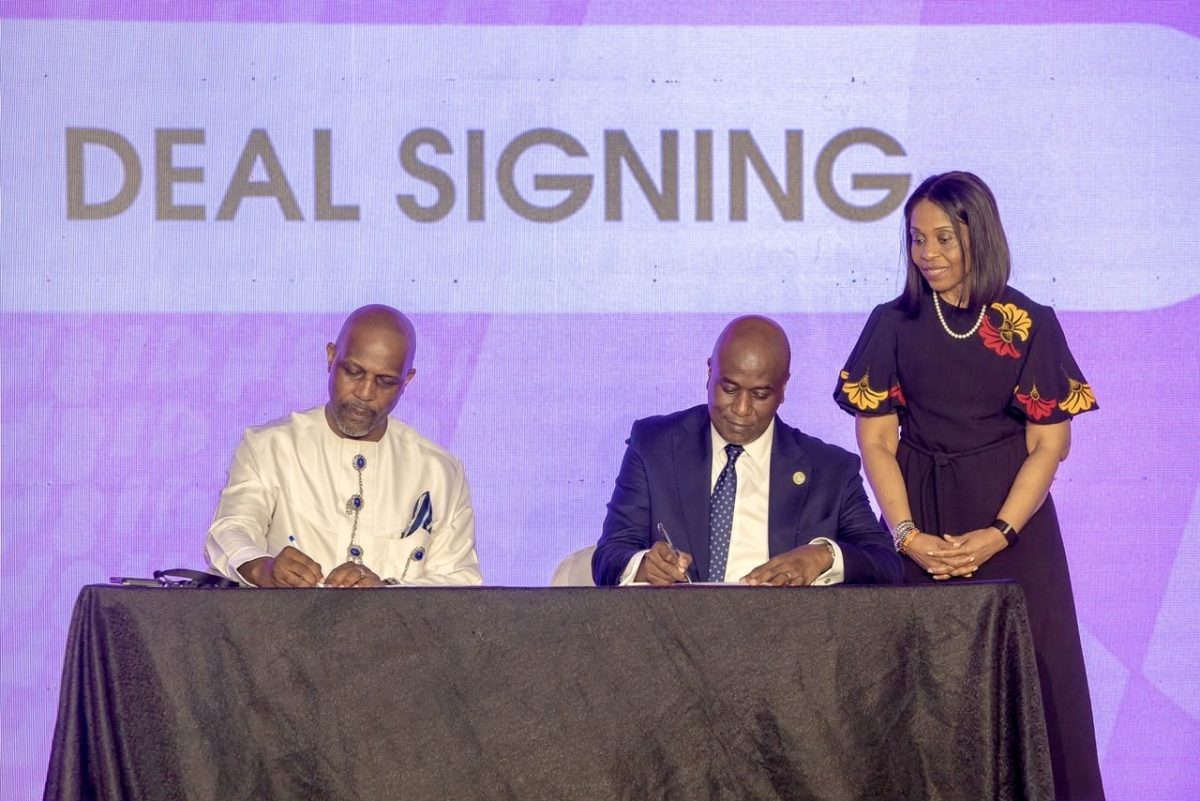
The agreement with CANEX Creations Incorporated marks a major boost for the Nigerian historical film, as African development finance moves deeper into the business of financing, preserving and commercialising the continent’s cultural stories ahead of FESTAC ’77’s 50th anniversary.
A major financial endorsement has strengthened the prospects of 77: The Festac Conspiracy, the Nigerian historical film that revisits one of Africa’s most significant cultural gatherings, following an investment agreement with CANEX Creations Incorporated (CCI), an investment subsidiary within the Afreximbank Group.
The agreement was signed during the ongoing 2026 Creative Africa Nexus Weekend (CANEX WKND) in Lagos, bringing together the film’s executive producer, Prince Tonye T.J.T. Princewill, Chairman of the Board of Adonis Production, and CCI, represented by its Chief Executive Officer, Osahon Akpata.
The signing ceremony took place at the Banquet Hall of the National Theatre, now known as the Wole Soyinka Centre for Culture and Creative Arts. Executive Vice-President of Afreximbank, Mrs Kanayo Awani, who also chairs the CCI board, joined the signatories on stage for the occasion.
The agreement represents an important vote of confidence in a film project that seeks to translate a defining chapter of African cultural history into an internationally competitive cinematic production.
Afreximbank-backed investment puts African capital behind African stories
The significance of the agreement extends beyond the immediate fortunes of the film.
CANEX Creations Incorporated is a wholly owned subsidiary of the Fund for Export Development in Africa (FEDA), Afreximbank’s investment arm. It was established to commercialise African intellectual property and support creators and businesses across sectors including film, television, music, fashion, technology and other intellectual-property-driven industries.
Unlike conventional cultural sponsorship, CCI operates within an investment framework designed to unlock commercial value from African creative assets and connect them with wider markets.
Its involvement in 77: The Festac Conspiracy therefore offers an important example of African financial institutions supporting locally developed intellectual property with international commercial potential.
Speaking at the agreement ceremony, Akpata expressed confidence in the production and pledged the organisation’s full support.
He described the project as:
“A film Africa can be proud of.”
He also urged other filmmakers to emulate Adonis Production by prioritising excellence in their productions.
His endorsement carries significance within the wider ambitions of CANEX, which seeks to move African creative industries beyond international recognition towards sustainable businesses capable of generating investment returns, employment and export earnings.
Afreximbank has expanded its financing commitment to Africa’s creative and cultural industries to US$2 billion for the 2024–2027 period. The commitment covers the wider creative economy and should not be confused with the undisclosed financial value of the agreement involving this particular film.
Princewill: Africa has more than enough stories to tell
Princewill welcomed the investment and expressed appreciation for the confidence shown by CCI in the production.
He pledged that Adonis Production would justify the support and create reasons for the institution to consider further investments in African filmmaking.
Explaining the production company’s philosophy, he said:
“Adonis Production focuses on true stories because Africa has so much truth to tell. Reality is stranger than fiction.
“This building, our Festac village were both inspired by that Festival of Arts and Culture and I feel honoured that 50 years later, we will get to be celebrating it with our film.”
His remarks place the agreement within a broader cultural context.
The National Theatre was built to serve as the principal venue for FESTAC ’77, while Festac Town became one of the enduring legacies of the festival.
FESTAC ’77, formally the Second World Black and African Festival of Arts and Culture, took place in Lagos from January 15 to February 12, 1977.
The historic gathering brought together more than 17,000 participants from 59 Black African countries and communities, celebrating African heritage, artistic expression and cultural connections across the diaspora.
It remains one of the most significant demonstrations of Pan-African cultural cooperation.
Nigeria and the wider African community are preparing to commemorate its 50th anniversary in 2027, giving the film an especially relevant historical and commercial moment.
From ’76 to ’77: Nollywood revisits a defining chapter of history
77: The Festac Conspiracy is a sequel to ’76, the historical Nigerian drama directed by Izu Ojukwu and released in 2016.
The earlier production examined the human consequences of the failed 1976 military coup and the assassination of General Murtala Mohammed, following the experiences of Captain Joseph Dewa and his pregnant wife, Suzie.
The film starred Ramsey Nouah, Rita Dominic and Chidi Mokeme, among other actors, and is currently listed on Netflix.
The sequel shifts the historical focus to the political intrigue and international tensions surrounding FESTAC ’77, offering audiences a cinematic exploration of the events behind the cultural celebration.
Ojukwu returns as director, with Princewill and Adonijah Owiriwa among the production’s executive leadership. Ramsey Nouah and Rita Dominic are also among the returning cast, while Seun Kuti features as his father, the legendary Afrobeat pioneer Fela Anikulapo Kuti.
The decision to connect the two productions creates an opportunity to tell a larger Nigerian historical story through popular entertainment.
Where ’76 explored the political instability and personal sacrifices surrounding a military coup, 77 takes audiences towards another defining moment in Nigeria’s post-independence history, examining the ambitions, personalities and intrigues associated with a landmark Pan-African cultural gathering.
It also gives younger audiences an opportunity to encounter a major chapter of African history through a contemporary cinematic production.
A bigger opportunity for Africa’s creative economy
The agreement comes as Afreximbank intensifies efforts to address one of the creative industry’s longstanding problems: the disconnect between African creative talent and the financial returns generated by its products.
Opening CANEX WKND 2026, Afreximbank President and Chairman, Dr George Elombi, highlighted the imbalance between Africa’s global cultural influence and its share of the industry’s economic value.
“Our talent is global, but our share of the value is not,” he said.
He also criticised the extent to which external players control distribution networks, marketing platforms, intellectual property rights and content catalogues, often limiting the financial benefits retained by African creators.
That challenge makes CCI’s participation in 77: The Festac Conspiracy particularly relevant.
African filmmakers have increasingly demonstrated their ability to produce stories with international appeal. Securing the capital, distribution arrangements and commercial partnerships necessary to maximise the value of those productions remains a major industry priority.
Investment from African institutions could help strengthen local ownership, improve production capacity and create more opportunities for African companies to benefit from the commercial success of their intellectual property.
For Nigeria, whose film industry remains one of the continent’s most visible creative sectors, such partnerships could also help attract additional institutional investors into historical filmmaking and other ambitious productions.
The 2026 CANEX WKND, running from November 5 to 8 at the Wole Soyinka Centre for Culture and Creative Arts in Lagos, provides a platform for these conversations and commercial partnerships across film, music, fashion, literature and other creative industries.
The countdown to 2027
With its cinema release scheduled for early 2027, 77: The Festac Conspiracy is approaching a potentially significant moment for both Nigerian cinema and African cultural storytelling.
Its arrival ahead of the 50th anniversary of FESTAC ’77 offers an opportunity to reconnect audiences with a historic gathering whose influence extended beyond Nigeria to the wider African continent and its diaspora.
The Afreximbank-backed agreement also sends an encouraging message to filmmakers and creative entrepreneurs seeking investment for stories rooted in African history and identity.
For Adonis Production, the immediate challenge will be to translate the financial partnership and institutional confidence into a compelling film that attracts audiences at home and internationally.
For the wider industry, the bigger opportunity is to demonstrate that African stories can generate not only cultural recognition but also lasting commercial value.
As Princewill’s remarks suggest, Africa does not lack stories worth telling. The growing question is whether the continent can build the financing, production and distribution structures necessary to ensure that it also benefits from telling them.
Follow us on our broadcast channels today!
- WhatsApp: https://whatsapp.com/channel/0029VawZ8TbDDmFT1a1Syg46
- Telegram: https://t.me/atlanticpostchannel
- Facebook: https://www.messenger.com/channel/atlanticpostng



Join the debate; let’s know your opinion.