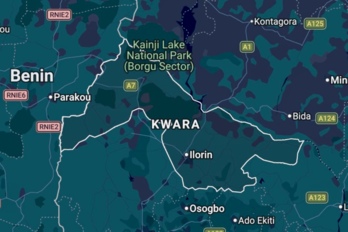
The attack on Yashikira in Baruten Local Government Area of Kwara State has once again laid bare the fragility of security in the state’s northern corridor, after suspected bandits struck in the early hours of Monday, 25 May 2026, set part of the Emir’s palace ablaze and abducted 10 people, including women and children.
The Kwara State Police Command later confirmed that the palace and the Yashikira Police Divisional Headquarters were attacked simultaneously, describing the raid as a “coordinated and desperate operation”.
What makes the incident particularly alarming is not only the brutality of the raid, but its apparent level of planning. According to the police, the attackers moved against both the palace and the police station at about 2:00 a.m., while residents said gunfire rang out from around midnight as frightened families ran into surrounding bushes for safety.
That simultaneous targeting of state authority and traditional authority suggests a raid designed to humiliate the community, overwhelm local resistance and create maximum panic.
The police said officers on duty repelled the assault on the station, but they also confirmed that 10 persons were abducted before the attackers fled to an unknown destination.
In a strongly worded statement, the command condemned what it called a “cowardly and audacious attack”, and said Commissioner of Police Ojo Adekimi had ordered a “full-scale intelligence-driven tactical” operation involving the military, police, forest guards and vigilantes.
The command also said security personnel had begun combing nearby forests and suspected hideouts.
Early resident accounts pointed to even deeper trauma inside the royal household. One report quoted a resident as saying that three wives and four children of the Emir were among those taken away, while another witness said the attackers arrived on motorcycles and headed straight for the palace complex.
Those accounts have not yet been independently broken down in the police statement, but they underline the fear that the monarch’s family was deliberately singled out in the raid.
The Yashikira attack is not an isolated flare-up. Kwara North, especially the Baruten and Kaiama axis, has been under repeated pressure from banditry, kidnapping and reprisal-style violence over the past year.
In April 2025, Daily Trust reported intensifying attacks by a group identified by locals as Mahmuda across communities in Baruten, Kaiama and neighbouring areas of Niger State, with victims, vigilantes and rural traders repeatedly caught in the crossfire.
More recently, political and community voices have warned that insecurity in Kwara North has persisted for years and forced residents to flee to nearby settlements.
That wider pattern matters because Yashikira sits inside a corridor that appears increasingly vulnerable to cross-border criminal movement and forest-based safe havens.
Daily Trust reported that the violence has stretched across villages in Kaiama, Baruten and Borgu, while a February 2026 PUNCH report noted that the state had already been dealing with severe insecurity linked to suspected bandit and terrorist activity in the area.
A separate April 2026 PUNCH report also showed that the police had recently arrested a suspect in Kaiama in connection with criminal networks linked to ISWAP and Lakurawa.
Considered collectively, those reports suggest a theatre of insecurity that has become more mobile, more organised and harder to police with conventional patrols alone.
For residents, the deeper grievance is not only that attacks keep happening, but that warnings appear to be ignored until after bloodshed and destruction.
PUNCH quoted community voices and local leaders describing years of persistent attacks, mass abductions and forced displacement across Kwara North.
That frustration is now likely to sharpen again, because a palace attack carries symbolic weight far beyond the immediate material damage.
It signals that even the traditional seat of authority, which should normally be among the best protected structures in a town, can be breached at will.
The security response announced so far is significant, but it will be judged by results, not language. The police say a joint operation is under way, involving multiple agencies and local vigilante structures.
That is the right first step, but the Yashikira raid has exposed a recurring weakness in border communities: thin security coverage, difficult terrain, and criminal groups that appear to know the roads, forests and escape routes far better than the people tasked with stopping them. Unless that operational gap is closed, similar raids are likely to continue.
Kwara State now faces a familiar but worsening test. It must protect vulnerable border settlements, restore confidence in rural policing, and stop armed groups from turning communities such as Yashikira into repeated theatres of terror.
The latest attack is more than another crime report. It is a warning that the border belt is no longer merely troubled. It is in crisis.
Follow us on our broadcast channels today!
- WhatsApp: https://whatsapp.com/channel/0029VawZ8TbDDmFT1a1Syg46
- Telegram: https://t.me/atlanticpostchannel
- Facebook: https://www.messenger.com/channel/atlanticpostng