Court Dismisses Bid to Bar Jonathan, Reigniting 2027 Power Game
ABUJA, Nigeria — The political temperature around Nigeria’s 2027 presidential race rose sharply on Tuesday after a Federal High Court in Abuja dismissed a suit seeking to bar former President Goodluck Jonathan from contesting, in a ruling that has reopened one of the most sensitive constitutional questions in the country’s post-2015 political history.
The challenge was brought by Abuja-based lawyer Johnmary Jideobi, who wanted the court to permanently stop Jonathan from presenting himself to any party as a presidential aspirant and to restrain INEC from accepting or publishing his name.
The case turned on sections 1(1), (2), (3) and 137(3) of the 1999 Constitution, with the plaintiff arguing that Jonathan had already exhausted his constitutional entitlement by first taking office in 2010 after the death of President Umaru Musa Yar’Adua and then winning election in 2011.
Jonathan’s lawyers countered that the matter had already been settled by earlier judgments, while the Attorney-General of the Federation also aligned with the ex-president and urged the court to throw the suit out.
That argument is not new. Nigerian courts have twice before held Jonathan eligible to run, first in 2013 and again in 2022.
Atlantic Post’s review of the legal history shows that the 2013 ruling held that Jonathan’s 2010 accession through constitutional succession was not an “election”, and that the Court of Appeal affirmed that view in 2015.
It also shows that the 2018 constitutional amendment inserting section 137(3) could not be applied retrospectively to strip away a right that had already accrued.
That legal backdrop is why Jonathan’s camp treated the Abuja suit as an attempt to relitigate a settled issue. His lawyer, Chris Uche (SAN), told the court that the claimant had “no locus standi” and “no cause of action”, insisting that the same question had already travelled through the courts up to the Court of Appeal.
He also urged the judge to dismiss the matter and award heavy costs against the plaintiff, while the Ministry of Justice separately backed dismissal.
The judge’s earlier conduct in the matter had already shown impatience with what he viewed as delay tactics. On 15 May, Justice Peter Lifu rebuked the plaintiff and his lawyer for lack of diligence and awarded a N1 million cost against Jideobi, describing their conduct as “unacceptable”.
In that ruling, the court also stressed that political disputes deserve accelerated hearing because they are tied to INEC’s timetable and the electoral calendar.
Jonathan himself has not formally declared for 2027, but he has clearly kept the door open. When youths urged him to run at his Abuja residence on 7 May, he replied: “Presidential race is not a computer game, but I’ve heard you, and I’ll consult widely.”
He also used the moment to warn that political participation matters and said many young Nigerians still do not even have voter cards. That remark has since become one of the defining lines in the Jonathan comeback debate.
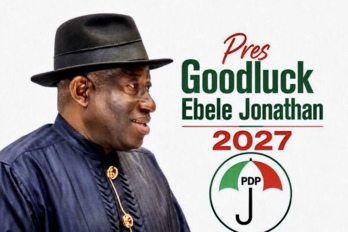
The biggest political signal came from the Peoples Democratic Party. On 20 May, reports from Abuja showed the Kabiru Turaki-led Interim National Working Committee granting Jonathan an automatic ticket and waiving the normal screening process.
Babangida Aliyu, who spoke for the screening committee, said the party had effectively cleared Jonathan, declaring that the waiver meant he had been “declared and cleared as the candidate” for the PDP presidential election.
That move is important because it suggests that Jonathan’s 2027 conversation is no longer merely academic or legal. It is now also organisational and strategic.
A former president who left office in 2015, whose eligibility has been litigated for years, and who is now being courted by a major opposition party, sits at the centre of a potentially explosive contest over incumbency, opposition unity and southern political calculations.
The court’s ruling, therefore, does more than settle one lawsuit. It gives fresh momentum to a race that is already being shaped by speculation, elite bargaining and the unfinished business of Nigeria’s constitutional politics.
The broader lesson is that Jonathan remains one of the few Nigerian politicians whose name can still force both legal and political re-examination of the rulebook.
Whether he ultimately runs or not, the latest ruling has handed his supporters a major talking point and his opponents a fresh battle line. For now, the 2027 race has gained a new centre of gravity, and it is Jonathan’s name that once again sits at the heart of it.
Follow us on our broadcast channels today!
- WhatsApp: https://whatsapp.com/channel/0029VawZ8TbDDmFT1a1Syg46
- Telegram: https://t.me/atlanticpostchannel
- Facebook: https://www.messenger.com/channel/atlanticpostng