ABUJA, Nigeria — The alleged coup plot case hanging over President Bola Tinubu’s administration has now entered one of its most combustible phases, with the military’s secret court martial of 36 serving personnel proceeding in parallel with a separate Federal High Court prosecution of six other suspects.
Public reporting shows that the Defence Headquarters inaugurated the military panel on 24 April 2026, while the civilian case, filed by the Federal Government, has moved on an accelerated timetable in Abuja.
What has sharpened the controversy is not only the gravity of the allegations, but the way the military process has been conducted.
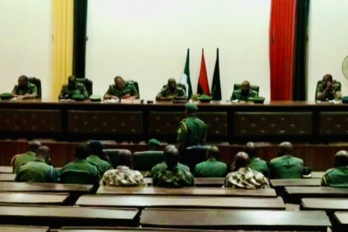
Channels Television reported that accredited journalists were denied access and barred from using mobile phones as the court martial was inaugurated behind closed doors at Scorpion Mess, Asokoro, Abuja.
The report also confirmed that the panel was constituted to try 36 serving personnel over an alleged plot to overthrow the administration.
The Defence Headquarters has insisted the tribunal is being run within the service’s legal framework.
In the Punch report on the inauguration, military spokesman Brig.-Gen. Tukur Gusau said the proceedings would be handled with “highest standards of fairness, impartiality and strict adherence to due process”.
The military also framed the exercise as a disciplinary step aimed at reinforcing accountability and safeguarding national integrity.
Yet the legal firestorm surrounding the case is being driven by a far larger question. Under the 1999 Constitution, the Federal High Court “shall have and exercise jurisdiction and powers in respect of treason, treasonable felony and allied offences”.
That constitutional wording sits at the centre of the argument that grave allegations bordering on coup plotting belong before a civilian judge, not a military panel sitting in secrecy.
Human rights lawyer Femi Falana, SAN, has emerged as the most forceful public critic of the split-track approach.
In comments published by Channels Television, he said the plan to try six suspects in the Federal High Court and 36 others before a General Court Martial for the same alleged offence “cannot be justified under any law in Nigeria”.
He also argued that a General Court Martial lacks the competence to try treason, treasonable felony and terrorism-related offences under the current constitutional order.
Falana’s position goes beyond procedure. He has argued that the government cannot constitutionally split suspects in the same alleged plot into two different legal lanes and still claim equality before the law.
He further urged the Attorney-General of the Federation to halt the military trial and consolidate the prosecutions under the proper civilian framework, warning that the use of different tribunals for the same alleged conduct undermines due process and public confidence.
That constitutional challenge matters because the civilian case already contains the language of a full-blown national security prosecution.
According to AP, the six defendants arraigned in Abuja face 13 charges, and the charge sheet says they “conspired with one another to levy war against the state to overawe the president of the Federal Republic.”
AP and Reuters also reported that the defendants pleaded not guilty, that a seventh suspect remains at large, and that the trial is moving on an accelerated basis before the Federal High Court.
Against that background, the allegations now circulating from the secret military proceedings have deepened suspicion rather than quietened it.
SaharaReporters’ account says defence lawyers accused the prosecution of presenting and withdrawing different versions of the charges, describing them as vague and repeatedly recycled.
The same account says the defence challenged the secrecy of the hearing and insisted that allegations of treason and coup plotting are constitutional matters, not mere service infractions.
While that specific courtroom account remains reported rather than independently public, the broader secrecy around the military hearing is confirmed by other outlets.
The tension is heightened by Nigeria’s history and by the legal symbolism of this case. AP noted that the country returned to democracy in 1999 after decades of military rule, and Reuters described the prosecution as the most significant treason case under Tinubu so far.
In a country still haunted by coups old and new, how the state handles a suspected plot does not merely test the accused officers. It tests the credibility of the institutions prosecuting them.
If the allegations are serious, the process must look serious too, with openness, consistency and clear jurisdictional authority.
The immediate question is therefore not only whether any conspiracy existed, but whether the state can prove its case without corroding its own standards.
The military says discipline and national integrity are at stake. The defence says constitutional boundaries are being crossed. With a closed military courtroom on one side and an accelerated civilian trial on the other, this is now as much a battle over legitimacy as it is over allegations of disloyalty.
Follow us on our broadcast channels today!
- WhatsApp: https://whatsapp.com/channel/0029VawZ8TbDDmFT1a1Syg46
- Telegram: https://t.me/atlanticpostchannel
- Facebook: https://www.messenger.com/channel/atlanticpostng